Building Brains and Bonds: The Synergy of Early Learning Toys and Storytelling for Babies
—
Introduction: The First Classroom Is the Playmat
From the moment a baby enters the world, every sight, sound, and touch becomes a lesson. The first three years of life are a period of extraordinary neural growth, with the brain forming more than one million new neural connections every second. During this critical window, two powerful tools stand out for their ability to stimulate cognitive, emotional, and linguistic development: early learning toys and storytelling. While often viewed separately, these two elements are far more effective when woven together. This article explores how carefully chosen toys can become props for storytelling, and how storytelling can transform a simple toy into a gateway for language acquisition, empathy, and problem-solving.
—
1. The Science Behind Early Learning Toys
1.1 Why Toys Matter for Infant Development
Early learning toys are not mere distractions; they are instruments of discovery. According to developmental psychologist Jean Piaget, babies learn through sensorimotor exploration—touching, tasting, shaking, and dropping objects. A rattle teaches cause and effect; a textured ball introduces the concept of “hard” versus “soft”; stacking cups build spatial awareness and hand-eye coordination. The key is open-endedness—toys that can be used in multiple ways encourage creativity more than those with a single function.
However, the value of a toy is not intrinsic. It depends on how it is presented. A set of wooden blocks left in a corner may be ignored, but the same blocks become a castle, a mountain, or a character in a story when an adult narrates their significance. This is where storytelling enters the equation.
1.2 Choosing the Right Toys for Storytelling Integration
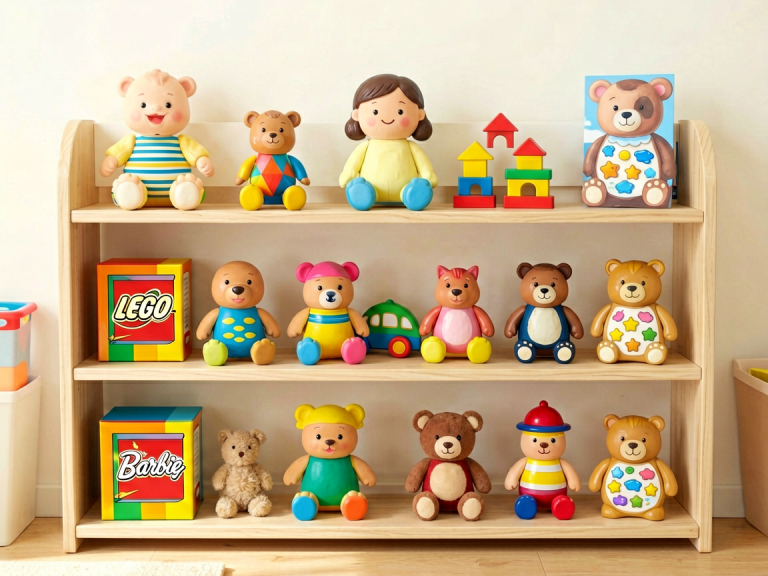
Not all toys lend themselves to narrative play. For babies (ages 0–12 months), the best early learning toys for storytelling are those that engage multiple senses and invite interaction:
- Soft fabric books and puppets – These allow the caregiver to animate characters and voice different tones, capturing the baby’s attention through visual contrast and movement.
- Rattles and musical instruments – Sounds can become part of a story (e.g., “The rain goes *shh shh* — that’s the shaker!”).
- Stacking cups and nesting blocks – These can represent animals, houses, or even the concept of “big” and “small” in a simple tale.
- Mirrors – A baby’s own reflection becomes the starring character in a story about faces and emotions.
The rule is simple: choose toys that invite manipulation and can be easily incorporated into a verbal narrative.
—
2. Storytelling as the Catalyst for Cognitive Growth
2.1 More Than Words: What Storytelling Teaches Babies
Many parents assume that storytelling is only beneficial once a child can understand language. In truth, storytelling begins long before the first word. When a caregiver holds a baby and speaks in a rhythmic, melodic voice, the baby learns the cadence of language—the rise and fall of tones that signal emotion and meaning. Even without comprehension, infants are mapping the phonemes of their native tongue.
As the baby grows, storytelling provides a framework for sequencing (first this happened, then that), cause and effect (the wolf huffed and puffed, so the house fell down), and social-emotional vocabulary (happy, sad, scared). Studies from Harvard University’s Center on the Developing Child show that back-and-forth “serve and return” interactions—like those during shared story time—build strong brain architecture.
2.2 The Role of Repetition and Familiarity
Babies thrive on repetition. Hearing the same story multiple times reinforces neural pathways. When a favorite toy is used as the protagonist of a repeated story—for example, a little stuffed bear who goes on a daily adventure—the baby begins to anticipate what comes next. This anticipation is the foundation of prediction skills, a cornerstone of later reading comprehension.
Moreover, storytelling allows parents to introduce new vocabulary in a low-stress, context-rich environment. A toy dump truck can “rumble” and “roar” while the story describes it “carrying heavy rocks.” The baby hears the word and sees the action simultaneously—a powerful dual-coding learning experience.
—
3. Practical Strategies: Combining Toys and Storytelling
3.1 Storytelling with Everyday Objects
You do not need expensive educational gadgets. A simple cardboard box can become a “house,” a “car,” or a “cave” in a story. To make this effective, follow these steps:
- Name the toy – Give it a personality. (“This is Bella the Bunny. She has soft ears.”)
- Add action – Move the toy as you speak. (“Bella hops! Hop, hop, hop!”)
- Introduce a problem – Keep it simple. (“Oh no, Bella lost her carrot. Can you help find it?”)
- Engage the baby – Pause and look at the baby expectantly. Even a 6-month-old may reach for the toy or coo in response.
This technique, sometimes called “object-based storytelling,” works because it pairs tactile engagement with auditory narrative, stimulating both the motor and language centers of the brain.
3.2 Age-Appropriate Storytelling Techniques
- 0–6 months: Focus on rhythm and facial expressions. Hold a high-contrast black-and-white toy and narrate a short, sing-song story. The toy’s movement keeps the baby’s visual attention; your voice provides comfort.
- 6–12 months: Use toys that make sounds (rattles, crinkle paper). Create a story that includes the sound (“The duck says *quack* and the rain goes *pitter-patter*”). Let the baby hold the noisy toy and shake it as part of the story.
- 12–18 months: Introduce simple plots with two characters. A stuffed dog and a block can be friends who take turns. Encourage the baby to hand you the toy to “participate” in the story.
- 18–24 months: Let the baby choose which toy becomes the hero. This fosters decision-making. Your story can now have two steps: “First the cat climbs the chair, then she sits on the pillow.”
3.3 Creating a “Storytelling Toy Box”
Dedicate a small basket or box to toys that are designated for storytelling time. Include:
- A hand puppet (animal or person)
- A set of small plastic animals
- A wooden train or car
- A doll with simple clothing
- A mirror
Rotate the toys every two weeks to maintain novelty. The goal is not to overwhelm the baby but to create a ritual: when the storytelling box comes out, it is time for imagination.
—
4. Long-Term Benefits: From Babble to Literacy
4.1 Language Development Milestones
Research from the American Academy of Pediatrics indicates that children who are regularly exposed to interactive storytelling—especially when paired with tangible objects—score higher on vocabulary tests at age 2. The toys provide a concrete reference for abstract words. For instance, the word “under” becomes clear when a toy car is placed *under* a blanket during a story.
4.2 Emotional and Social Gains
Toys used in stories also teach empathy. When a baby sees a toy “crying” and the caregiver says, “Oh, the bear is sad. Let’s give him a hug,” the baby learns to recognize and respond to emotions. This kind of play is a precursor to theory of mind—the understanding that others have feelings and thoughts different from one’s own.
4.3 Fostering a Lifelong Love of Learning
Perhaps the most important outcome is that combining early learning toys with storytelling makes learning feel like play. The baby associates books, objects, and voices with warmth and attention. This positive emotional bond lays the groundwork for a child who will later approach reading, math, and science with curiosity rather than dread.
—
Conclusion: Every Story Starts with a Toy
The magic of early childhood lies not in expensive gadgets but in the quality of interactions between caregiver and child. A single wooden block can become a kingdom; a soft stuffed elephant can teach the word “gentle.” When early learning toys are deliberately paired with storytelling, they become more than playthings—they become tools for building language, logic, and love. So the next time you pick up a rattle or a board book, remember: you are not just entertaining a baby. You are laying the neural foundations for a lifelong storyteller.
*Word count: approximately 1,050 words*