Building Early Minds: Play Activities for 6-Month-Olds That Foster Logical Thinking
Introduction
At six months old, a baby’s world is rapidly expanding. They are no longer passive observers; they grab, mouth, shake, and drop objects with newfound determination. While many parents focus on physical milestones like sitting or crawling, this age is also a golden window for cognitive development—specifically, the beginnings of logic. Logic in infancy is not about formal reasoning or numbers; it is about recognizing patterns, understanding cause and effect, noticing similarities and differences, and grasping object permanence. These foundational skills are the building blocks of all future problem-solving. The best part? You can nurture them through simple, joyful play activities that fit naturally into daily routines. Below are carefully chosen play ideas, each designed to target a specific logical skill, along with explanations of how they work.
Cause and Effect: The First “If-Then” Lesson
Activity: The “Drop and Retrieve” Game
When a six-month-old deliberately drops a toy from their high chair, they are not being naughty—they are conducting a scientific experiment. This classic behavior is their first encounter with cause and effect: “If I let go, then it falls.” You can turn this into a structured logical activity. Sit with your baby in a safe, clean area (such as a play mat) and offer them a lightweight rattle or a soft block. Let them hold it, then gently encourage them to drop it. Each time, pick it up, show it to them with a surprised expression, and say, “Oh! It fell! Let’s get it back!” Then hand it to them again.
Repeat this sequence several times. Over days, your baby will begin to anticipate the result. They may even pause before dropping, as if processing the cause and effect. To deepen the logical connection, vary the surface: drop a toy onto a carpet (soft sound, no bounce) versus a wooden floor (loud sound, slight bounce). Watch their eyes—they will notice the difference. This activity teaches that actions produce predictable outcomes, a cornerstone of logical deduction.
Activity: The “Switch and Sound” Toy
Introduce a simple cause-and-effect toy, such as a plastic container with a hinged lid that makes a clicking sound when opened. Show your baby how pressing a button or lifting a flap produces a sound or reveals a hidden object. At six months, they may not have the fine motor skills to activate it themselves, but you can place your hand over theirs and gently guide the action. Repeat the same motion several times, saying, “Push the button—there’s the noise!” Eventually, your baby may start reaching for the button or looking at it expectantly. This reinforces the mental link between a specific action and a specific consequence.
Object Permanence: Understanding That Things Exist Even When Hidden
Activity: The “Peek-a-Boo” Variation with a Cloth
Peek-a-boo is universally loved for a reason: it directly teaches object permanence, which is a logical concept. At six months, babies are just beginning to grasp that an object (or person) continues to exist even when out of sight. To build this skill, use a small, colorful toy (like a rattle or a soft ring) and a lightweight scarf or cloth. Let your baby see the toy clearly. Then, while they are watching, slowly cover the toy with the cloth. Pause for a moment, then dramatically pull the cloth away, exclaiming, “There it is!” Repeat several times, then slowly increase the pause time to 2–3 seconds before revealing the toy.
As your baby becomes familiar with the game, they may start to pull the cloth away themselves. This shows they have mentally predicted the toy’s reappearance. For a next step, partially hide the toy under the cloth so that one corner is visible. Watch if your baby reaches for that corner—this is an early logical strategy: “I see part of it, so the whole thing must be behind there.” You can also hide the toy under one of two identical cloths and let your baby search. This builds working memory and the logical concept of location constancy.
Activity: The “Rolling Ball” Obstacle
Place your baby on their tummy (if they can tolerate it) or seated with support. Take a soft, brightly colored ball and roll it behind a small cushion or a book that is propped up. Say, “Where did the ball go?” Pause, then slowly move the obstacle aside to reveal the ball. Repeat. Over time, your baby will track the ball’s trajectory with their eyes and anticipate its hidden location. This activity also strengthens visual tracking, which is necessary for logical sequencing.
Pattern Recognition and Simple Sorting
Activity: “Same and Different” Basket Play
Despite their young age, six-month-olds can begin to notice patterns if they are simple and concrete. Prepare a shallow basket or tray with three or four identical objects (e.g., all the same type of rubber teether ring) and one distinct object (e.g., a wooden block). Place them in front of your baby. Let them explore each item by grabbing and mouthing them (always supervise for safety). After a minute, pick up one of the rings and show it to them, then pick up the block and show it. Say, “Ring… ring… ring… and a block! Different!” Use contrasting colors if possible—for example, three blue rings and one red block.
Do not expect your baby to sort; they are too young for that. Instead, you are building the neural pathways for comparison. Over repeated sessions, babies often show a preference for the unique object, staring at it longer. This is called the “novelty preference” and is evidence that they have detected a mismatch in the pattern. You can also introduce patterns of action: for instance, tap a spoon on the table three times, pause, then tap again. Babies will start to anticipate the next tap. These early pattern recognition experiences form the basis of mathematical logic.
Activity: “Texture Exploration” with a Pattern Board
Create a simple texture board by gluing small squares of different materials (satin, corduroy, felt, and a soft plastic) onto a sturdy piece of cardboard. Arrange them in a repeating pattern, such as satin, corduroy, satin, corduroy. Let your baby run their fingers over the board. Name each texture as they touch it: “Soft satin… bumpy corduroy… soft satin…” After a few tries, guide their hand to the next square in the pattern and pause, letting them feel the change. The repetition of the tactile experience helps them notice sequences, a primitive form of logical ordering.
Spatial Reasoning and Problem-Solving
Activity: The “Nesting Cup” Exploration
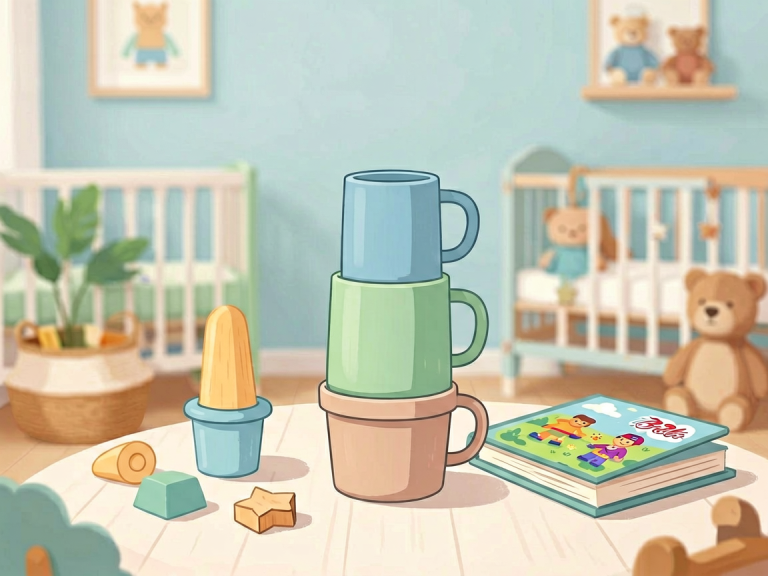
Around six months, babies begin to show interest in how objects fit together. Offer a set of two or three large, lightweight nesting cups (plastic or silicone). Show your baby how one cup fits inside another. Then simply let them explore. They will likely try to bang the cups together, mouth them, and perhaps attempt to stack. Do not correct them; the goal is free discovery. However, you can model the logic: take two cups and deliberately try to put the larger one inside the smaller one (which won’t work). Say, “Oh, it doesn’t fit! Let’s try this way,” and successfully fit the smaller into the larger. This demonstrates trial and error and reversibility—key logical operations.
Activity: The “Tissue Box” Pull Game
Take an empty tissue box (or a small wipes container) and stuff it with colorful scarves or pieces of fabric, leaving one end visible. Show your baby how to pull the scarf out. They will love the surprise of the fabric emerging. Once they have pulled out all the scarves, show them how to stuff one back in. This simple activity actually involves an understanding of containment and reversal: an object can go in and come out, and the order may change. It is a precursor to more complex spatial logic.
Conclusion
At six months, a baby’s brain is forming connections at a breathtaking rate. While they cannot solve equations or build with blocks, they are actively constructing the mental frameworks that will later allow them to do so. The activities described above are not about “teaching” logic in the traditional sense; they are about providing rich, repetitive, and responsive experiences that let babies discover relationships between actions and outcomes, objects and locations, and patterns and exceptions. By engaging in these playful interactions, you are helping your baby lay the foundational logic that will support all future learning—from solving puzzles to understanding mathematics and science. So go ahead, drop that rattle one more time, hide the toy under the cloth, and watch your little one’s mind grow.