Building the Foundation of Sharing: Play Activities for Babies
Introduction
Sharing is one of the most complex and rewarding social skills that a child will ever develop. It requires empathy, impulse control, an understanding of fairness, and the ability to delay gratification—all of which are cognitive and emotional milestones that typically emerge well beyond the first year of life. For parents of babies (infants and toddlers up to about 18 months), the concept of “sharing” might seem almost irrelevant. After all, a six-month-old has no concept of ownership, and a one-year-old is famously possessive of even the most ordinary object. Yet the seeds of generosity and cooperation are planted much earlier than most people realize. Through carefully designed play activities, caregivers can lay the groundwork for sharing without forcing a developmental stage that the baby has not yet reached. This article explores why early exposure to sharing-oriented play matters, outlines the developmental timeline for sharing in infancy, and provides six specific play activities that nurture the building blocks of sharing—turn-taking, joint attention, and emotional awareness—while remaining respectful of a baby’s natural developmental limits. By engaging in these activities from around six months onward, parents can help their baby move from solitary play toward the beginnings of social reciprocity, setting the stage for genuine sharing in the toddler and preschool years.
—
The Developmental Timeline of Sharing in Infancy
Before diving into play activities, it is essential to understand what sharing looks like—and does not look like—in the first 18 months of life. Newborns have no social awareness of others as separate beings. Around six to nine months, babies begin to show “joint attention”—the ability to follow a caregiver’s gaze or point to an object. This is the earliest prerequisite for sharing because it involves recognizing that another person is interested in the same thing. By nine to twelve months, babies often offer objects to adults, but this is rarely altruistic; it is more often a way to initiate interaction or to get the adult to activate a toy. True sharing—voluntarily giving up an object for another’s benefit—usually emerges between 18 and 24 months, and even then it is inconsistent. Therefore, for babies under 18 months, the goal of play activities is not to force them to give up their favorite blanket or block, but to build the social-emotional infrastructure that will later make sharing natural. Key building blocks include: the ability to attend to another person’s actions, the ability to take turns in a simple game, the capacity for imitation, and the gradual understanding that toys can be used by more than one person. The following activities are designed to strengthen these precursors.
—
Key Principles for Baby Sharing Activities
When designing or choosing play activities to foster sharing in babies, caregivers should keep several principles in mind. First, follow the baby’s lead. Never force a baby to hand over a toy; that creates anxiety and resistance. Instead, introduce activities where sharing is built into the game, not demanded. Second, keep sessions short and joyful. A baby’s attention span is measured in minutes, so three to five minutes of a sharing-focused game is enough. Third, model the behavior you wish to see. Babies learn through imitation long before they understand verbal instructions. When you offer a toy to your baby and say “my turn, your turn,” you are demonstrating the rhythm of sharing. Fourth, celebrate moments of spontaneous generosity. If your baby hands you a toy, light up with joy and say “Thank you! You shared!” even if it was accidental. This positive reinforcement encourages repetition. Finally, keep expectations realistic. A baby who happily claps during a turn-taking game is making progress; one who screams when you take a toy is behaving completely normally for their age. The goal is to create positive associations with the idea of “we both play,” not to achieve perfect generosity.
—
Six Play Activities to Foster Sharing in Babies
1. “My Turn, Your Turn” with a Single Toy
This classic activity begins around the age of six months, when babies can hold objects and pass them. Sit facing your baby with a single, simple toy that makes a sound or has a pleasing texture—a rattle, a soft ball with a bell inside, or a crinkly fabric square. Hold the toy and say “My turn!” while shaking it or making it crinkle. Then, gently offer the toy to your baby and say “Your turn!” Let them explore it for a few seconds. After a short pause, extend your hand and say “My turn again?” If the baby willingly gives you the toy, take it with enthusiasm. If they resist, do not grab; instead, simply present a second identical toy (or wait and try again later). Over time, as you repeat this game daily for two to three minutes, the baby will learn the predictable pattern of back-and-forth. This is not sharing in the altruistic sense, but it is a powerful lesson in turn-taking—the foundational rhythm of sharing.
2. Mirror Play for Joint Attention
Joint attention—the ability to share focus on an object with another person—is a direct precursor to sharing. An excellent activity for babies from seven months onward involves a mirror and a puppet or a colorful toy. Sit with your baby in front of a large, unbreakable mirror. Hold a stuffed animal or a toy car up to the mirror so that both you and your baby can see its reflection. Point to the reflection and say “Look, it’s the bear! Can you see the bear?” Move the toy so it “dances” in the mirror, and make happy sounds. Now, offer the real toy to your baby. While they hold it, point to their reflection and say “You have the bear! I see you with the bear!” This simple game teaches your baby that you and they can both look at the same thing at the same time. It builds the understanding that objects can be jointly owned in experience—a crucial step toward sharing.
3. The “Give and Receive” Game with a Collection of Toys
Between nine and twelve months, babies become fascinated with giving objects to caregivers, often expecting the object to be given back (a proto-conversation). Harness this natural inclination by placing a small basket of three or four soft toys or blocks on the floor. Sit across from your baby. Take one toy, show it to them, and say “Here, this is for you!” Hand it over. Then, point to another toy in the basket and say “Can you give that to me?” If the baby hands you a toy, receive it with a warm “Thank you!” and then give it back. If they do not hand it over, do not insist; simply pick up another toy and offer it. The goal is to make giving a positive, fun interaction. Over many repetitions, the baby begins to associate the act of handing something over with a happy social response. This activity works especially well with toys that make noise when shaken or squeezed, as the sound provides instant feedback.
4. Parallel Play with Duplicate Objects
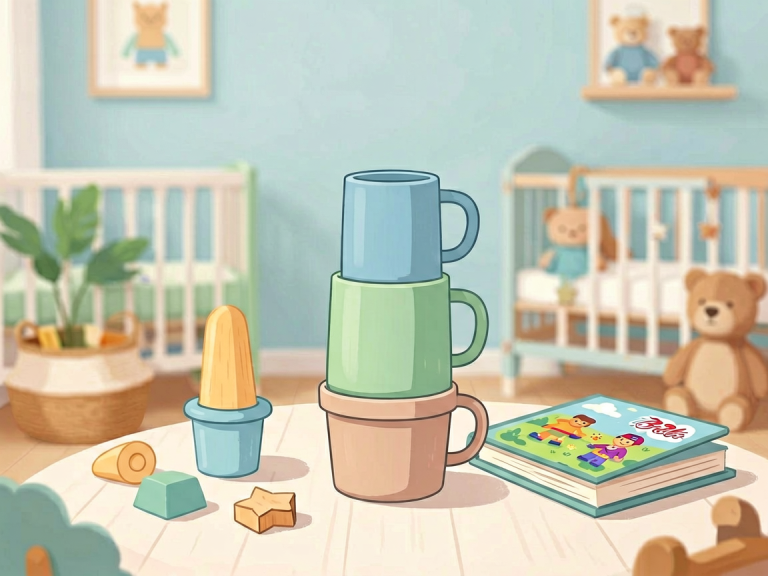
Sharing often fails because babies do not want to give up a toy they are attached to. A clever strategy is to provide duplicate toys—two identical balls, two same-shaped blocks, two matching cups. When two babies (or a baby and an adult) each have the same object, the pressure to “share” the one toy disappears. Sit side by side with your baby, each holding a rattle. Shake yours and encourage your baby to shake theirs. Then, swap rattles with your baby—make a gentle trade. Because both rattles are identical, the baby is more likely to accept the swap. You can also roll two balls back and forth: you roll yours to the baby, and they roll theirs back (or you roll theirs back to them). This activity teaches that playing with an object does not mean owning it exclusively; the same type of fun can be had with another person’s toy. The ability to accept a similar object in exchange is a big step toward true sharing.
5. Playful “Help Me” Activities
Babies as young as ten to twelve months love to be helpers. This natural desire can be channeled into sharing-oriented play. Set up a simple clean-up game: scatter a few soft blocks or stuffed animals on the floor. Hold a small basket and in an animated voice say, “Oh no! The blocks are all over! Can you help me put them in the basket?” Reach for one block, put it in the basket, and say “I put one in! Your turn!” Look expectantly at your baby. They may pick up a block and put it in the basket—and if they do, celebrate as if they just shared a treasure. If they hand you the block to put in, that is also a form of cooperation. This activity builds the idea that toys are shared items that we work on together. It also incorporates turn-taking and joint goal-setting, all of which are foundational for later sharing.
6. Peekaboo with an Object
Peekaboo is a classic game that teaches object permanence and social reciprocity. To adapt it for sharing, incorporate a favorite toy. Cover a small stuffed dog with a cloth and say “Where’s the dog?” Then dramatically reveal it, saying “There he is! My turn to hide him!” Hide the toy again, but this time let your baby pull the cloth off. Then, hand the toy to your baby and say “Your turn to hide!” Even if the baby only clutches the toy, you have introduced the idea of taking ownership of a shared game. The back-and-forth of hiding and finding naturally involves sharing the object and the experience. Over time, you can encourage the baby to hide the toy under the cloth and let you find it, which is a simple form of giving and receiving.
—
Tips for Parents and Caregivers
To make these activities effective, keep the environment calm and free from overstimulation. Turn off background noise and put away other distracting toys. Use a warm, playful tone of voice; babies respond to emotional cues more than words. Be patient—some days your baby will engage eagerly, and other days they will refuse to give up a toy. That is completely normal. Never punish or scold for not sharing; instead, gently redirect to a different activity. Also, remember that your own modeling is crucial. Let your baby see you sharing with other family members: offer a bite of your snack to your partner, or hand a book to a sibling. Comment on it: “I shared my apple with daddy! Look, we both get some!” Babies absorb these social lessons through observation.
Additionally, consider the timing of these activities. The best moments are when your baby is well-rested and fed, not hungry or cranky. A tired or hungry baby cannot learn social skills. Finally, do not expect overnight results. You are planting seeds that will bloom months or even a year later. By consistently engaging in these playful, pressure-free sharing games from the second half of the first year onward, you are giving your baby the emotional vocabulary and social habits that make sharing feel natural when their cognitive abilities catch up.
—
Conclusion
Sharing is not an innate behavior for babies; it is a complex social skill that develops gradually, rooted in early experiences of joint attention, turn-taking, and positive emotional interaction. The six play activities described above—from the simple “My Turn, Your Turn” game to parallel play with duplicates and cooperative clean-up games—provide a gentle, developmentally appropriate way to introduce the concept of sharing from as early as six months. These activities do not force babies to give up prized possessions; instead, they build the foundational blocks: the ability to take turns, to focus on a shared object, to initiate giving, and to enjoy cooperative play. By engaging in these short, joyful sessions, caregivers help their babies feel safe and happy in a social world where “we” matters as much as “me.” In time, as the toddler years approach, these early seeds will flower into true generosity, cooperation, and the deep satisfaction that comes from sharing with others. The journey begins not with a command to “share,” but with a smile, a toy, and the simple invitation to play together.