Building the Foundation: A Guide to Teaching Early Math to Babies
Introduction
When we think of teaching mathematics, images of chalkboards, algebraic equations, and geometry proofs often come to mind. Yet the roots of mathematical thinking are planted long before a child enters a classroom—indeed, they begin in infancy. Babies are not born with an innate understanding of numbers, but research in developmental psychology has shown that even newborns possess a primitive sense of quantity, known as “number sense.” This means that from the very first months of life, infants can distinguish between small sets of objects, notice changes in quantity, and begin to form the neural pathways that support later mathematical reasoning.
Teaching early math to babies is not about drilling flashcards or forcing them to recite numbers. Instead, it is about creating a rich, nurturing environment where mathematical concepts are woven naturally into daily interactions. The goal is to build a strong intuitive foundation—one that will make formal math learning later in life feel familiar, logical, and even joyful. In this article, we will explore practical, research-backed strategies for introducing early mathematical concepts to babies, using everyday activities, play, and language.
—
Understanding the Mathematical Mind of a Baby
Before diving into specific teaching methods, it is essential to understand what babies are capable of perceiving. Studies using habituation techniques—where babies are shown a series of images until they lose interest, then shown a new image—have demonstrated that infants as young as five months can detect changes in the number of objects. For example, if a baby is repeatedly shown two dots, and then presented with three dots, they will stare longer at the new quantity, indicating that they notice the difference.
This “approximate number system” allows babies to compare quantities without counting. They can also recognize simple patterns, such as a sequence of sounds or movements, and they are sensitive to the order of events. Moreover, infants are natural pattern-seekers. They pay attention to the rhythm of a lullaby, the alternating steps of a parent’s walking, and the repeating shapes in a mobile. These early pattern-recognition skills are the bedrock of mathematical thinking, including algebra and geometry.
Therefore, the first step in teaching early math is to acknowledge that the baby is already a little mathematician. Our role as caregivers is not to instruct but to offer experiences that reinforce and expand these innate abilities.
—
Everyday Conversations and Number Talk
Language is one of the most powerful tools for building early math skills. Even before a baby can speak, they are absorbing the sounds and rhythms of speech. When parents and caregivers use “math talk” in everyday contexts, they help the baby make connections between words and quantities.
For instance, during diaper changes, you might say, “I have one diaper—let’s put it on you,” or while feeding, “Look, two peas on your tray.” This may seem trivial, but hearing number words in meaningful, repetitive contexts helps babies begin to associate the word “two” with a specific quantity. Research from the University of Chicago has shown that the amount of number talk a child hears between 14 and 30 months strongly predicts their later math achievement. For younger babies, even simple phrases like “one, two, three—up we go!” when lifting them, or counting their toes during a bath, establish a positive connection between numbers and physical experience.
It is also beneficial to use spatial language. Words like “up,” “down,” “inside,” “outside,” “big,” and “little” help babies develop an early sense of geometry and measurement. While playing with blocks, you can say, “Let’s put the big block on top of the little one.” While moving a toy car, you might comment, “The car goes under the table, then around the chair.” This kind of talk not only enriches vocabulary but also sharpens spatial reasoning—a key component of math.
—
Sensory Play and Counting
Babies learn through their senses. Sensory play—activities that engage touch, sight, sound, and even taste—provides a natural stage for mathematical exploration. One simple activity is using textured balls or soft blocks of different sizes. Let the baby pick them up, drop them, and mouth them while you narrate: “You have the blue ball. That’s one ball. Now I have two balls!”
You can also create a “treasure basket” filled with objects of various shapes, weights, and dimensions. For example, include a smooth wooden egg, a crinkly fabric star, and a soft rubber cube. As the baby explores, you can label the shapes: “That’s a round ball. This one has corners—it’s a cube.” Over time, the baby will begin to differentiate these properties, laying the groundwork for geometry.
Counting during sensory play is especially effective when it is accompanied by tactile feedback. For instance, during bath time, you can count the bubbles as you pop them one by one: “One bubble, pop! Two bubbles, pop! Three bubbles, pop!” The combination of auditory counting, visual disappearance, and physical action engages multiple brain regions, reinforcing the concept of one-to-one correspondence.
Another activity is stacking rings or cups. Even if the baby cannot yet stack them perfectly, they will enjoy holding and mouthing them. As you stack, count the rings aloud: “One ring on the post, two rings on the post.” The predictable sequence of stacking and the eventual toppling of the tower teaches cause-and-effect as well as ordinality—the idea that order matters.
—
Patterns and Sequences in Daily Routines
Patterns are everywhere, and babies are especially attuned to them. A daily routine itself is a pattern: wake up, feed, play, nap, feed, play, bath, sleep. When caregivers follow a consistent sequence, the baby begins to anticipate what comes next. This anticipation is a form of pattern recognition and sequencing—both essential mathematical skills.
You can make patterns explicit during play. For example, while playing with blocks, create a simple pattern: red block, blue block, red block, blue block. Even if the baby cannot build the pattern themselves, they will watch with interest. Point to each block and say, “Red, blue, red, blue—can you see the pattern?” For older babies (around 9–12 months), you might encourage them to continue a simple pattern by handing them the next block.
Musical patterns are equally valuable. Singing songs with repetitive phrases, such as “Twinkle, Twinkle, Little Star” or “Row, Row, Row Your Boat,” helps babies detect repeating melodic and rhythmic structures. Clapping along to a beat—slow, fast, or alternating—also teaches pattern recognition. You can use a drum or a shaker to create a simple rhythm: tap, tap, pause; tap, tap, pause. The baby may eventually attempt to mimic the rhythm by shaking their rattle in response.
Even during feeding, you can introduce patterns. For instance, offer a bite of apple, then a bite of banana, then apple again. As you alternate, you can say, “Apple, banana, apple—that’s a pattern!” This not only makes mealtime fun but also reinforces the idea of repeating sequences.
—
Spatial Awareness and Shape Recognition
Spatial reasoning—the ability to understand and remember the spatial relationships among objects—is a strong predictor of later STEM (science, technology, engineering, and mathematics) success. Babies develop spatial awareness naturally as they move, reach, and crawl. However, we can intentionally nurture this skill through specific activities.
One classic activity is playing with nesting cups or stacking blocks. As the baby tries to fit a smaller cup inside a larger one, they are learning about size comparison and volume. You can say, “The little cup goes inside the big cup. It fits! Now try the big cup inside the little one—oh, it doesn’t fit.” This trial-and-error exploration teaches concepts like “more than” and “less than” in a concrete way.
Shape sorters are another excellent tool. While the baby may not yet be able to correctly match shapes, they will enjoy banging the pieces together. As you play together, name each shape: “That’s a circle. Can you find the circle hole? Here it is—let’s push it through.” Even if the baby doesn’t succeed, the exposure to shape names and the physical experience of trying to fit a shape into a hole builds neural connections.
Mirror play also enhances spatial awareness. Place a baby-safe mirror on the floor so that the baby can see their own reflection. Move a toy to different locations in front of the mirror and ask, “Where is the toy now? Is it in front of you or behind you?” This helps the baby understand position words and develop a sense of their own body in space.
For babies who are beginning to crawl or pull up, create simple obstacle courses with pillows and soft tunnels. As they navigate around, under, and over objects, they are mentally mapping their environment. Narrate their movements: “You are going under the table, now you are over the pillow.” These spatial experiences are the same ones that later help children understand coordinate systems and geometry.
—
The Role of Music and Rhythm
Music and mathematics share deep structural connections. Both rely on patterns, sequences, ratios, and timing. Introducing babies to music, especially through live singing and simple instruments, can boost their mathematical development.
Clapping games, such as “Pat-a-Cake” or “Peek-a-Boo” with a rhythmic beat, teach babies to anticipate a regular pulse. This sense of timing is related to counting and measuring. You can modify these games by varying the tempo: fast claps, then slow claps. The baby will learn to adjust their own movements to match the rhythm, which strengthens neural pathways for sequential processing.
Singing number songs, like “Five Little Ducks” or “Ten in the Bed,” combines counting with a musical narrative. As you hold up fingers to represent each little duck, the baby sees a visual representation of the number. Even if they cannot yet hold up their own fingers, they are absorbing the idea that numbers go with quantities. Use hand motions to make the song interactive.
Simple rhythm instruments, such as maracas, drums, or jingle bells, allow babies to create their own patterns. Let them shake the maraca fast and then slow. You can demonstrate: “Mommy shakes fast, now you try!” This cause-and-effect exploration also introduces the concept of speed, which is a form of rate—a foundational mathematical idea.
For very young babies, just listening to varied music—classical, folk, or world music—exposes them to different rhythmic patterns and mathematical ratios inherent in musical intervals. While the intellectual understanding is far off, the brain is busy building the architecture that will later support pattern detection.
—
Creating a Math-Rich Environment
The physical environment plays a crucial role in early math learning. By intentionally placing math-related items within the baby’s reach, you create constant opportunities for exploration.
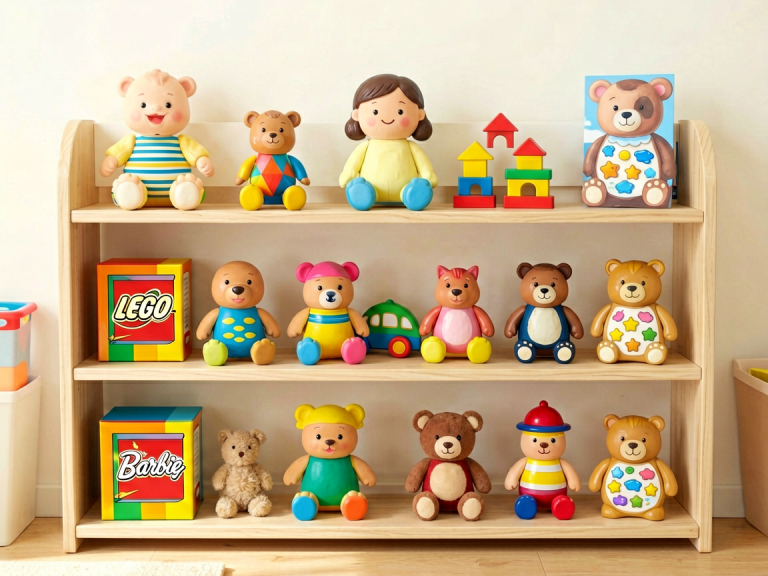
Consider a low shelf or basket with a selection of toys that emphasize mathematical properties: stacking rings, nesting cups, shape sorters, blocks of different sizes, and puzzles with large knobs. Rotate these toys regularly to maintain novelty. Also include everyday objects like measuring spoons, wooden spoons of different lengths, and fabric swatches of various textures and colors.
Hang a mobile with geometric shapes or patterns above the changing table. As the baby gazes up, they are practicing visual tracking and shape recognition. Use high-contrast black-and-white patterns for newborns, and later introduce colorful shapes with clear outlines.
Wall decorations can also be mathematical. Place a simple number poster with large, clear numerals at the baby’s eye level—not for memorization, but for casual visual exposure. You can point to the number “2” when you give the baby two crackers.
Most importantly, model a positive attitude toward math. When you count steps, measure ingredients while cooking, or compare sizes while shopping, narrate these actions aloud. Babies pick up on their caregivers’ emotions. If you express joy and curiosity when talking about numbers, the baby will associate math with warmth and fun.
—
Conclusion
Teaching early math to babies is not about accelerating academic achievement or creating child prodigies. It is about honoring the natural mathematical thinking that already exists in every infant and providing a loving, language-rich environment that allows those seeds to grow. Through everyday conversations, sensory play, pattern recognition, spatial activities, music, and a thoughtfully designed environment, we can help babies develop a strong intuitive sense of number, shape, and sequence.
The key is to follow the baby’s lead. Watch for moments of curiosity—when they stare intently at a pattern, reach for a specific shape, or giggle at a rhythmic song. Those are the golden opportunities to introduce a mathematical idea in a playful, pressure-free way. Remember, the foundation of all later math learning is not memorized facts but rather a deep, embodied understanding that the world is full of order, patterns, and relationships. By nurturing that understanding from the very beginning, we give our babies a gift that will serve them for a lifetime.