Building Words, One Play at a Time: The Best Toys for Language Development in 4-Year-Olds
Introduction
At four years old, children are linguistic explorers. Their vocabulary is expanding at a remarkable rate—from roughly 1,000 words at age three to over 1,500 by age four—and they begin to string together complex sentences, ask endless “why” questions, and experiment with storytelling. This is a critical window for language development, and the right toys can transform playtime into a rich, natural language laboratory. Unlike passive screen time, hands-on toys encourage conversation, narration, questioning, and creative thinking. The key is to choose toys that spark interaction: between child and caregiver, child and peers, or even child and toy itself (when the toy prompts verbal responses). This article explores specific categories of toys that are proven to boost vocabulary, grammar, narrative skills, and social communication in four-year-olds, with practical advice on how to maximize language growth during play.
1. Pretend Play Sets: The Power of Storytelling and Dialogue
Pretend play is arguably the single most powerful vehicle for language development at age four. When a child adopts a role—be it a doctor, a chef, a firefighter, or a parent—they must use language to define the scenario, assign roles, and negotiate actions. Toys that facilitate this kind of imaginative immersion are invaluable.
Doctor’s Kit or Play Kitchen
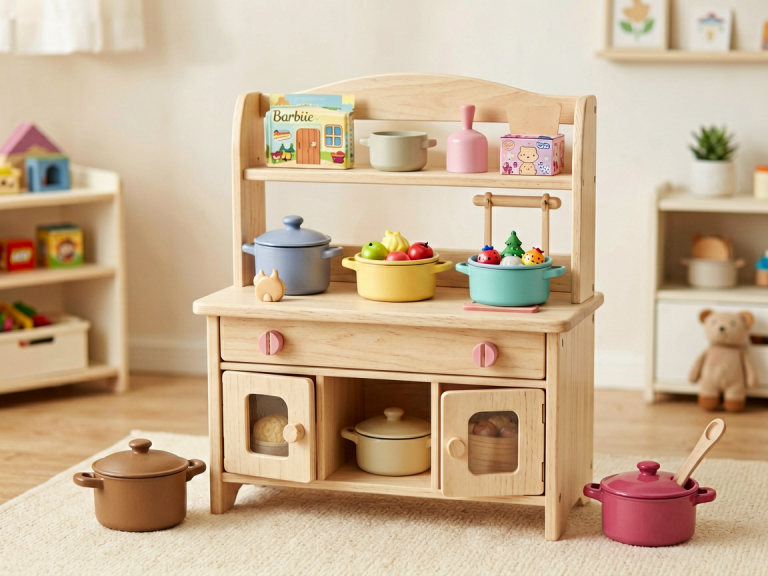
A simple doctor’s set (stethoscope, syringe, bandages) or a play kitchen with pots, pans, and plastic food invites endless dialogue. A child might say, “Okay, teddy bear, you have a fever. I need to take your temperature. Don’t worry, it will be quick!” This type of play naturally elicits complete sentences, question forms (“Does it hurt here?”), and imperative verbs (“Lie down, please”). The child also practices turn-taking in conversation, a foundational social-linguistic skill. Parents can extend the language by asking open-ended questions: “What do we do next?” or “Why does the patient need medicine?” This stretches the child’s ability to explain and reason.
Dress-Up Costumes and Puppets
Costumes transform a child into a character with a distinct voice and perspective. A four-year-old wearing a firefighter hat might shout, “Get back! The fire is too big! I need more water!” Puppets, especially hand puppets with moving mouths, encourage dialogue between the child and the puppet, or between two puppets. The child must create distinct voices and decide what each character will say. This role-switching practice directly builds narrative skills and helps children understand that different people have different points of view—a crucial step in pragmatic language development.
2. Building Toys and Construction Sets: Vocabulary for Spatial and Sequential Language
While building blocks are often associated with motor skills and engineering, they are equally potent for language learning—if played with intentionally. Four-year-olds are ready to learn directional and comparative words, sequencing language, and descriptive adjectives.
Wooden Blocks, LEGO Duplo, or Magnetic Tiles
When a child builds a tower, they might say, “I’m putting the big blue block on top of the small red one.” This sentence alone contains size adjectives (“big,” “small”), colors, and prepositions (“on top of”). Parents can model richer language: “You placed the triangle block between the two squares. That’s very balanced!” Over time, the child internalizes these spatial terms. Construction play also invites sequential language: “First I build the base, then I add the roof, and finally I put a flag on top.” Asking the child to explain their building process (“Tell me how you made that rocket”) encourages them to organize their thoughts into a logical sequence—an essential precursor to storytelling.
3. Storytelling and Sequencing Toys: Building Narrative Structure
Four-year-olds love to hear stories, but they also need to practice telling them. Toys that support sequencing, character development, and plot creation can dramatically improve a child’s ability to construct coherent narratives.
Story Cubes or Picture Cards
Story cubes (dice with pictures of characters, objects, and actions on each face) are perfect. A child rolls the cubes and must create a story linking the four images that appear. For example, a sun, a cat, a castle, and a key might become: “One sunny day, a cat found a key. The key opened a mysterious castle door. Inside, there was a treasure!” This activity forces the child to use connecting words (“then,” “because,” “suddenly”) and to establish cause-and-effect relationships. Picture cards that need to be arranged in order (such as a three-step “how to make a sandwich” sequence) also teach temporal language: “First, you take the bread. Next, you put peanut butter on it. Last, you eat it.”
Puppet Theaters and Felt Boards
A simple felt board with cut-out characters and scenery allows a child to physically move pieces while narrating. This tactile element reduces cognitive load, letting the child focus on language. Parents can start with a familiar story (“Let’s tell the story of the Three Little Pigs”) and then encourage original tales. The child learns to set the scene (“Once upon a time, in a forest…”), introduce characters (“There was a friendly wolf…”), and resolve the plot. The goal is not perfection but practice; each attempt builds confidence and vocabulary.
4. Interactive Electronic Toys That Require Verbal Responses
Not all screen-based toys are detrimental. Carefully chosen interactive toys that require the child to speak can be effective—as long as they are used in moderation and with adult mediation.
Talking Storybooks and Voice-Activated Toys
Some electronic storybooks allow the child to press buttons that ask questions (“What color is the dog?”) or that prompt the child to repeat words. These reinforce vocabulary and pronunciation in a low-pressure way. Similarly, toys like a “talk back” phone or a simple voice recorder let the child record and play back their own voice, which is both fascinating and educational. When a child hears themselves say “I want a banana,” they become more aware of articulation and sentence structure. Parents should sit with the child during use, adding comments like, “I heard you say ‘banana’ very clearly! Can you tell me what the phone said back to you?” This turns a solitary activity into a social language exchange.
5. Board Games and Card Games: The Social Side of Language
Board games for four-year-olds are not just about winning—they are about following rules, taking turns, and communicating. Games that require verbal instruction or description are gold mines for language.
Memory Games and Simple Matching Cards
When playing memory, a child must say, “I turn over the card with the red apple,” and then later, “I found the match! They are both apples.” This uses descriptive language and comparatives. Cooperative games (where all players work together against a common challenge) encourage phrases like “Let’s try this one” or “Don’t forget the star!” The social pressure of a game motivates even reluctant speakers to articulate their thoughts clearly.
Games That Require Giving and Following Directions
Games like “Simon Says” or simple treasure hunts (where you hide a toy and give verbal clues) are excellent. For example, “Take three steps forward, then look under the yellow chair.” The child must process and execute multi-step instructions, which strengthens listening comprehension—a critical component of language development. In return, when the child gets to be the “leader,” they practice constructing clear commands.
6. Art and Craft Supplies: A Canvas for Descriptive Language
Art is often overlooked as a language tool, but when a child draws or crafts, they naturally talk about what they are creating. Art supplies—crayons, play dough, scissors, glue—are wonderfully open-ended.
Play Dough and Modeling Clay
While rolling a snake or pressing a star shape, a child might describe their actions: “I’m making a long, slimy snake. It’s green and blue. It has a red tongue.” Parents can introduce new adjectives: “That snake looks bumpy. Is it bumpy or smooth?” The child learns to compare textures, colors, and shapes. After creating, the child can tell a story about their sculpture: “This is a hungry dinosaur who eats leaves.” This transforms art into a springboard for narration.
Drawing and Storytelling Journals
A sketchbook where the child draws a picture and then dictates a story to an adult (who writes it down) is a powerful tool. The adult can model written language: “Oh, you say the cat is sleeping under the rainbow? Let me write that: ‘The cat is sleeping under the rainbow.’ ” Over time, the child starts to recognize that spoken words can become written words, bridging oral and literacy skills. Dictation also allows the child to use more complex sentences than they could write independently, stretching their expressive language.
Conclusion
Language development at age four is not a classroom lesson—it is a joyful, messy, and interactive journey. The best toys for building vocabulary, grammar, and narrative skills are those that invite conversation, encourage role-playing, and stimulate the child to explain, question, and describe. From doctor kits that inspire healing dialogues to building blocks that teach spatial prepositions, from puppet theaters that unlock storytelling to simple board games that demand clear instructions, every play experience can be a language lesson. The adult’s role is crucial: not to direct the play, but to participate as a curious, responsive partner. When a parent says, “Tell me more about that dragon,” or “What happened after the princess climbed the tower?” they are handing the child the keys to a richer, more expressive world. So choose toys that open doors—not just of imagination, but of language itself.