Building Words Through Play: Engaging Activities to Boost Toddler Language Development
—
Introduction
The toddler years—roughly ages one to three—are a whirlwind of discovery. During this period, a child’s brain forms more than a million new neural connections every second, and language acquisition accelerates at an astonishing rate. Yet many parents and caregivers wonder: *How can I actively support my toddler’s language development without turning everyday life into a classroom?* The answer is simple and joyful: play.
Play is not just fun; it is the natural laboratory where toddlers experiment with sounds, words, sentence structures, and social communication. By thoughtfully integrating language-rich activities into playtime, we can transform ordinary moments into powerful learning opportunities. This article explores a variety of play ideas specifically designed to foster vocabulary growth, listening comprehension, conversational turn-taking, and expressive language—all while keeping your little one engaged and delighted.
—
1. Pretend Play: The Gateway to Narrative and Social Language
Why it works
When a toddler picks up a toy phone and pretends to call Grandma, she is doing far more than mimicking an action. She is constructing a mental scenario, selecting vocabulary (*“Hi, Grandma! I’m making cookies.”*), and experimenting with tone and turn-taking. Pretend play (also called symbolic play) forces children to use language to assign roles, describe actions, and negotiate storylines.
Play ideas to try
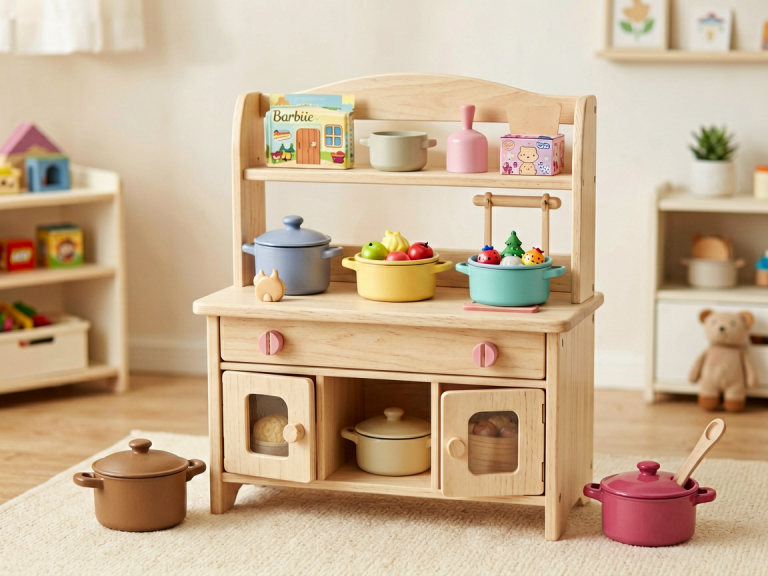
- Kitchen corner: Set up a small play kitchen with pots, pans, and plastic food. Model phrases like *“I’m stirring the soup. Can you pass me the salt?”* Then ask open-ended questions: *“What are you cooking? Who is coming for dinner?”*
- Dress-up box: Provide hats, scarves, old handbags, and a mirror. Encourage your toddler to become a firefighter, a doctor, or a superhero. Use new vocabulary: *“The doctor listens to your heart with a stethoscope. Can you say stethoscope?”*
- Teddy bear’s picnic: Put a few stuffed animals on a blanket. Narrate the scene: *“Teddy is hungry. What should we feed him? Apple or banana?”* Let your toddler decide and respond, even if only with a sound or a gesture.
Language development focus
This type of play builds narrative skills (beginning, middle, end), introduces role-specific vocabulary, and teaches polite social phrases like *“please”* and *“thank you.”* It also encourages the use of two- to three-word phrases: *“Dolly eat cookie,”* which gradually become more complex.
—
2. Music, Rhymes, and Finger Plays: Rhythm and Repetition Build Phonemic Awareness
Why it works
Songs and nursery rhymes are packed with rhyming words, repetitive structures, and simple melodies that make language predictable and memorable. The rhythm helps toddlers break speech into syllables, a crucial pre-reading skill known as phonemic awareness. Finger plays (songs with hand movements, like *“Itsy Bitsy Spider”*) combine motor coordination with language, reinforcing word meanings through physical action.
Play ideas to try
- Daily song circle: Sing familiar songs like *“Twinkle, Twinkle, Little Star”* or *“Old MacDonald.”* Leave out the last word of a line and pause, giving your toddler a chance to fill it in: *“Old MacDonald had a ____ (farm).”*
- Action songs: *“If You’re Happy and You Know It”* teaches emotion words (*happy, angry, sleepy*) and action commands. Change the lyrics: *“If you’re happy and you know it, stomp your feet!”*
- Homemade musical instruments: Fill a plastic bottle with rice to make a shaker. Sing a simple chant: *“Shake it high, shake it low. Shake it fast, shake it slow.”* This pairs directional words (*high, low*) with tempo words (*fast, slow*).
Language development focus
Repetition strengthens vocabulary retention. Rhymes support sound discrimination—the ability to hear that *cat* and *hat* end the same way. Gestures during finger plays also help toddlers connect words to actions, reinforcing comprehension before they can produce the words themselves.
—
3. Book Exploration: From Pointing to Storytelling
Why it works
Shared book reading is one of the most powerful predictors of later language and literacy success. For toddlers, the goal is not to read every word on the page but to engage with pictures, point to objects, and hear rich vocabulary in context. Interactive reading—where you ask questions and encourage your child to respond—turns a passive activity into an active conversation.
Play ideas to try
- “I-spy” books: Use a picture dictionary or any illustrated book. Say, *“I spy something red. Can you find the red ball?”* When your toddler points, name the object and expand: *“Yes, that’s a red ball. The ball is round and bouncy.”*
- Lift-the-flap books: Books like *“Where’s Spot?”* build anticipation and vocabulary. As your toddler lifts a flap, say, *“Is Spot under the bed? No, it’s a turtle! Hello, turtle!”*
- Make your own photo book: Print family photos and paste them into a small album. Go through it together: *“Who is that? It’s Grandma! And what is Grandma holding? A cake!”* This personalizes language and sparks emotional connections.
Language development focus
Books introduce decontextualized language—words that refer to things not present—which is essential for later academic success. Asking *“What do you think will happen next?”* builds prediction skills. Pointing to pictures while naming them directly connects the spoken word to its visual referent.
—
4. Sensory Play with Descriptive Language
Why it works
Sensory play—activities that engage touch, sight, sound, smell, and taste—naturally invites toddlers to describe their experiences. When a child squishes playdough or pours water, they need words to express what they feel: *sticky, cold, smooth, bumpy.* Providing this vocabulary during play enriches their descriptive language.
Play ideas to try
- Playdough fun: Use homemade or store-bought playdough. Roll it into snakes, cut with plastic knives, and press in buttons. Narrate: *“My playdough is soft. I’m rolling a long snake. Can you make a round ball?”* Introduce comparative words: *“Your snake is longer than mine!”*
- Sensory bins: Fill a shallow bin with dry rice, beans, or sand. Hide small toys inside. As your toddler digs, comment: *“You found a blue car! The car feels little and hard. Can you find something fuzzy?”*
- Water play: In the bathtub or a plastic tub, provide cups, funnels, and waterproof toys. Use action verbs: *“Pour the water. Splash! The boat floats. Uh-oh, the cup sank!”*
Language development focus
Sensory play naturally elicits adjectives (texture, temperature, size) and verbs (pour, scoop, squeeze). It also encourages cause-and-effect language: *“If I push the funnel down, the water comes out.”* The hands-on nature makes vocabulary stick because it is tied to a physical sensation.
—
5. Outdoor Adventures: Vocabulary in a Living Classroom
Why it works
The outdoors is a dynamic, ever-changing environment full of novel vocabulary. A walk around the block offers dozens of new words: *squirrel, mailbox, puddle, sidewalk, flower.* Physical movement also releases energy, making toddlers more receptive to language input.
Play ideas to try
- Nature scavenger hunt: Before going outside, name three things to find: a leaf, a rock, a stick. As you walk, repeat the words and ask, *“Do you see a leaf? There’s one—a green leaf!”* Later, expand to colors, sizes, and textures: *“This leaf is rough. This one is smooth.”*
- Playground commentary: While your toddler swings, slides, or climbs, describe the actions: *“You’re going up the ladder. Now slide down fast! Whee!”* Use prepositions: *“You’re in the tunnel. Now you’re out!”*
- Digging in the dirt: Give your toddler a small shovel and a bucket. Talk about what you find: *“You dug a big hole. Look—a worm! The worm is wiggly. Should we put it back in the dirt?”*
Language development focus
Outdoor play introduces location words (in, on, under, behind), action verbs (run, jump, climb), and nature-specific nouns. It also provides opportunities for safety language (*“Stop at the edge”*) and social greetings (*“Say hi to the doggy!”*).
—
6. Turn-Taking Games: The Foundation of Conversation
Why it works
Conversation is essentially an elaborate turn-taking game. Simple interactive games teach toddlers the rhythm of back-and-forth communication—listening, waiting, and responding. These skills are the bedrock of pragmatic language (social use of language).
Play ideas to try
- Ball rolling: Sit facing your toddler and roll a soft ball back and forth. Each time you roll it, say *“Your turn”* or *“My turn.”* Add words: *“Roll the ball to Mommy. Catch it! Now roll it back.”*
- Peek-a-boo variations: Classic peek-a-boo teaches anticipation and joint attention. Add language: *“Where’s Sarah? Peek-a-boo! I see you!”* For older toddlers, play hide-and-seek with a toy: *“Where’s the teddy? Is it behind the couch? No, it’s under the pillow!”*
- Simple board games: Games like *“Chutes and Ladders”* for very young children (with large images and no reading) allow you to practice question-answer patterns: *“What number did you spin? You landed on the slide!”*
Language development focus
Turn-taking games reinforce the social rules of conversation: look at the speaker, wait for a response, and stay on topic. They also model question forms and answers, which toddlers will soon use to ask their own countless “why” questions.
—
Conclusion
Toddler language development does not require flashcards, expensive apps, or structured lessons. It thrives in the messy, joyful, and repetitive world of play. Whether you are stirring pretend soup, singing a silly rhyme, digging for worms, or rolling a ball back and forth, every interaction is an opportunity to wrap words around experience.
The most important ingredient is your engaged presence—talking with (not at) your toddler, following their interests, and celebrating their attempts at communication, no matter how babbled or broken. Over time, those single words become two-word phrases, then three-word sentences, and eventually the complex stories they will tell for the rest of their lives. So go ahead: pick a play idea from this article, sit on the floor, and let the language grow wild.