Cultivating Curiosity: Beginner Toys That Spark Critical Thinking in Young Minds
Introduction
Critical thinking—the ability to analyze information, evaluate evidence, and form reasoned judgments—is one of the most essential skills for success in the 21st century. Yet it is not an innate gift; it is a muscle that must be exercised from an early age. For young children, especially toddlers and preschoolers, the most effective gym for this muscle is play. The right beginner toys can transform moments of fun into powerful learning experiences, laying the groundwork for logical reasoning, problem-solving, and creative exploration. Unlike passive entertainment (such as many digital videos), well-designed toys invite children to ask questions, test hypotheses, and learn through trial and error. This article explores several categories of beginner-friendly toys that deliberately cultivate critical thinking, offering parents and educators a roadmap to meaningful play.
Building Blocks: The Architecture of Logic
Perhaps no toy is more fundamental to critical thinking than a simple set of building blocks. Wooden blocks, plastic interlocking bricks (such as Duplo or Lego), or foam blocks all serve the same purpose: they force a child to think in three dimensions. When a toddler tries to stack two blocks without them toppling, she is engaging in rudimentary physics—experimenting with balance, weight distribution, and center of gravity. As children grow, they begin to plan structures: “I want a tower that is taller than this chair.” This requires setting a goal, predicting outcomes, and adjusting strategies when the blocks fall. The open-ended nature of building blocks means there is no single “correct” answer. A child must decide how to solve a spatial puzzle, and each failure becomes a lesson in cause and effect. By introducing a variety of shapes and sizes, these toys teach classification, symmetry, and sequential thinking—all core components of critical reasoning.
Puzzles: Piecing Together Problem-Solving
From simple two-piece shape sorters for infants to jigsaw puzzles of 24–48 pieces for five-year-olds, puzzles are a classic tool for developing analytical skills. A puzzle demands that a child identify patterns, compare shapes and colors, and test possibilities. The process of trying a piece in one place, finding it doesn’t fit, and then rotating it or trying another location is an early form of hypothesis testing. Moreover, puzzles require sustained attention and patience—qualities essential for deeper thinking. More advanced puzzles, such as those with irregular edges or gradient colors, encourage children to develop strategies: “I will first find all the corner pieces,” or “I will group pieces by color.” These meta-cognitive strategies are the very essence of critical thinking: thinking about how to think. For beginners, puzzles with large knobbed pieces or those made of wood are ideal because they provide tactile feedback and reduce frustration, ensuring that the challenge remains motivating rather than overwhelming.
Board Games: Strategic Thinking in Action
Board games designed for young children are perhaps the most social way to foster critical thinking. Games like “Candy Land” or “Chutes and Ladders” are often dismissed as pure luck, but even these introduce turn-taking, rule-following, and emotional regulation—foundational for rational discourse. However, for true strategic development, games that involve choice and consequence are far superior. Classics such as “Connect Four,” “Checkers” (simplified for young players), or “The Game of Life Junior” require a child to weigh options, anticipate an opponent’s moves, and adapt. For example, in “Connect Four,” a four-year-old must think: “If I put my piece here, will that block the other player from winning? Or should I try to create my own line?” This is rudimentary game theory. Cooperative board games—such as “Hoot Owl Hoot!”—add another layer: children must work together to solve a shared problem, discussing strategies and negotiating solutions. This collaborative critical thinking teaches communication, perspective-taking, and the ability to revise plans based on new information—skills that are invaluable in real-world problem-solving.
Logic and Pattern Games: Training the Mind
For children who enjoy structured challenges, logic and pattern games offer direct practice in deductive reasoning. Items like simple Sudoku puzzles (using pictures instead of numbers), pattern blocks, or matching games (e.g., “Memory”) train the brain to recognize sequences, categorize information, and make logical deductions. A classic example is the “What Comes Next?” activity: a set of colored beads or cards arranged in a repeating pattern (red, blue, red, blue) with one missing. The child must infer the rule and choose the correct bead. This explicitly exercises inductive reasoning—the ability to derive general principles from specific examples. More sophisticated toys, such as Logic Link or SmartGames’ beginner-level puzzles (like “Three Little Piggies”), present a scenario with constraints. For instance, a child must place three toy pigs and a wolf on a board such that the wolf cannot reach them, following a picture clue. This requires analyzing spatial relationships, interpreting visual information, and applying multiple rules simultaneously. For beginners, these puzzles often come with color-coded clues or graduated difficulty levels, allowing children to build confidence while stretching their minds.
Construction and Magnetic Toys: Engineering Thought
Beyond simple blocks, construction toys that involve magnets, gears, or connectors introduce principles of mechanical reasoning. Magnetic tiles (such as Magna-Tiles or Magformers) are especially popular among young children because they snap together effortlessly, allowing even a two-year-old to create complex 3D shapes. As they build bridges, houses, or rockets, children are unconsciously engaging with structural integrity: “If I put too many tiles on top, will it fall?” They learn about symmetry, balance, and the importance of a sturdy base. Gears toys (like Gears! Gears! Gears! by Learning Resources) add motion: a child must figure out how to connect gears so that turning one causes others to spin. This is a direct lesson in cause-and-effect, sequencing, and mechanical logic. Construction sets often include idea cards that show finished models, but the real critical thinking happens when a child deviates from the plan or tries to fix a broken structure. The iterative process of building, failing, adjusting, and rebuilding mirrors the scientific method—perfect for fostering a growth mindset and resilience.
Role-Play and Storytelling: Imagining Possibilities
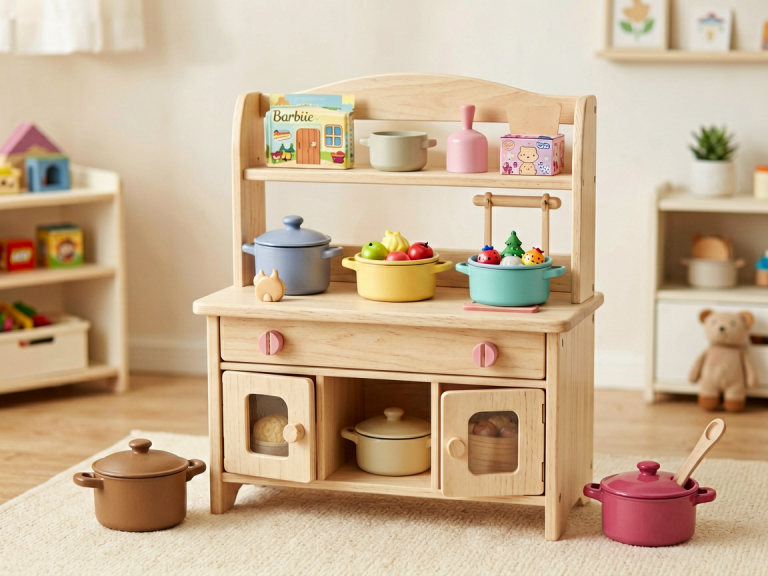
Open-ended role-play toys—such as play kitchens, doctor kits, tool sets, or dollhouses—may seem purely imaginative, but they are powerful engines for critical thinking. When a child pretends to be a chef making dinner for a stuffed animal, she must solve real-world problems: “The bear is hungry, but I don’t have bread. What can I use instead?” This encourages resourcefulness, cause-effect reasoning, and decision-making. Role-play also forces children to adopt different perspectives, an aspect of critical thinking often overlooked. To effectively play “doctor,” a child must think about the patient’s symptoms and decide on a treatment—a simplified version of diagnostic reasoning. Furthermore, storytelling props (puppets, felt boards, or simple finger puppets) prompt children to create narratives with a beginning, middle, and end. This requires sequencing, character motivation, and conflict resolution—all components of logical narrative structure. When adults engage in “serve-and-return” conversation during role-play—asking “Why is the patient sad?” or “What should we do next?”—they help children articulate their reasoning and refine their ideas.
Conclusion: Choosing Toys That Grow With Your Child
The best beginner toys for critical thinking are not always the most expensive or technologically advanced. In fact, the simplest tools—blocks, puzzles, board games, and imagination kits—often offer the richest opportunities for cognitive development. What matters most is the child’s interaction with the toy: the opportunity to experiment, make mistakes, and try again. Parents and educators should look for toys that are open-ended (allow multiple solutions), that encourage strategic planning, and that naturally prompt questions like “What if?” and “Why?” Equally important is the adult’s role: sitting beside the child, asking thoughtful questions, and celebrating the process of thinking itself, not just the correct answer. By intentionally selecting beginner toys that stimulate curiosity and logical reasoning, we give children the strongest possible foundation for a lifetime of analytical thought, creative problem-solving, and informed decision-making. And we remind ourselves that the most powerful learning happens when children are playing—because play is, at its core, a joyful and endless inquiry.