The Ultimate Guide to Early Learning Toys for Parents: Nurturing Development Through Play
Introduction
As a parent, you want the very best for your child. From the moment they enter the world, every interaction, every sound, and every object they encounter becomes a building block for their future. Among the countless decisions you will make, choosing the right early learning toys stands out as one of the most impactful. Toys are not just playthings—they are the tools through which infants and toddlers explore their environment, develop crucial skills, and begin to understand themselves and others. Yet, with an overwhelming array of colorful, noisy, and often expensive options on the market, knowing which toys truly support early development can feel like a daunting task. This guide is designed to empower you with research-backed insights, practical tips, and age-appropriate recommendations so that you can confidently select toys that nurture your child’s cognitive, motor, social, and emotional growth.
Why Early Learning Toys Matter
The first five years of life are a period of extraordinary brain development. During this time, neural connections are formed at a staggering rate—over one million new connections per second. Every sensory experience, from feeling a textured rattle to stacking blocks, helps wire the brain for learning. Early learning toys are specifically designed to stimulate these connections in a playful, engaging way. Unlike passive entertainment (like screen time), quality toys invite active exploration, problem-solving, and creativity. They encourage children to use their hands, eyes, ears, and minds in concert, laying the foundation for skills such as concentration, memory, language, and spatial reasoning. Moreover, playtime with toys offers a unique opportunity for parent-child bonding, which itself is a critical factor in healthy emotional development. By understanding the “why” behind toy selection, you shift from simply buying products to intentionally fostering your child’s potential.
Key Principles for Choosing Early Learning Toys
Before diving into specific toys, it is essential to establish a framework for evaluation. Not every flashy toy is educational, and not every simple toy is boring. Keep these four principles in mind when shopping for early learning toys:
- Open-Ended Over Single-Purpose
Open-ended toys—such as blocks, balls, play dough, and nesting cups—can be used in countless ways. They grow with your child, offering new challenges as abilities develop. A set of wooden blocks, for example, can be stacked, sorted by color, used as pretend food, or knocked down in a game of cause and effect. In contrast, a battery-operated toy that only lights up when a button is pressed has a limited play value and often leads to quick boredom.
- Safety First, Always
Young children explore the world with their mouths. Any toy intended for children under three must be free of small parts that could pose a choking hazard. Check for non-toxic materials, water-based paints, and sturdy construction. Look for certifications such as ASTM (American Society for Testing and Materials) or CE marks. Avoid toys with long cords or strings that could cause strangulation.
- Age-Appropriate Challenge
A toy that is too advanced will frustrate a child; one that is too simple will bore them. Manufacturers typically list age recommendations, but these are guidelines, not rules. Observe your child’s current interests and abilities. A toy that requires fine motor precision may be perfect for a 14-month-old but overwhelming for a 9-month-old. The sweet spot lies in what early childhood experts call the “zone of proximal development”—challenging enough to promote growth, yet achievable with a bit of effort or assistance.
- Sensory Richness without Overstimulation
Babies and toddlers learn through their senses. Toys that engage multiple senses—texture, sound, visual contrast, and even taste-safe materials—are valuable. However, avoid toys that are excessively loud, flashing, or chaotic. Overstimulation can lead to meltdowns and actually hinder learning. The best toys offer a balanced sensory experience, such as a soft fabric book with crinkle pages, a wooden rattle with a gentle sound, or a set of smooth, colorful stacking rings.
Age-by-Age Guide to Early Learning Toys
To help you navigate the developmental landscape, here is a detailed breakdown of suitable toys for each stage from birth to age five.
0–6 Months: Sensory Awakening
During the first half-year, infants are primarily focused on discovering their own bodies and the immediate world around them. Their vision is blurry at first, so high-contrast patterns (black-and-white, then primary colors) capture their attention. They also begin to track objects, reach for toys, and bring them to their mouths.
- Recommended toys:
- High-contrast black-and-white cards or mobiles (for visual tracking)
- Soft, crinkly fabric toys or rattles with different textures
- Unbreakable mirrors (babies love looking at faces)
- Easy-to-grasp rings or teethers (silicone or natural wood, free of BPA)
- Activity gyms with hanging toys that encourage batting and kicking
- Parent tip: Talk to your baby while they explore. Describe the toy (“You found the crinkle square!”) to build early language connections.
6–12 Months: Cause and Effect & Motor Milestones
Now your baby is sitting up, perhaps crawling, and soon pulling to stand. They become fascinated with cause and effect: “When I shake this, it makes noise. When I drop it, you pick it up.” Hand-eye coordination improves rapidly.
- Recommended toys:
- Stacking cups or nesting bowls (teaches size relationships)
- Simple shape sorters with large, easy-to-manipulate pieces
- Push-and-pull toys (like a wooden cart that makes clicking sounds)
- Balls of different sizes and textures (for rolling, chasing, and grasping)
- Board books with bright pictures and sturdy pages
- Musical instruments like small drums, maracas, or xylophones
- Parent tip: Allow your baby to explore freely, even if that means dropping or banging toys. These actions are experiments, not misbehavior.
1–2 Years: Independence & Problem-Solving
Toddlers are on the move—walking, running, climbing. Their language explodes, and they begin to imitate adult actions. Imaginary play starts to emerge. They also develop a strong sense of ownership and may insist on doing things themselves.
- Recommended toys:
- Simple puzzles with large knobs (2–4 pieces)
- Chunky crayons, finger paints, and large paper (for scribbling and mark-making)
- Toy telephones, dolls, or play kitchen items (encourages pretend play)
- Activity tables or busy boards with latches, switches, and beads
- Ride-on toys (without pedals) for gross motor development
- Object permanence boxes (where a ball disappears and reappears)
- Parent tip: Introduce simple sorting games (by color or size). Let your toddler help with “clean-up” by placing toys into a basket—it builds responsibility and spatial awareness.
2–3 Years: Imagination & Early Logic
Preschoolers are now capable of more complex pretend play and begin to understand basic rules. They enjoy building, matching, and sequencing. Fine motor skills become refined enough for more precise tasks.
- Recommended toys:
- Building blocks (larger sets, ideally wooden or large plastic)
- Simple board games with one or two steps (e.g., matching games)
- Lacing beads or threading cards (develops hand-eye coordination)
- Play dough with cutters and rollers (sensory and creative)
- Dress-up clothes and props for role-playing
- Sturdy picture books with simple stories and repetitive text
- Parent tip: Ask open-ended questions during play: “What will happen if we put the blue block on top?” or “Can you make a house for the teddy bear?” This encourages language and reasoning.
3–5 Years: Pre-Academic Readiness
This is the golden age of early learning. Children are ready for more structured play that builds literacy, numeracy, and social skills. They also develop stronger hand muscles for writing.
- Recommended toys:
- Letter and number puzzles or magnetic boards
- Counting bears or other small manipulatives for math readiness
- Children’s scissors (age-appropriate, blunt-tip) and safety glue for craft projects
- Memory matching games, lotto, or simple card games
- Construction sets like Duplo or larger Lego
- Simple science kits (e.g., grow a crystal, magnetic wands)
- Puppets or dolls for storytelling and emotional expression
- Parent tip: Incorporate toys into daily routines. Use counting bears to set the table (“Let’s give each bear a plate”) or letter magnets to spell your child’s name together.
Types of Early Learning Toys and Their Benefits
Beyond age categories, it is helpful to think about toys in terms of the developmental domains they support.
Sensory Toys (e.g., water mats, textured balls, sensory bottles)
These toys help children integrate information from their senses. They calm and focus a child while building neural pathways for later learning, especially in children with sensory processing differences.
Motor Skills Toys (e.g., stacking rings, threading toys, climbing structures)
Fine motor skills involve small muscle movements necessary for writing and self-care. Gross motor skills—crawling, walking, balancing—are essential for overall physical health and even cognitive development, as movement stimulates brain regions involved in memory and attention.
Cognitive Toys (e.g., puzzles, shape sorters, pattern blocks)
These toys encourage problem-solving, classification, memory, and logical thinking. They teach concepts like size, shape, color, number, and order.
Language and Literacy Toys (e.g., picture books, alphabet puzzles, talking storybooks)
Language-rich play builds vocabulary, comprehension, and pre-reading skills. Even toys that do not “speak” can inspire conversation when you talk about them with your child.
Social-Emotional Toys (e.g., dolls, puppets, play food, board games)
Playing with others—or even alone with representative toys—helps children practice empathy, sharing, turn-taking, and emotional regulation. A child who feeds a doll and puts it to bed is learning caregiving and routine.
Safety Considerations and Quality Indicators
No guide would be complete without a thorough look at safety. Always read labels and inspect toys regularly for wear and tear. Here are key safety points:
- Choking hazards: Avoid small parts that can fit inside a toilet paper roll (approximately 1.25 inches in diameter) for children under three.
- Toxic materials: Look for “non-toxic,” “BPA-free,” “phthalate-free,” and “lead-free” assurances. Wood should be smoothly sanded with non-toxic paint.
- Battery compartments: These should be secured with screws, not just a sliding cover, to prevent a child from accessing batteries.
- Noise levels: If a toy sounds loud to you, it is too loud for a child. Prolonged exposure to high-decibel toys can damage hearing.
- String and cord length: Any cord longer than 12 inches (30 cm) poses a strangulation risk for infants and toddlers.
Quality indicators include solid construction, absence of sharp edges, easy-to-clean surfaces, and a timeless design that will not break or become obsolete quickly. Investing in fewer, better toys often yields more learning than a room full of plastic novelties.
How to Maximize the Learning Potential of Toys
A toy by itself cannot teach a child; it is the interaction that makes it educational. As a parent, you are the best toy in the room. Here are strategies to extend learning during play:
- Be present. Put down your phone and get on the floor with your child. Your attention validates their exploration and deepens their engagement.
- Narrate and question. Describe what you see (“You put the red circle inside the triangle hole!”). Ask open-ended questions (“What else could we build with these blocks?”).
- Follow your child’s lead. If they are obsessed with stacking all the cups instead of sorting them by color, let them. Interest-driven play is more powerful than adult-directed instruction.
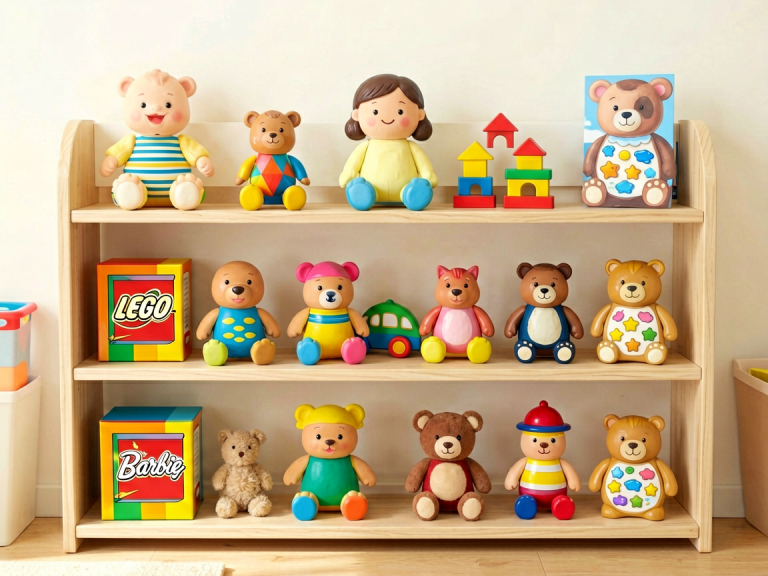
- Rotate toys. Instead of having all toys available at once, rotate a selection every two weeks. This keeps toys fresh and reduces overstimulation.
- Combine toys. A set of blocks and a few plastic animals can become a zoo; stacking cups and a bath can turn into a pouring experiment. Creativity multiplies when toys are mixed.
- Embrace messiness. Sensory play—sand, water, paint, play dough—can be messy, but it is profoundly beneficial. Lay down a waterproof mat and let the learning flow.
Conclusion
Choosing early learning toys for your child is not about buying the newest or most expensive items. It is about understanding your child’s developmental stage, selecting toys that invite open-ended discovery, and then stepping into their world to play alongside them. Every time your baby grasps a rattle, your toddler stacks a block, or your preschooler pretends to run a grocery store, their brain is wiring itself for future success. You do not need a degree in child development to be an excellent toy guide—you just need a little knowledge, a lot of patience, and the willingness to let play unfold naturally. Remember, the simplest toy, offered with your loving attention, can be the most powerful learning tool of all. Happy playing!