Inspiring Little Scientists: STEM Activities for Toddler Girls That Spark Curiosity and Confidence
Introduction
The world of STEM—science, technology, engineering, and mathematics—often carries an invisible label that says “for older kids” or “for boys.” But the truth is, the foundation for a lifelong love of discovery begins in the earliest years, and it belongs to every child, including toddler girls. Between the ages of one and three, a child’s brain is developing at an astonishing rate, forming connections that will shape how she learns, thinks, and problem-solves for the rest of her life. This is the perfect window to introduce simple, playful, and empowering STEM activities that nurture her natural curiosity. This article offers a rich collection of science and STEM activities specifically designed for toddler girls—no lab coat, no advanced vocabulary, just everyday moments turned into little experiments. Whether you are a parent, a caregiver, or an early childhood educator, these ideas will help you create a joyful, gender-inclusive environment where every little girl feels like a scientist.
Why STEM for Toddler Girls Matters More Than You Think
Many people assume that toddlers are too young for science. But toddlers are natural scientists. They drop things to see what happens, they mix food on their highchair tray, they poke, taste, and observe everything. The difference is that intentional STEM activities guide this innate exploration toward specific skills: cause and effect, pattern recognition, fine motor development, and vocabulary building. For toddler girls, early exposure to STEM is especially important because societal stereotypes about gender and ability often begin before children can even talk. Research shows that parents and teachers may unconsciously offer more science-related toys and language to boys, which can shape a girl’s self-perception of her own competence. By deliberately including STEM activities in a toddler girl’s daily life, we send a powerful message: *You are smart. You are curious. You can figure things out.* This early confidence becomes a shield against later doubt. Moreover, STEM play for toddlers is not about teaching equations or complex theories; it is about fostering a mindset—wondering why the soap makes bubbles, predicting whether a rock will sink, or testing how many blocks a tower can hold before it tumbles. These small moments build the neural pathways for critical thinking.
Simple Science Experiments for Tiny Hands
Sink or Float: The Classic Water Exploration
Fill a shallow plastic tub with water and gather a collection of safe household objects: a cork, a plastic spoon, a small stone, a rubber duck, a leaf, a piece of sponge. Let your toddler girl drop each item into the water one by one and watch what happens. As she does, use simple language: “Look, the stone went down—it sank! The duck is staying on top—it floats!” Ask open questions: “What do you think will happen to the sponge?” This activity teaches the concept of density and buoyancy in the most concrete way possible. It also builds vocabulary (sink, float, heavy, light) and encourages prediction. For a special twist, add a drop of food coloring to the water (with supervision) to make it even more magical.
Homemade Oobleck: A Non-Newtonian Miracle
Mix two cups of cornstarch with one cup of water. Stir until you get a gooey substance that feels solid when you squeeze it but drips like liquid when you let it go. Let your toddler girl play with it on a tray or in a shallow bin. She can poke it, scoop it, let it run through her fingers, and try to roll it into a ball. This is a fantastic sensory science activity that introduces the concept of states of matter in a completely hands-on way. Explain simply: “When you squeeze it, it feels hard like a solid. When you let go, it melts like a liquid. Isn’t that strange and wonderful?” The messy, tactile experience is perfect for toddler girls who learn by doing.
Color Mixing in Ice Cubes
Freeze ice cubes using water tinted with red, blue, and yellow food coloring. Place a few cubes of different colors in a clear glass bowl and let your toddler girl watch them melt. As they melt, the colors will begin to mix and create new colors. You can also give her a dropper or a small spoon to drip warm water onto the cubes to speed up the process. This activity combines chemistry (color mixing), physics (melting), and fine motor skills. Sing a little song: “Red and blue make purple, just like magic!” This builds early color recognition and the understanding that combining elements can create something new.
Engineering Play for Future Builders
The Great Block Tower Challenge
Block play is one of the most powerful engineering activities for toddlers. Give your toddler girl a set of wooden or foam blocks and encourage her to build the tallest tower she can. Instead of building it for her, let her try, wobble, and rebuild. When the tower falls, smile and say, “Uh-oh, it fell! Let’s find a wider base this time.” This teaches structural stability, balance, and the engineering design process: plan, build, test, and improve. You can also add variety by using soft blocks, cardboard boxes, or even stacked plastic cups. For extra fun, challenge her to build a “bridge” for her toy animals to walk across. The key is to let her lead and to praise the process, not just the result.
Ramp Adventures with Cars and Balls
Take a piece of cardboard, a flat book, or a plastic tray and prop it up at a slight angle to create a ramp. Let your toddler girl roll different objects down the ramp: a small car, a marble, a round block, a wadded-up piece of paper. Ask her to predict which will go faster or farther. Then test it. This simple engineering activity introduces concepts of gravity, friction, and speed. She will learn that smooth objects roll faster, and that a higher ramp makes the objects go further. You can even adjust the angle together and observe the change. Use words like “steeper,” “faster,” “slower,” “roll,” and “slide.” This is pure engineering fun disguised as play.
DIY Pasta and Playdough Structures
Cook a handful of spaghetti until it is al dente, then let it cool. Give your toddler girl a small ball of playdough and show her how to stick the spaghetti pieces into the playdough to make a “spider,” a “tree,” or a “house.” She can also try to connect two playdough balls with a spaghetti stick like a bridge. This activity strengthens fine motor control, spatial reasoning, and creativity. It’s also a wonderful introduction to structural engineering—how do you make a stable frame? What happens if you use too much pasta? The combination of soft playdough and rigid spaghetti creates endless possibilities for little builders.
Technology and Nature: Screen-Free Exploration
Using a Simple Magnifying Glass
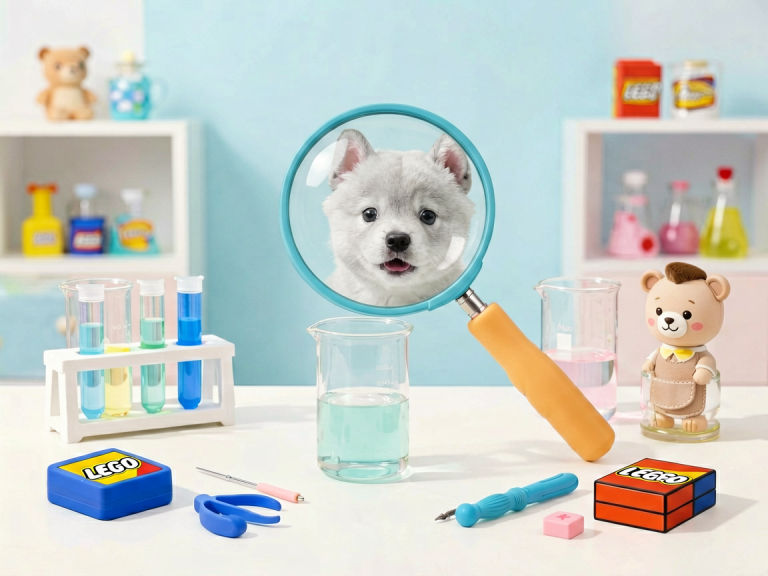
Technology for toddlers does not have to mean screens. A large, sturdy magnifying glass with a handle is a fantastic piece of scientific equipment. Go outside with your toddler girl and look at leaves, a patch of grass, the bark of a tree, or an ant. Let her hold the magnifying glass and move it closer and farther. She will be amazed at how the world looks bigger and more detailed. Talk about what you see: “Look! The leaf has tiny lines. Those are like its veins.” This activity develops observation skills and introduces the idea that tools can help us see things our eyes alone cannot. It also connects her to nature, which is the original laboratory.
Light and Shadow Play
On a sunny day, use a flashlight in a dim room or go outside when the sun is low. Make shadow puppets with your hands or use a toy to cast shadows on a wall or the ground. Let your toddler girl try to catch the shadow or make it disappear by moving the toy. Explain, “The light is blocked by the toy, so the shadow appears.” You can also trace shadows with chalk on the sidewalk and come back later to see how they have moved. This introduces basic principles of light, optics, and the movement of the sun. It also sparks wonder: where does the shadow go when the light is turned off?
Exploring Sound with Homemade Shakers
Create simple sound-making instruments by filling small, sealed plastic bottles or containers with different materials: rice, dry beans, pasta, bells, or sand. Let your toddler girl shake each one and listen to the different sounds. Ask her which one is loud, which is soft, which sounds like rain, which sounds like a drum. This is an introduction to the physics of sound (vibration) and also a great sensory activity. You can also tap different objects (a wooden spoon on a pot, a plastic cup on a table) and compare the sounds. This builds auditory discrimination and a sense of rhythm—both important for cognitive development.
Math in Everyday Life
Sorting and Classifying with Nature Treasures
Take a short walk with your toddler girl and collect small natural objects: leaves, acorns, pebbles, flowers, pinecones. Bring them home and spread them on a tray. Then ask her to sort them into groups: all the rocks together, all the leaves together, or all the big things together, all the small things together. You can also sort by color, shape, or texture. This is the foundation of mathematical thinking: classification, comparison, and sets. Use language like “same,” “different,” “more,” “less,” and “belongs.” These words build number sense before any formal counting happens.
Counting Steps, Snacks, and Stairs
Math is everywhere in a toddler’s daily routine. Count the steps as you climb the stairs: “One, two, three, four—we made it!” Count the crackers on her plate as you hand them to her. Count her fingers and toes during diaper changes. Sing counting songs like “Five Little Ducks” or “One, Two, Buckle My Shoe.” The goal is not for her to memorize numbers, but to hear the rhythm and pattern of counting. This builds the auditory foundation for numeracy. When she sees you counting, she learns that numbers have meaning and that math is part of everyday life.
Pattern Play with Colored Beads or Buttons
Give your toddler girl a few large, safe beads or colored buttons (supervise to avoid choking hazards) and a string or a piece of yarn. Show her a simple pattern: red, blue, red, blue. Let her try to copy the pattern, or just let her string them randomly. Even if she cannot replicate the pattern, the act of comparing colors and arranging them in sequence builds pattern recognition—a key early math skill. You can also create patterns with stickers on paper or with a row of toys. Point out patterns in nature, too: the stripes on a zebra, the spots on a ladybug, the repeating shape of a honeycomb.
Tips for Successful STEM Time with Toddlers
- Follow her lead. If she is more interested in pouring water than in watching the ice melt, let her pour. The learning happens in her own exploration, not in your agenda.
- Keep it short and sweet. Toddler attention spans are brief—ten to fifteen minutes is plenty. Stop before she gets frustrated or bored, and come back to the activity another day.
- Embrace mess. Science is messy. Lay down a plastic tablecloth, dress her in washable clothes, and accept that water will spill and cornstarch will get on the floor. The joy of learning outweighs the cleanup.
- Use rich language. Describe what you see, what she is doing, and what is happening. Even if she cannot talk back yet, she is absorbing vocabulary that will later become part of her thinking.
- Praise effort, not outcome. Instead of saying “Good job—your tower didn’t fall!” say, “You tried so hard to balance that block. I like how you kept going even when it wobbled.” This builds a growth mindset.
- Include dolls in STEM play. Let her teddy bear “help” with the experiment, or build a ramp for the doll to slide down. This integrates STEM with her imaginative world and reinforces that anyone can be a scientist.
Conclusion
STEM for toddler girls is not about pushing academics early or turning every moment into a lesson. It is about honoring the way young children naturally learn—through hands-on, sensory, joyful exploration. When we give a toddler girl the chance to mix colors, build a wobbly tower, or watch a leaf float in a puddle, we are giving her permission to ask questions, make mistakes, and feel proud of her discoveries. These simple activities plant the seeds of confidence, curiosity, and competence that will grow into a lifelong love of learning. And perhaps most importantly, they tell her, in the most concrete way possible, that science is for her. So go ahead—fill that tub with water, set up that ramp, and watch your little scientist bloom. The world is her laboratory, and she is ready to explore it.