Joyful Indoor Play: Engaging Activities for Babies to Boost Development and Bonding
Introduction: Why Indoor Play Matters for Babies
In the early months and years of life, a baby’s brain is developing at an astonishing pace. Every sight, sound, touch, and movement helps shape neural connections that form the foundation for learning, language, and social skills. While outdoor adventures are wonderful, many parents find themselves spending significant time indoors — whether due to weather, safety concerns, or simply the demands of daily life. The good news is that the home environment offers a rich landscape for purposeful play. Indoor play activities for babies are not just about keeping them occupied; they are essential opportunities for sensory exploration, motor development, and emotional bonding. This article presents a variety of carefully designed indoor play ideas, organized by developmental focus, that require minimal equipment but deliver maximum benefit. Each activity is safe, age-appropriate, and can be adapted as your baby grows. Remember: the best play is guided by your baby’s cues — follow their lead, and let curiosity be the compass.
1. Sensory Play: Awakening the Senses in a Safe Space
Sensory play is any activity that stimulates a baby’s senses: touch, sight, sound, smell, and even taste (with appropriate supervision). Babies are natural scientists, and indoor environments can easily become sensory laboratories.
1.1 Texture Treasure Baskets
One of the simplest yet most effective sensory activities is a treasure basket filled with everyday household objects that offer different textures. Line a sturdy basket or a shallow box with a soft cloth, then add items such as a clean wooden spoon, a soft silk scarf, a crinkly piece of paper, a smooth stone (large enough not to be swallowed), a rubber spatula, and a small towel. Let your baby sit on a mat or in a high chair (with you right beside them) and explore freely. They will grasp, mouth, shake, and drop each item, learning about weight, texture, and cause and effect. Rotate the objects weekly to maintain novelty. This activity supports fine motor skills and cognitive development through open-ended exploration.
1.2 Water Play in the High Chair
Water play can be done indoors with minimal mess — simply place a shallow plastic tray or a large baking dish on the high chair tray (or use a special water-play table). Add a few inches of lukewarm water and safe toys like plastic cups, floating ducks, or a small sieve. For babies who are not yet sitting independently, you can hold them on your lap near a bowl of water, always keeping a firm grip. The sensation of water on their hands, the splashing sounds, and the motion of floating objects provide rich sensory input. To extend the activity, add a few drops of food coloring (only if baby won’t ingest the water) or float a piece of ice for a temperature surprise. Always supervise water play closely — never leave a baby unattended near water, even a small amount.
1.3 Homemade Sensory Bags
For a mess-free sensory experience, create sealed sensory bags. Fill a sturdy zip-top freezer bag with a handful of hair gel, a few drops of food coloring, and small objects like buttons, glitter, or plastic beads (sealed tightly). Tape the bag to the floor or a low table so baby can press, pat, and squish the contents without getting messy. The gel provides a fascinating resistance, and the moving objects inside capture visual attention. This is especially good for babies who are in the mouthing stage, as the bag prevents ingestion. You can also make a “rainbow bag” by dividing the gel into smaller bags inside one large bag for extra visual complexity.
2. Gross Motor Play: Building Strength and Coordination Indoors
Gross motor skills involve the large muscles of the body — arms, legs, and torso. Indoor play can effectively support tummy time, rolling, crawling, and eventually walking.
2.1 Obstacle Course with Soft Pillows
Clear a space on the living room floor and create a simple obstacle course using cushions, pillows, rolled blankets, and soft toys. For a baby who is learning to crawl, arrange pillows in a line to create a gentle “mountain” to climb over. Place a favorite toy just out of reach on the other side to encourage forward movement. For younger babies (2–4 months), lay them on their tummy on a soft but firm surface and place a low, safe mirror in front of them — babies love looking at their own reflection, which motivates them to lift their head and push up with their arms. Older babies who are pulling to stand can use a sturdy couch or low table (with padding) as a support. Always check that no sharp corners or tripping hazards exist.
2.2 Rolling Games
From about 3 months onward, babies begin to roll from tummy to back and vice versa. Encourage this milestone by placing your baby on a soft blanket on the floor. Lie down beside them and gently guide their hips to show them how to roll over. Sing a simple song like “Roll, roll, roll your baby” as you demonstrate. You can also place a brightly colored toy slightly to their side to entice them to reach and roll. Once they master rolling, you can help them practice rolling across the floor — lay them on their back and gently encourage a log roll (keeping arms overhead) on a padded surface. This builds core strength and body awareness.
2.3 Dance Party for Movement
Put on some upbeat, child-friendly music (or even classical tunes) and hold your baby securely while you sway, bounce, and twirl gently. This activity helps develop vestibular sense (balance) and provides rhythmic stimulation. For babies who can sit with support, place them in your lap and bounce to the beat. For older babies who are standing with assistance, encourage them to “dance” by shifting weight from leg to leg. The key is to keep movements slow and controlled — no vigorous shaking. Use a soft rug to prevent slips. Dance parties also strengthen the parent-child bond through eye contact, smiling, and shared joy.
3. Fine Motor and Cognitive Play: Small Hands, Big Discoveries
While gross motor gets babies moving, fine motor activities refine the small muscles in hands and fingers, crucial for tasks like grasping, pointing, and eventually self-feeding.
3.1 Container Play (Fill and Dump)
Babies are fascinated by the concept of object permanence — things still exist even when hidden. Provide a collection of small, safe containers (plastic yogurt cups, empty cardboard tubes, large plastic bottles with lids removed) and a basket of toys that are too large to swallow (like wooden blocks, large pom-poms, or plastic eggs). Show your baby how to drop items into a container, then dump them out. This simple activity teaches cause and effect (dropping makes a sound), hand-eye coordination, and spatial awareness. Start with one container and one object, then increase complexity. For safety, avoid anything small enough to fit through a toilet paper tube (a common choking hazard guideline). Always supervise mouthing.
3.2 Stacking and Nesting
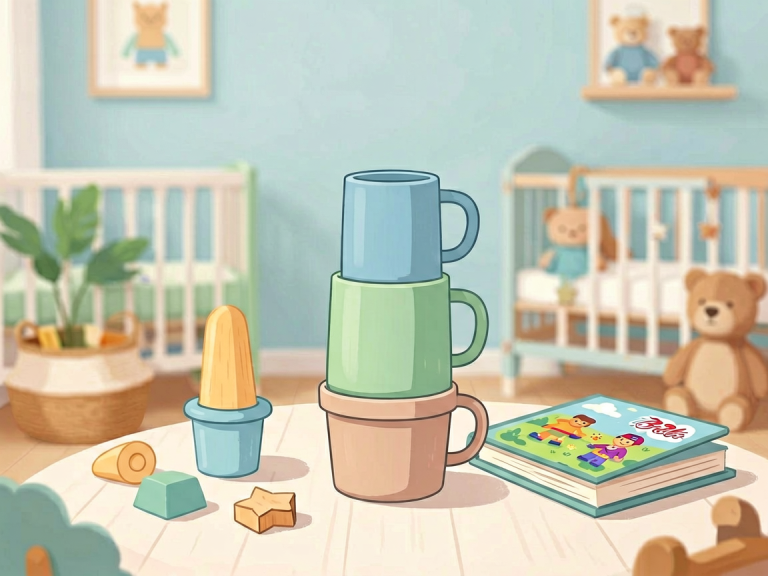
Stacking cups or rings are classic indoor toys for a reason — they offer layered developmental challenges. For a baby around 6–9 months, simply placing a ring over a post requires precise visual and motor skills. Begin with a single large ring on a stable base and let your baby try. Don’t worry if they knock it over — the knocking itself is learning. Soft fabric blocks are also excellent for stacking. They provide a safe, squeezable alternative for younger babies who might throw or mouth wooden blocks. Nesting cups (cups that fit inside one another) teach size relationships. Show your baby how to place a smaller cup inside a larger one, then dump them out. Expect repetition — babies thrive on repeated practice.
3.3 Fabric and Ribbon Pull Toys
Create a simple “pull box” using a small cardboard box with a hole cut in the lid. Thread a long piece of ribbon or a fabric strip through the hole and tie a knot on the inside so it won’t pull through completely. Let your baby grab the ribbon and pull — they will be delighted to see more ribbon appear (if you feed it through slowly behind the box). This activity strengthens hand grip and introduces the concept of tracking and object permanence. For extra fun, attach a small rattle or soft toy to the end of the ribbon. Always use short ribbons (less than 12 inches) to prevent any strangulation risk, and supervise closely.
4. Language and Social Play: Turning Sounds into Connection
Even before they can speak, babies are absorbing language and social cues. Indoor play is a perfect time for back-and-forth “conversations,” songs, and interactive games.
4.1 Peek-a-Boo and Face Games
Peek-a-boo is not just a silly game — it teaches babies that people and objects can disappear and reappear, building object permanence and reducing separation anxiety. You can play with your hands, a scarf, or a blanket. Vary the game by hiding your face behind a pillow, then reappearing with a big smile and a different expression. For older babies, hide a toy under a cup and lift the cup with an excited “Peek!” Let your baby lift the cup themselves when they can. This simple interaction encourages anticipation, memory, and social smiling.
4.2 Storytime with Touch
Reading to babies is vital for language development, but indoor play can make it even more engaging. Choose board books or cloth books with bright, high-contrast pictures and textures (furry patches, crinkly pages, mirrors). Sit your baby on your lap and let them touch the pages as you read. Use animated voices — change pitch for different characters, add sound effects (e.g., “Moo!” for a cow). Pause after each page to give your baby time to respond with coos, babbles, or pointing. Even if they don’t understand the words, they are learning turn-taking and vocabulary rhythm.
4.3 Singing and Finger Plays
Songs like “Itsy Bitsy Spider,” “Wheels on the Bus,” and “Pat-a-Cake” combine lyrics with hand motions. For babies, the hand motions are especially valuable. While singing “Pat-a-Cake,” gently guide your baby’s hands to clap together. For “Itsy Bitsy Spider,” show them the climbing motion with your fingers. These activities strengthen fine motor mimicry, listening skills, and emotional bonding through shared rhythm. Even a simple lullaby sung while holding your baby close releases oxytocin, the “bonding hormone,” making it a powerful indoor play activity.
5. Creating the Ideal Indoor Play Environment
To make the most of these activities, set up your indoor space intentionally. Choose a safe, clutter-free area with a soft play mat or carpet. Keep toys within reach but rotate them regularly to prevent boredom. Natural light is wonderful, but if you’re playing in the evening, warm, soft lighting will maintain a calm atmosphere. Always stay within arm’s reach of your baby, especially for any activity that involves small objects or movement. Tune in to your baby’s cues — if they lose interest or become fussy, switch activities or take a break for cuddles and quiet time. Remember, the goal is not perfection but connection and exploration.
Conclusion: The Magic of Simple Moments
Indoor play with your baby doesn’t require elaborate toys or scheduled “learning time.” The most powerful activities often spring from everyday objects and your own presence. A cardboard box, a wooden spoon, your voice — these are the tools of joyful discovery. As you incorporate these play ideas into your daily routine, you’ll notice your baby becoming more curious, more coordinated, and more engaged. More importantly, you’ll be building a foundation of trust and love that will carry through all the years ahead. So spread that blanket on the floor, turn on a soft smile, and let the indoor adventures begin.