Language Through Play: Toys That Build Vocabulary, Grammar, and Conversation in Preschoolers
Introduction
The preschool years—roughly ages 3 to 5—are a golden window for language development. During this period, children’s vocabularies explode from a few hundred words to over 2,000, they begin to form complex sentences, and they learn to use language for storytelling, reasoning, and social interaction. While everyday conversations with caregivers are irreplaceable, the toys children play with can serve as powerful catalysts for this linguistic growth. The right toys do more than entertain; they invite preschoolers to name objects, describe actions, negotiate roles, ask questions, and construct narratives. This article explores how thoughtfully chosen toys can build language skills and offers practical guidance for parents, educators, and caregivers looking to maximize each play experience.
—
The Language Milestones of Preschoolers
To understand which toys are most effective, it helps to first review the typical language achievements of a preschooler. At age 3, children are usually combining three to four words into simple sentences (“I want red ball”), asking “why” and “what” questions, and using plurals and past tense—though often incorrectly (“I runned fast”). By age 4, they can tell short stories, use conjunctions like “and” and “but,” and follow two‑step directions. By age 5, sentences become longer and more complex, they can define simple words, and they engage in extended conversations that include reasoning and predicting. Any toy that encourages a child to speak, listen, and respond at or slightly above their current level supports these milestones. Importantly, the toy itself is only one part of the equation; the social interaction surrounding it—the back‑and‑forth dialogue, the naming, the questioning—is where the real language growth happens.
—
Why Play Is the Perfect Vehicle for Language Learning
Play is intrinsically motivating. When a child is deeply engaged in a pretend scenario or a puzzle, they are naturally driven to communicate their intentions, seek help, and share excitement. This “want” to talk provides a low‑pressure context for practicing new words and sentence structures. Moreover, play is repetitive yet varied: a child might cook pretend soup dozens of times, each time learning new vocabulary for ingredients, utensils, and actions. Repetition solidifies neural pathways, while variation introduces flexibility. Play also offers immediate feedback—if a child says “I want the blue block” and receives it, they learn that language has real power. Finally, play is social; even solitary play often involves inner speech, and when joined by an adult or peer, it becomes a rich dialogue. Therefore, the most effective language‑building toys are those that spark imagination, require cooperation, and invite open‑ended conversation.
—
Pretend Play Toys: The Foundation of Narrative Language
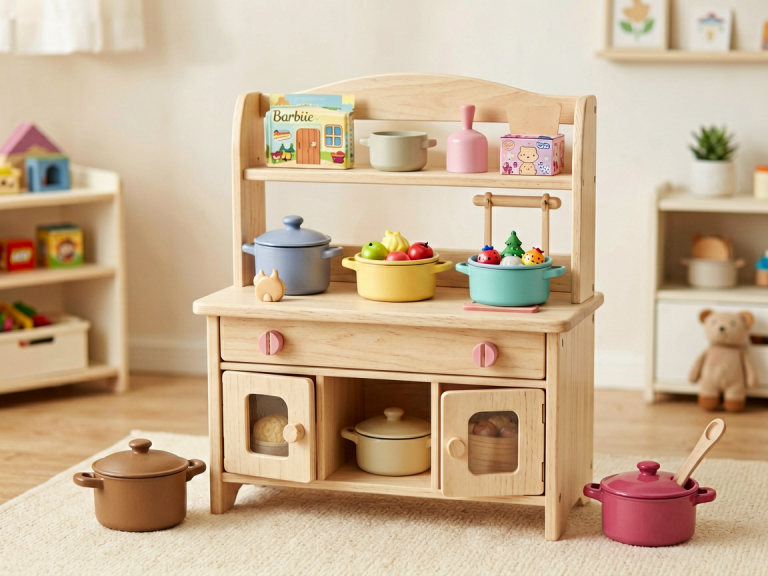
Nothing fuels language like a well‑stocked play kitchen, a dress‑up trunk, or a doctor’s kit. Pretend play toys encourage children to create entire worlds and assign roles—parent, chef, patient, teacher. In these scenarios, children must use language to set the scene (“We are in a restaurant now”), negotiate roles (“You be the mommy and I be the baby”), and describe actions (“I am stirring the soup with a big spoon”). Such play naturally elicits what linguists call “narrative language”: the ability to sequence events, use past and future tense, and build cause‑and‑effect relationships (“Because the baby is sick, I have to give her medicine”). Furthermore, pretend play often requires children to take on the perspective of others, which promotes the use of mental‑state verbs like “think,” “know,” and “feel.” To maximize these benefits, adults should join the play briefly, modeling rich vocabulary (“Let’s sauté the onions until they are golden brown”) and asking open‑ended questions (“What do you think will happen next?”). With time, the child internalizes these language structures and uses them independently.
—
Interactive Storytelling Tools: Puppets, Story Cubes, and Wordless Books
Puppets are remarkable language tools because they create a safe, playful distance between the child and the act of speaking. A shy preschooler who hesitates to talk directly may chatter freely when a puppet “talks” for them. Puppets invite dialogue: the child can ask the puppet questions, give it commands, or tell it a story. This back‑and‑forth mimics the turn‑taking of real conversation and helps develop pragmatic language skills, such as staying on topic and responding appropriately. Similarly, story cubes—dice with pictures on each face—are excellent for building expressive language. A child rolls the cubes, sees a house, a frog, and a rain cloud, and must invent a story connecting them. This exercise forces vocabulary retrieval, sequencing, and creative thinking. Wordless picture books function in the same way: without text to lean on, the child becomes the storyteller, describing each page in their own words. These tools push children to move beyond labeling (“That’s a dog”) into constructing full sentences and narratives (“The dog is running after a ball, and then he hides in the bush”). Adults can scaffold by asking, “What do you think the frog is thinking?” or “How does the story end?” This playful pressure to produce language dramatically accelerates growth.
—
Board Games and Card Games: Structured Social Language
Simple board games—such as Candy Land, Chutes and Ladders, or matching memory games—offer a built‑in structure that demands language use. To play, children must name objects (“I have a blue square!”), take turns verbally (“It’s my turn now”), describe actions (“I’m moving my piece up the purple path”), and react to outcomes (“Oh no, I slid down the chute!”). These games are particularly effective for teaching social language: please, thank you, your turn, my turn, good game. They also introduce vocabulary for prepositions (over, under, behind), colors, numbers, and comparative language (bigger, smaller, first, last). Card games like “Go Fish” require children to form complete questions (“Do you have a red circle?”) and respond politely (“Yes, I do. Here you go.”). For preschoolers, the simplicity of the rules frees up cognitive resources to focus on the language. Additionally, games often involve mild competition, which naturally elicits exclamations, negotiations, and even simple arguments—all rich language opportunities. To deepen the benefit, adults can narrate their own moves (“I’m going to draw a card and hope for a yellow one”) and encourage the child to explain their strategy, turning a game into a conversation.
—
Building and Construction Toys: Descriptive and Spatial Vocabulary
Blocks, magnetic tiles, Legos, and other construction toys are deceptively powerful for language development. As children build towers, bridges, and houses, they need words to describe shapes, sizes, positions, and functions. “I need a long red block on top of the two blue squares.” “This arch is too small for the tunnel.” “Let’s put the triangle roof here.” Such utterances require precise vocabulary (tall, short, curved, rectangular, above, beside, between). Construction play also invites planning and problem‑solving language: “If I put this heavy block here, the tower might fall. What should I do?” Children learn to hypothesize and justify their decisions. Furthermore, when building with others, they must coordinate actions and share materials, producing requests, suggestions, and disagreements: “Can I have that green piece?” “No, I need it for my spaceship.” “Okay, we can share.” This collaborative negotiation is a rich context for learning polite forms, compound sentences, and conditional language (“If you let me use that, then you can have this one later”). Adults can enhance learning by describing what the child is doing (“You’re balancing a curved block on two rectangular pillars”), asking open‑ended questions (“How could we make a doorway?”), and introducing new words naturally (“That’s a cantilever—it sticks out without support from below”).
—
Musical and Rhyming Toys: Phonological Awareness
Language development isn’t just about vocabulary and grammar; it also depends on phonological awareness—the ability to hear and manipulate sounds in words. This skill is a strong predictor of later reading success. Musical toys, including simple instruments like drums, shakers, and xylophones, encourage rhythm and sound discrimination. Singing songs with repetitive lyrics and rhymes (e.g., “Old MacDonald,” “Wheels on the Bus”) helps children notice that words are made up of smaller sound units. When they tap a drum to the syllables of their name (MA‑ry, SAM‑my), they are practicing syllable segmentation. Rhyming toys—such as puzzles that pair “cat” with “hat,” or games that ask “Find something that rhymes with ‘cake’”—directly train phonemic awareness. Even a simple plastic microphone can be used for echo games (“I say ‘mat,’ you say ‘sat’”). These activities are playful and engaging, and they build the foundational skills children need to decode written words later. Importantly, musical play also supports memory: songs and rhymes are easier to recall because of their rhythmic structure, so new words learned in a song often stick more readily than those encountered in isolation.
—
How to Maximize Language Growth Through Toy Play
While the toys themselves are valuable, adults play a crucial role in turning play into language‑learning opportunities. First, follow the child’s lead: if they are interested in the red truck, talk about the truck rather than redirecting to a flashcard. This increases engagement and motivation. Second, model expanded language: when a child says “Truck go,” you can respond “Yes, the big red truck is going very fast down the road.” This adds vocabulary and grammatical complexity without correcting or criticizing. Third, ask open‑ended questions that require more than a yes/no answer: “What do you think will happen if we add one more block?” “How does the puppet feel right now?” Fourth, create opportunities for repetition by keeping toys accessible and rotating them regularly; repeated play with the same toys deepens familiarity and allows language to become more sophisticated over time. Finally, encourage peer play when possible, as preschoolers learn a great deal from negotiating with each other, even if that negotiation sometimes leads to conflict—which itself requires words to resolve.
—
Conclusion
Toys are far more than distractions; they are the tools through which preschoolers build the architecture of language. From the imaginative dialogues sparked by a play kitchen to the sound‑play of a musical instrument, every well‑chosen toy can become a springboard for vocabulary expansion, sentence formation, storytelling, and social communication. The key is not to buy the most expensive or flashy toy, but to select ones that invite conversation, problem‑solving, and creativity. When combined with an engaged adult who listens, models, and asks thoughtful questions, these toys transform play into a powerful language‑learning engine. By investing in toys that talk—and talking about those toys—parents and educators give preschoolers the richest gift of all: the words to express themselves, connect with others, and navigate the world.