Math in the Making: Playful Activities to Foster Early Numeracy in Babies
—
Introduction
When most people think of early math, they picture flashcards, worksheets, or a stern teacher pointing at a chalkboard. Yet for babies—those tiny explorers who learn through every sense, every movement, and every loving interaction—mathematics begins long before formal instruction. From the moment an infant reaches for a rattle, they are engaging with fundamental concepts: size, shape, quantity, pattern, and space. Research in developmental psychology and early childhood education consistently shows that the foundations of mathematical thinking are laid in the first two years of life, and that the most powerful tool for building these foundations is not a curriculum but play.
Play is the language of infancy. It is how babies make sense of the world, test hypotheses, and build neural connections. When we intentionally design play activities that highlight mathematical ideas, we do not pressure or accelerate development; instead, we enrich the natural curiosity that every baby possesses. This article explores a variety of play-based activities that help babies from birth to 18 months build early math skills. Each activity is grounded in a specific mathematical concept, and all can be adapted to a child’s developmental stage. By weaving math into daily routines and joyful interactions, parents and caregivers can set the stage for a lifetime of confident, intuitive numeracy.
—
1. The Case for Early Math Play: Why It Matters
Before diving into activities, it is worth understanding why early math matters so much. Longitudinal studies, such as those from the National Institute of Child Health and Human Development, have found that early mathematical knowledge at kindergarten entry predicts later academic achievement in both math and reading—often more strongly than early literacy skills. But this does not mean we should push babies into counting drills. Instead, the optimal approach is to embed mathematical experiences into everyday play.
When a baby stacks blocks, they are exploring spatial reasoning and proportionality. When they shake a rattle and notice it makes a sound only when moved, they are grasping cause and effect and sequence. When they see a parent put three toys into a basket and then take two out, they are absorbing addition and subtraction at a concrete, sensory level. These early experiences build the brain’s number sense, which is the intuitive understanding of quantity and magnitude. And because a baby’s brain is so plastic, these playful encounters physically shape neural pathways that will support more abstract math later.
The term "early math" for babies does not mean equations or symbols. It means:
- Number sense: recognizing small quantities (one, two, three) and noticing changes.
- Geometry and spatial sense: understanding shapes, positions, and how objects fit together.
- Patterns and algebra: noticing repetitions, sequences, and rules.
- Measurement: comparing sizes, weights, and lengths.
- Data and logic: sorting, matching, and making predictions.
All of these can be learned through simple, joyful play.
—
2. Sensory Play and Quantity Concepts: From One to Many
Babies are born with an innate ability to distinguish between small quantities. Even newborns can tell the difference between one dot and two dots on a screen (in controlled experiments). However, this raw ability needs to be strengthened and connected to real-world objects. Sensory play—activities that engage touch, sight, sound, and sometimes taste—provides the perfect medium for building quantity concepts.
Activity: Treasure Baskets with Varied Counts
Fill a shallow basket or box with five to seven safe objects, such as wooden rings, soft cloth balls, plastic measuring spoons, and large buttons. Let the baby explore freely. As they handle each object, narrate what you see: “You picked up one ring. Now you have two—a ring and a spoon.” Later, remove one object and say, “Now there are only two. Where did the third one go?” This simple labeling helps the baby connect the spoken number word to the actual object. Over time, you can vary the number of items in the basket, always keeping the total between one and four, because that is the range babies can perceive intuitively.
Activity: Water Play with Containers
During bath time or a supervised water play session, provide a set of identical cups (e.g., three small plastic cups) of different colors. Fill them one by one, saying “one cup full, two cups full, three cups full.” Then pour the water from all three into a larger container and back again. Babies are fascinated by the transformation of quantity—the water looks different in different containers, but the amount stays the same. This is an early exploration of conservation of number (though they will not fully grasp it until preschool, the exposure matters).
Activity: Finger Counting Songs
Sing songs like “Five Little Ducks” or “This Old Man” while holding up fingers. Let the baby touch your fingers as you count. Even if they cannot speak, they are absorbing the one-to-one correspondence between the song’s objects and your digits. Encourage them to grasp one finger at a time. This builds the crucial concept of one-to-one correspondence, the understanding that each object corresponds to one number word.
—
3. Spatial Awareness Through Movement and Objects
Spatial reasoning—the ability to understand and remember the positions of objects in space—is a strong predictor of later mathematical achievement, especially in geometry and problem-solving. Babies naturally develop spatial awareness as they learn to reach, crawl, and eventually walk. Play activities that emphasize movements, positions, and relationships between objects directly strengthen this skill.
Activity: Tunnel and Obstacle Courses
Create a simple tunnel using a cardboard box with both ends open, or purchase a pop-up fabric tunnel. Encourage your baby to crawl through it. As they move from one side to the other, they experience concepts like inside, outside, through, and around. Place a soft toy at the far end and say, “The teddy is inside the tunnel. Can you crawl to him?” Later, put the toy on top of the tunnel and say it is above you. These directional words become part of their vocabulary of space.
Activity: Stacking and Nesting
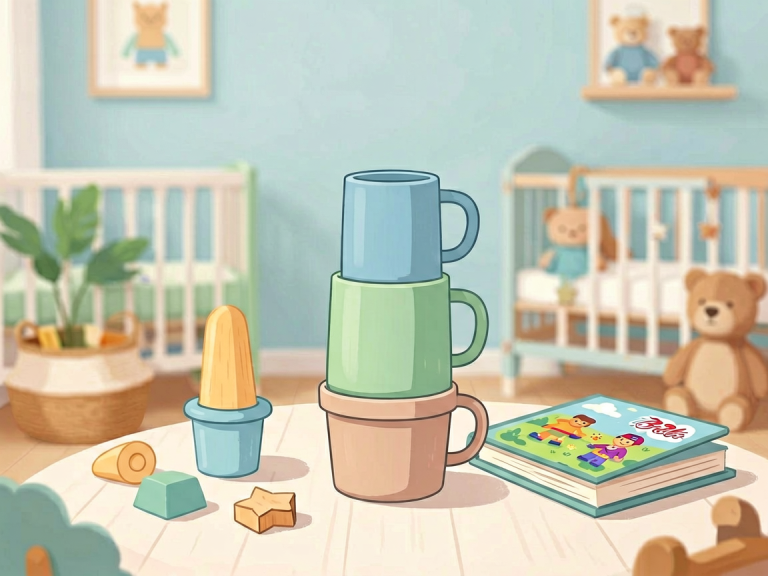
Stacking cups, rings, or blocks are classic toys for good reason. Provide a set of stacking cups that nest inside one another. Show the baby how a smaller cup fits inside a larger one. Then stack them from largest to smallest. Babies love the challenge of balancing a ring on a post—this requires fine motor control and an intuitive grasp of size order and alignment. Narrate your actions: “The big cup goes on the bottom. The medium cup goes on top. Now the little cup goes on the very top.” This introduces seriation (ordering by size).
Activity: Mirror Play and Positioning
Place a baby-safe mirror on the floor or wall. Let the baby look at their own reflection. Then move a toy behind them, above them, or to the side. Ask, “Where is the ball? Is it in front of you or behind you?” While the baby cannot answer verbally, they will turn to look. This helps them understand relative position—a building block for geometry. You can also lay the baby on their back and dangle a toy at different distances: close enough to grasp (near) and too far (far). Say the words “near” and “far” consistently.
—
4. Patterns and Sequences in Daily Routines
Pattern recognition is the heart of mathematical thinking. Babies notice patterns long before they can name them—they anticipate a parent’s face appearing after a game of peek-a-boo, or the sound of a spoon hitting a bowl before breakfast. We can capitalize on this natural pattern-sensing ability by making it explicit and varied.
Activity: Peek-a-Boo with a Twist
Peek-a-boo is perhaps the first game of pattern and prediction a baby ever plays. The sequence is simple: face hidden, pause, reveal. But you can vary the pattern to deepen mathematical learning. Try a 1-2-3 peek-a-boo: hide your face, then show it after saying “one… two… three!” Pause longer on different numbers. The baby will learn to anticipate the reveal after a specific count. Alternatively, hide your face behind a blanket, then behind a pillow, then behind your hands—each time a different “container,” but the same action sequence: hide, wait, reveal. This helps the baby abstract the pattern from the specific objects.
Activity: Clapping and Rhythm Games
Babies love rhythm. Clap a simple pattern: clap-clap-pause, clap-clap-pause. Then change it to clap-pause-clap-pause. Hold your baby’s hands and help them clap along. Use a drum or a box to tap patterns. You can even use your voice: “Ba-ba-boom, ba-ba-boom.” These rhythmic patterns are auditory sequences that lay the groundwork for algebraic thinking. Later, when a child encounters 2, 4, 6, 8, they will recall that they already know how to recognize and continue a pattern.
Activity: Routine Sequencing
Babies thrive on routines because they are predictable sequences. During diaper changes, say out loud: “First I take off your diaper. Second, I wipe. Third, I put on a new diaper. Fourth, we put your pants back on.” Use hand gestures for “first,” “second,” etc. After several repetitions, pause before the last step and see if the baby anticipates it (e.g., lifting their bottom). This builds an understanding of ordinal numbers and sequence. Similarly, during feeding, you can say, “First we put food on the spoon. Then we lift it. Then we eat. Then we swallow.”
—
5. Comparing and Sorting with Everyday Items
Comparison is a fundamental mathematical operation: bigger/smaller, more/less, heavier/lighter, same/different. Babies begin comparing objects visually and tactilely from around six months. Sorting—grouping objects by a shared attribute—is a precursor to classification and data analysis.
Activity: Natural Object Sorting
Gather a collection of safe natural objects such as pinecones, smooth stones, leaves, and acorns (always supervise to prevent choking). Provide a muffin tin or a divided tray. Show the baby how to put all the stones in one section and all the leaves in another. While they may not be able to sort accurately at first, the act of picking up and placing objects in different compartments develops one-to-one correspondence and classification. Narrate: “This leaf is smooth. This stone is rough. They are different.” If the baby tries to put a stone with the leaves, you can say, “Oh, that stone is not like the leaves. Let’s put it with the other stones.”
Activity: Toy Comparisons
Use two similar but different-sized toys, such as a large ball and a small ball. Hold them up side by side. Say, “This ball is big. This ball is small. Which one do you want?” Let the baby reach for one. Then offer two cups of water—one almost full, one half full—and let the baby splash in each. Comment on “more water” and “less water.” This builds comparative language and an intuitive sense of quantity.
Activity: Matching Pairs
Give the baby two identical objects, such as two socks of the same color, or two soft blocks. Show them that the blocks are the same: “Look, the blue block and the blue block are the same!” Then introduce a different color: “This one is red. It is different.” Over time, the baby will learn to match pairs by touch and sight. This is an early step toward understanding equality and inequality.
—
6. Language and Math: Talking About Numbers and Shapes
The words we use during play matter enormously. Even before babies can speak, they are building a receptive vocabulary. When we consistently use math-rich language—words like “more,” “less,” “circle,” “tall,” “short,” “first,” “last,” “all,” “none”—we are planting seeds that will bloom into formal understanding. A 2010 study by Susan Levine and colleagues at the University of Chicago found that the amount of math talk parents used with their children between 14 and 30 months predicted the children’s math knowledge at age 4. So talk, talk, talk—but in a natural, playful way.
Activity: Shape Hunt
Point out shapes in the environment: “Your plate is a circle. The window is a rectangle. That book is a square.” For older babies (12+ months), cut out simple shapes from colored paper and let them grasp them. Play a game of “find the circle” among a group of shapes. Even if they cannot say the word, they will learn to visually discriminate between shapes. Talk about the edges (straight vs. curved) and corners. This builds geometric vocabulary.
Activity: Counting Everything
Count steps as you walk: “One step, two steps, three steps… we’re at the door!” Count the number of crackers on the tray, the number of fingers on their hand, the number of toy cars they push. Use your finger to point at each item as you count, reinforcing one-to-one correspondence. When they drop a toy, say, “Now there is one less. You had three, and now you have two.” These simple statements, repeated hundreds of times, build the neural pathways for arithmetic.
Activity: “More” and “All Done”
During snack time, offer a few pieces of soft fruit. After the baby eats one, ask, “Do you want more?” Hold up one additional piece and say, “Look, one more. Now you have two.” When they finish, say, “All gone! There are zero left.” The concept of zero—the idea of having nothing—is surprisingly profound. Children often struggle with zero in elementary school because they have rarely heard it used. Use it naturally: “There are no more blocks in the basket. The basket is empty. Zero blocks.”
—
7. Conclusion: The Joy of Mathematical Play
Mathematics is not a foreign language to be translated into a baby’s world—it is already there, hiding in the rattle’s rhythm, the stacking cup’s height, the bath toy’s buoyancy. By approaching play with intention and delight, we do not “teach” math in a rigid sense; instead, we invite our babies to participate in a conversation that has been going on since the beginning of human invention. Every time a baby lifts a spoon to see how many peas fall off, they are experimenting with quantity and gravity. Every time they try to fit a square block into a round hole, they are testing shape and space. Our role is to notice, to name, and to celebrate.
The activities outlined in this article—sensory baskets, tunnels, patterning songs, sorting games, shape hunts, and countless everyday moments—are not a rigid curriculum but a menu of possibilities. Choose what feels natural for your child’s temperament and stage. Some babies will love the repetition of stacking cups; others will prefer the movement of a tunnel. All will benefit from the math-rich language you weave into each moment.
Perhaps the most important lesson is this: early math play should never feel like work. If a baby loses interest, follow their lead. If they want to dump the treasure basket on the floor instead of sorting it, let them—even dumping is a mathematical exploration of volume and gravity! The goal is not to produce a toddler who can count to a hundred, but to nurture a child who feels confident, curious, and joyful when encountering numbers, shapes, and patterns. That confidence, planted in the fertile soil of playful infancy, will grow into a sturdy tree of mathematical understanding.
So go ahead: sing a counting song while changing a diaper. Point out the round moon outside the window. Build a tower and let it crash. In each act of play, you are building a mind that will one day solve equations, design bridges, or simply enjoy the symmetry of a snowflake. And you are doing it with the most powerful tool in the universe: love, wrapped in laughter.