Nurturing Language Skills: Fun and Effective Activities for 3-Year-Olds
Introduction
At the age of three, children are like little sponges, absorbing language at an astonishing rate. Their vocabulary expands rapidly—from roughly 200 words at age two to over 1,000 words by age three—and they begin to form simple sentences, ask endless questions, and experiment with grammar. This critical window for language development offers parents and caregivers a golden opportunity to foster communication skills through playful, everyday interactions. While every child develops at their own pace, targeted activities can significantly boost vocabulary, sentence structure, listening comprehension, and social communication. The key is to make learning feel like play, not a chore. Below are seven categories of engaging, research-backed activities designed specifically for three-year-olds, each explained with practical tips on implementation and the specific language benefits they deliver.
—
1. Interactive Storytelling and Reading Aloud
Reading aloud is arguably the single most powerful activity for language development in early childhood, but for a three-year-old, passive listening is not enough. The magic happens when reading becomes an interactive dialogue. Choose picture books with repetitive phrases, rhymes, and vivid illustrations—classics like *Brown Bear, Brown Bear, What Do You See?* or *The Very Hungry Caterpillar* work wonderfully. While reading, pause frequently to ask open-ended questions: “What do you think will happen next?” “Why is the caterpillar so hungry?” “Can you point to the red apple?” Encourage your child to fill in the blanks of familiar lines: “Brown bear, brown bear, what do you ______?” This builds prediction skills, comprehension, and active recall.
Additionally, letting your child “read” the book to you—even if they only describe the pictures in their own words—promotes narrative thinking and vocabulary use. After finishing a story, act out key scenes with toys or simple costumes. For example, after *Goldilocks and the Three Bears*, you can use three bowls of different sizes and let your child retell the story through dramatic play. This multi-sensory approach reinforces new words (e.g., “porridge,” “too hot,” “just right”) and strengthens memory. Aim for at least 15–20 minutes of interactive reading daily, and revisit favorite books multiple times; repetition is how young children master language patterns.
—
2. Singing Songs and Nursery Rhymes
Music and language share deep neural connections, and singing is a joyful, low-pressure way to boost phonological awareness—the ability to hear and manipulate sounds in words, a foundational skill for later reading. Three-year-olds love rhyme, rhythm, and repetition. Classic nursery rhymes like “Twinkle, Twinkle, Little Star,” “Itsy Bitsy Spider,” and “Row, Row, Row Your Boat” teach syllable stress, intonation, and new vocabulary in a memorable package. Sing them slowly, exaggerating the sounds, and do the hand motions together. Adding actions (e.g., crawling fingers for the spider) connects words to physical movements, aiding comprehension.
To take it further, invent simple songs about daily routines—“This is the way we brush our teeth, brush our teeth, brush our teeth”—or change the lyrics of familiar tunes to include your child’s name. For example, sing “Old MacDonald” but replace animals with people your child knows: “And on his farm he had a Grandma… E-I-E-I-O.” This playful substitution encourages creative language use and flexible thinking. Clapping to the beat of syllables (e.g., “el-e-phant” with three claps) builds phonemic awareness. Even off-key singing is beneficial—the exposure to rich phonetic patterns and the emotional bonding of shared music make it a powerful language tool.
—
3. Engaging in Pretend Play (Dramatic Play)
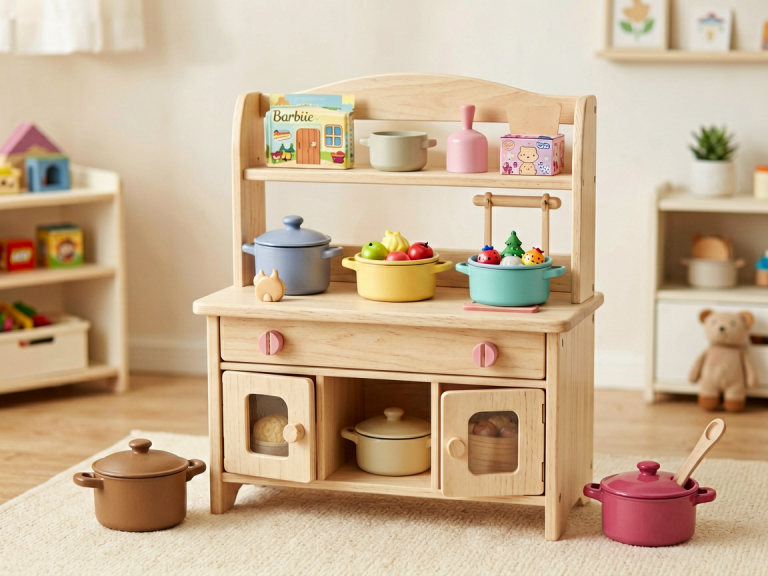
Pretend play is the ultimate language laboratory for a three-year-old. When children take on roles—doctor, chef, parent, superhero—they naturally produce language that is more complex and context-rich than in ordinary conversation. Set up a simple play corner: a toy kitchen with plastic fruits and pans, a doctor’s kit with a stethoscope and bandages, or a “grocery store” with empty boxes and a play cash register. As you join the play, take on a supporting role and model appropriate language: “Good morning, Chef! What are you cooking today? I’d like to order a pizza with extra cheese, please.” Then wait for your child to respond, allowing them to formulate their own sentences.
Use open-ended prompts to stretch vocabulary. Instead of saying “Pour the tea,” say “What kind of tea are you serving? Is it hot or cold? What does it smell like?” This encourages descriptive language and problem-solving. After the play session, ask your child to tell you a story about what happened: “Tell me about your trip to the store. Who did you see? What did you buy?” Retelling experiences—even imaginary ones—helps children organize thoughts into narrative sequences, using words like “first,” “then,” and “finally.” Pretend play also naturally teaches social language such as taking turns, asking politely, and negotiating roles, all of which are crucial for real-world communication.
—
4. Conversational Exchanges and Questioning
Three-year-olds are famously curious, often asking “Why?” a hundred times a day. Instead of brushing off their questions, turn these moments into rich language-building opportunities. When they ask “Why is the sky blue?” you don’t need to explain atmospheric physics; simply say, “That’s a great question! The sky looks blue because the sunlight is playing with the air. What color is the sky at night?” This not only answers their query but also keeps the conversation flowing, exposing them to new words like “sunlight” and “color.” Use the “serve and return” technique: when your child says something, respond by building on it. If they say, “Dog run,” you say, “Yes, the big brown dog is running fast! Where do you think he is going?” This expands their utterance from two words to a full sentence without correcting them.
During mealtime, car rides, or bath time, practice “dialogic” conversation: describe what you are doing (“I am peeling this orange. It feels bumpy and smells sweet. Can you say ‘orange’?”) and ask questions that require more than a yes/no answer: “What was your favorite part of the playground today?” “If you could be any animal, what would you be and why?” For three-year-olds who may struggle to answer, offer choices: “Do you want to wear the red shirt or the blue shirt? Tell me which one.” This empowers them to use their words to make decisions. Over time, these everyday dialogues build vocabulary, sentence length, and confidence in self-expression.
—
5. Word Games and Simple Puzzles
Structured games make language learning concrete and goal-oriented. Start with simple “I Spy” using colors, shapes, or initial sounds: “I spy with my little eye… something that is red! Can you find it?” This sharpens listening skills and reinforces attribute vocabulary. After your child finds the red block, ask them to find something that starts with the “b” sound (ball, book, banana). For many three-year-olds, phonemic awareness is just emerging, so focus on the initial sound rather than perfect pronunciation.
Memory card games with pictures (e.g., matching animals or common objects) also boost language. As your child flips a card, have them name the item aloud: “A cat! I see a cat.” If they match two cats, encourage a short sentence: “I found two cats!” Another favorite is “What’s Missing?” Lay out three to five toys, name each one, then have your child close their eyes while you hide one. They must say which item is gone, prompting recall and vocabulary retrieval. For a more advanced twist, add simple riddles: “I’m thinking of an animal that says ‘moo’ and gives us milk. What is it?” These games are short—5-10 minutes—but highly effective for focused language practice, and they teach turn-taking and patience as well.
—
6. Art and Craft Activities with Verbal Descriptions
Hands-on creative activities naturally invite descriptive language. Provide crayons, finger paints, playdough, or collage materials, and as you work together, narrate the process: “I am rolling the playdough into a long snake. Now I’m flattening it with my hand. What are you making?” Encourage your child to label colors, shapes, textures, and actions: “I made a red circle! It’s squishy.” For a more structured activity, make a simple “feeling book” by gluing different textured materials (cotton balls for soft, sandpaper for rough, foil for shiny) onto paper. As you touch each one, introduce the corresponding word and have your child repeat it.
After completing a picture or sculpture, ask your child to tell you a story about their creation. “Tell me about your painting. Who lives in that big purple house? What is the yellow squiggle?” This promotes narrative thinking and allows you to introduce new vocabulary in context (e.g., “squiggle,” “tower,” “rainbow”). Even cutting with safety scissors or tearing paper helps develop fine motor skills that are linked to the brain’s language centers. Keep the focus on process, not product—praise effort and description: “Wow, you used so many colors! Can you tell me about this blue part?” This positive reinforcement makes language feel rewarding.
—
7. Outdoor Exploration and Vocabulary Building
The natural world is a boundless source of novel vocabulary. Take regular walks in the park, backyard, or even around the block. Point out and name everything you see: “Look at the fluffy white cloud. That is a squirrel—it has a bushy tail. Hear the birds chirping? That sound is called a ‘tweet.’” Encourage your child to touch (safe) objects: leaves, bark, grass, stones. Describe the sensations: “The bark feels rough. The leaf is smooth and has veins.” This multi-sensory input anchors new words deeply.
Turn outdoor time into a scavenger hunt. Give your child a simple list (or a picture list) of things to find: “Find something yellow, something round, something that flies.” When they spot each item, have them say the word or a short phrase: “I found a yellow flower!” At the playground, describe actions: “You are going up the ladder. Now you are sliding down fast!” Use positional words like “under,” “over,” “behind,” “through” as your child navigates the equipment. Even a simple game of hide-and-seek involves calling out names and asking “Where is Mommy? I found you behind the tree!” Outdoor exploration naturally creates meaningful contexts for learning size words (big/small), location words, animal names, and weather vocabulary—all while getting fresh air and exercise.
—
Conclusion
Language development for a three-year-old does not require expensive toys or formal lessons. Instead, it thrives on everyday interactions infused with warmth, repetition, and play. The activities outlined above—interactive reading, singing, pretend play, conversations, word games, art, and outdoor exploration—all share common elements: they are child-led, engaging, and embedded in real-life contexts. By weaving language-rich moments into daily routines, you are not only building vocabulary and grammar but also nurturing a love for communication that will serve your child for a lifetime. Remember to listen actively, respond with enthusiasm, and let your child set the pace. Every silly song, made-up story, and messy craft is a building block for a confident, articulate speaker. So go ahead—read one more book, sing one more round of “Wheels on the Bus,” and ask one more “What do you think?” Your three-year-old’s thriving language journey starts right here, in the ordinary magic of your shared time.