The Ultimate Parent’s Guide to Language Toys: Playful Pathways to Early Communication
As a parent, you have likely witnessed the magic of your child’s first words—how a simple “mama” or “dada” can fill a room with joy. But language development is far more than a milestone to celebrate; it is the foundation upon which all future learning, social connection, and emotional expression is built. In today’s toy-filled world, it can be overwhelming to decide which playthings truly nurture that growth. Not every brightly colored box labeled “educational” delivers on its promise. This comprehensive guide will walk you through the science, the strategies, and the smart choices that turn playtime into a powerful language laboratory. From newborns babbling to preschoolers telling stories, the right language toys can spark curiosity, build vocabulary, and strengthen the parent-child bond—all while feeling like pure fun.
Understanding the Role of Language Toys in Development
Before diving into specific toys, it is essential to grasp what makes a toy genuinely “language-friendly.” Language development is not a passive process; it requires interaction, repetition, and meaningful context. A language toy should encourage your child to listen, imitate, respond, and eventually initiate communication. It should also invite you, the parent, to participate—because the most powerful language tool in any home is a caring adult who talks, reads, and plays with intention.
Language toys work on multiple levels. They can introduce new words (nouns, verbs, adjectives), model sentence structures, teach turn-taking in conversation, and even develop pre-literacy skills like phonemic awareness (the ability to hear and manipulate sounds). For infants, toys that produce varied sounds or have contrasting textures stimulate auditory and tactile processing, which primes the brain for language. For toddlers, toys that require naming, matching, or simple commands build receptive language (what they understand) and expressive language (what they say). For preschoolers, toys that encourage storytelling, rhyming, or problem-solving expand their narrative abilities and syntactic complexity.
The key is to choose toys that are developmentally appropriate and, most importantly, that invite back-and-forth interaction. A toy that simply flashes lights or recites letters in isolation—without any need for the child to respond—may entertain but does little to foster real communication. Similarly, toys that are too advanced can frustrate a child, leading to disengagement rather than learning.
Language Toys by Age: From Babbling to Brilliant Conversations
6–12 Months: Sensory Exploration and Sound Play
During the first year, babies are busy building the neural pathways that will later support language. They are attuned to the melody of speech—the rhythm, pitch, and intonation—long before they understand individual words. Toys that offer gentle auditory stimulation and encourage cause-and-effect hold the most value.
Look for soft rattles with different sounds, crinkle books, and simple musical instruments like shakers or a xylophone. Board books with high-contrast images and single words per page (such as “ball” or “cat”) are excellent, especially when you read them aloud with exaggerated expression. Mirrors are also surprisingly powerful: when a baby sees their own reflection and hears you say “baby,” they begin to connect the word with an image. Avoid electronic toys that produce loud, constant noise; instead, opt for items that respond to your baby’s actions, such as a pull cord that activates a gentle chime. The goal here is not vocabulary acquisition but rather building a foundation of listening, attention, and social turn-taking (e.g., you shake the rattle, baby shakes, you shake again).
12–24 Months: First Words and Early Vocabulary Explosion
The toddler years are a burst of linguistic growth. A child typically says their first word around 12 months and may have a vocabulary of 50 or more words by age two. During this phase, toys that name objects, actions, and attributes become invaluable. Realistic animal figures, fruit baskets, and vehicle sets encourage labeling (“dog,” “car,” “apple”). Simple puzzles with large knobs and pictures underneath each piece help link words to images.
Picture books remain a staple, but now you can introduce books with flaps to lift, textures to touch, and simple storylines. Interactive toys that “talk back”—such as a toy phone that says “hello” or a farm set that plays animal sounds—are engaging, but use them as a springboard for your own dialogue. When the cow says “moo,” you can say, “Yes, the cow says moo! What does the pig say?” This turns a passive experience into an active conversation. Flashcards can be useful, but only if used playfully—hide them in a sensory bin or tape them around the room for a scavenger hunt rather than drilling.
Avoid toys that only produce speech without requiring any response from the child. A tablet app that simply repeats the alphabet may be entertaining, but it does not teach the child to *use* language in a social context. Far better is a simple set of puppets: you can make the puppet “talk” to your child, ask questions, and wait for an answer. Even if your toddler only babbles or points, the turn-taking practice is invaluable.
2–3 Years: Sentences, Questions, and the Power of Storytelling
By age two, children begin combining two or three words into simple sentences (“more milk,” “daddy go”). Between two and three, they start asking “why” and “what,” and their imagination takes flight. This is the golden age for pretend play and more structured language activities.
Dress-up costumes, play kitchens, tool sets, and doctor kits all provide rich contexts for using language. When your child pretends to cook you a meal, they can name ingredients, describe actions (“I am stirring the soup”), and negotiate roles (“You be the baby, I be the mommy”). This spontaneous dialogue is far more beneficial than any drill. I also recommend story sequencing cards—simple sets of three or four cards that show a sequence (a baby waking up, eating breakfast, going out). Ask your child to arrange them and tell you what happens next. This builds narrative skills and the ability to use time-related words like “first,” “then,” and “after.”
Musical toys that involve singing and rhyming—such as a toy microphone or a simple drum for keeping a beat—support phonological awareness. Singing nursery rhymes together, even if you are off-key, exposes your child to the patterns of language. Electronic storybooks that highlight words as they are read can be useful for pre-reading, but again, they should supplement—not replace—the human reader. Your lap, your voice, and your questions (“What do you think will happen next?”) are irreplaceable.
3–5 Years: Advanced Language, Literacy Awareness, and Social Communication
Preschoolers are capable of complex sentences, telling simple stories, and understanding jokes. They also begin to recognize letters and sounds, a skill called phonemic awareness that is a strong predictor of later reading success. Language toys at this stage should challenge them to think about language itself.
Alphabet puzzles, magnetic letters, and letter-matching games help build letter recognition. Word-building toys that allow children to snap together letters to form simple words (like “cat” or “dog”) are excellent. However, avoid pushing direct reading too early—many children are not ready until age five or six. Instead, focus on playful exposure. Rhyming games (e.g., “I spy something that rhymes with ‘hat’”) are fun and developmentally perfect.
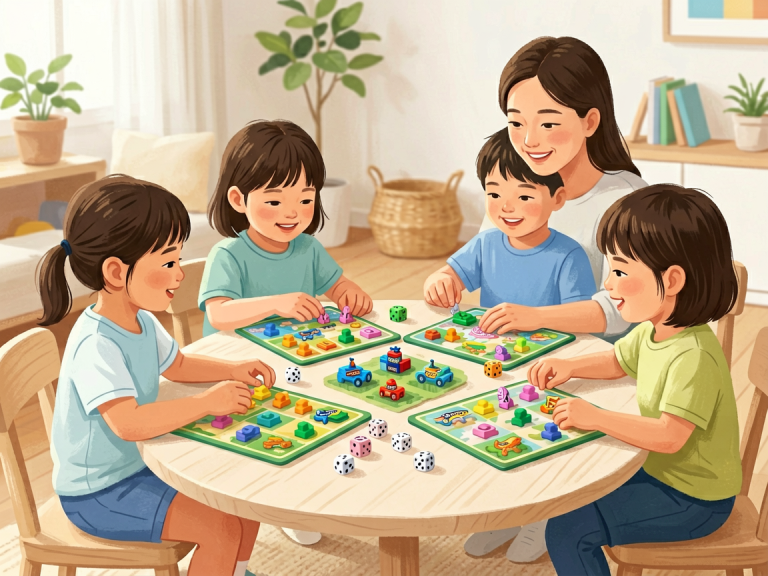
Board games that require taking turns, following instructions, and describing pictures (such as a simple version of “Guess Who?” or “Go Fish” with picture cards) promote social language. Puppets and dollhouses remain powerful, but now your child can create elaborate storylines, using past tense and connecting ideas (“The bunny was sad because he lost his carrot”). Storytelling cards or dice with pictures (a castle, a dragon, a princess) can inspire oral stories.
Electronic toys that record and play back your child’s voice, or that allow them to follow verbal directions in a game, offer a new layer of interactivity. But always remember: the best language learning happens when the toy serves as a prop for conversation between you and your child. No device can replace your facial expressions, your laughter, or the moment you pause to let your child finish a thought.
How to Choose Quality Language Toys: A Practical Checklist
With so many products on the market, it is easy to be seduced by flashy packaging or bold claims. Use this checklist to evaluate any potential language toy before you buy.
1. Does it invite interaction? A quality language toy requires your child to do something—press, pull, speak, match, or respond. A toy that merely entertains passively (e.g., a video that plays automatically) is not a language toy; it is a distraction.
2. Is it developmentally appropriate? A toy that is too hard leads to frustration; one that is too easy leads to boredom. Check the age recommendation, but also observe your child’s current abilities. If they cannot yet turn pages, a delicate paper book will be a source of tears, not words.
3. Does it encourage open-ended play? Toys that have one correct way to use them are less valuable than those that allow creativity. A set of wooden blocks can become a house, a rocket, or a castle—and each scenario sparks different language. The same is true for a simple ball: you can roll it, bounce it, name colors, practice “in” and “out,” and so on.
4. Is it durable and safe? Language toys will be chewed, dropped, and thrown. Avoid small parts for children under three. Choose materials that are easy to clean. If a toy makes electronic sounds, make sure the volume is not too loud (or better yet, look for one with a volume control button).
5. Does it support parent-child interaction or replace it? The best language toys come with a caregiver manual—not literally, but conceptually. They should prompt you to join in. A talking doll that only recites pre-recorded phrases may be fun for a few minutes, but a simple doll that you and your child talk *about* will yield far more meaningful language growth.
Integrating Language Toys into Daily Routines
Even the most carefully chosen toys lose their magic if they are used in isolation. Language development thrives on context and repetition, so weave toy play into your everyday moments. Keep a small basket of language-friendly toys in the car for errands. Place a few board books in the diaper-changing station so your baby can look at pictures while you narrate what you are doing (“Now I’m putting on your socks! Socks are soft.”). Use a simple puppet to help your toddler brush their teeth (“Mr. Frog says open wide so I can scrub those pearly whites!”).
Limit screen time and avoid using tablets or phones as language toys for children under two, according to the American Academy of Pediatrics. Even for older children, co-viewing and discussing what you see is far more effective than solo consumption. When you do use an app, choose one that requires your child to respond—such as one where they have to tap the correct picture after hearing a word—and sit with them to ask questions.
Finally, remember that the most important “language toy” in your home is you. Your voice, your attention, and your willingness to follow your child’s lead are more powerful than any product. The toy is simply a tool—a convenient excuse to laugh, to wonder, to name the world together. So choose wisely, play wholeheartedly, and trust that every conversation, no matter how small, is a building block for a lifetime of communication.
Conclusion: Play Is the Work of Language
Language toys are not a shortcut to genius; they are a joyful invitation to connect. When you hand your child a colorful rattle, you are not just giving them something to shake—you are setting the stage for a game of peek-a-boo, for naming the sound, for imitating the rhythm. When you pull out a set of farm animals, you are opening a door to “moo,” “baa,” and eventually “the cow is eating grass in the sunny field.” Every toy, chosen mindfully and paired with your warm interaction, becomes a stepping stone on the path from babble to book.
Trust your instincts as a parent. You know what makes your child smile, what makes them curious, what makes them want to talk. Use this guide as a compass, not a rulebook. Let your child lead the play, and let the language flow naturally. In the end, the greatest gift you can give is not a toy at all—it is the time you spend in conversation with your child, one word, one laugh, one story at a time.