Unlocking Imagination: The Best Toys for Creativity in 4-Year-Olds
Introduction: The Magic Age of Discovery
At four years old, children stand at a remarkable crossroads of development. Their language skills are blossoming, their motor coordination is becoming increasingly refined, and—most importantly—their imagination is running wild. This is the age when a cardboard box can become a spaceship, a blanket can transform into a castle, and a simple stick can morph into a magic wand. Parents and educators alike understand that nurturing this innate creativity is not just about fun; it is about building the cognitive flexibility, problem-solving abilities, and emotional intelligence that will serve children for a lifetime. But in a world saturated with flashing screens and pre-programmed toys, how do we choose objects that truly spark original thinking rather than passive consumption? The answer lies in selecting toys that are open-ended, multi-sensory, and responsive to a child's own decisions. Below, we explore the best categories of toys that fuel creativity in four-year-olds, each with specific examples and the developmental rationale behind them.
—
1. Building and Construction Sets: Engineering the Imagination
Few toys rival the creative potential of building sets. Unlike single-purpose toys that dictate a fixed outcome, construction materials invite children to become architects, engineers, and storytellers all at once. For a four-year-old, the best options are those that balance simplicity with variety.
Why They Work
Building toys require spatial reasoning, planning, and trial-and-error experimentation. When a child stacks blocks and the tower falls, she learns about gravity and balance—not as a lesson, but as a lived experience. More importantly, the same set of blocks can become a house one day, a bridge the next, and a robot on the third. This open-endedness is the very definition of a creative toy.
Top Picks
- Wooden Unit Blocks: Classic, unpainted wooden blocks in various shapes (rectangles, triangles, arches) are unmatched. They feel natural in small hands, stack securely, and encourage symmetrical or asymmetrical designs. A child might build a zoo for her stuffed animals, complete with a ramp and a roof.
- Magnetic Tiles: Translucent, colorful magnetic squares and triangles allow for both 2D and 3D creations. Their satisfying "click" and transparent walls let children see the internal structure of their designs. Four-year-olds often experiment with making towers that twist, houses with windows, or even simple vehicles.
- Large Interlocking Bricks (e.g., Duplo): The bigger cousins of standard bricks are perfect for small fingers. They allow children to create recognizable objects—a car, a house, a rocket—with enough detail to feel proud, but without the frustration of tiny pieces.
How to Encourage Creativity
Resist the urge to show your child a picture of what to build. Instead, ask open-ended questions like, "What does your building need to keep the animals dry?" or "Can you make a tower that tilts but doesn't fall?" The process of discovery is the true creative reward.
—
2. Art and Craft Supplies: The Canvas of the Mind
Art materials are the most direct gateway to creative expression. At age four, children are moving beyond scribbles into representational drawing—the first sky-blue circle might be a sun, and a wobbly line might be a snake. Providing the right tools empowers them to translate their inner world into visible form.
Why They Work
Unstructured art activities strengthen fine motor skills, hand-eye coordination, and decision-making. More importantly, they teach children that there is no "wrong" way to create. A purple sky or a green dog is not an error—it is an invention. This freedom is essential for developing a creative mindset.
Top Picks
- Washable Tempera Paints and Large Brushes: Nothing beats the joy of mixing colors on a big sheet of paper. Four-year-olds love the tactile sensation of paint, and the process of discovering that yellow and blue make green is a small miracle they can experience firsthand.
- Play-Doh or Modeling Clay: Squishing, rolling, and sculpting dough builds hand strength and invites narrative play. A child might roll a "snake" that becomes a bridge for a toy car, or press cookie cutters to make pretend food for a tea party.
- Safety Scissors, Glue Sticks, and Collage Materials: Old magazines, fabric scraps, buttons, and feathers become raw material for original compositions. The act of cutting, gluing, and arranging teaches composition and purposeful choice.
How to Encourage Creativity
Provide a "creation station" with accessible supplies, but avoid directing the outcome. Instead of "Let's make a flower," try "I wonder what you will make today with these sparkly pieces." Celebrate the process, not just the finished product.
—
3. Pretend Play Kits and Costumes: Stepping into Other Lives
Imaginative role-play is the engine of social and emotional creativity. At four, children begin to understand that other people have different thoughts and feelings, and pretending to be a firefighter, a doctor, or a mother duck helps them explore these perspectives.
Why They Work
Pretend play requires children to negotiate scenarios, build narratives, and solve "problems" (e.g., "Our bear is sick—how do we make him better?"). This type of play directly stimulates the prefrontal cortex, which is responsible for flexible thinking and planning. The best pretend play toys are those that provide loose scripts and props rather than a rigid story.
Top Picks
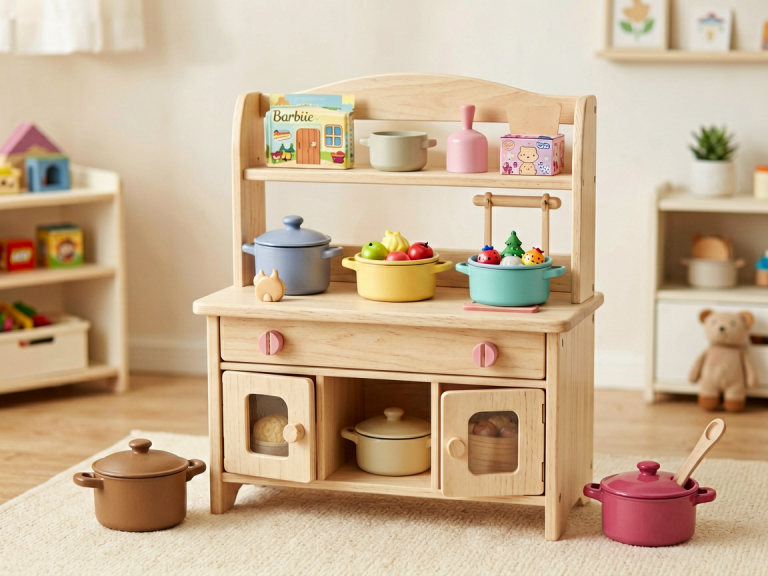
- Wooden Play Kitchen and Simple Food Sets: A mini kitchen with pots, pans, and wooden fruits lets a child cook a feast for her stuffed animals. The absence of electronic sounds or lights means she must create the sizzle and the conversation herself.
- Costume Trunk with Basic Elements: A cape, a hat, a pair of goggles, a feather boa, and a simple mask are more powerful than a full, fixed character costume. These items can be combined in infinite ways—today's pirate is tomorrow's astronaut.
- Play Doctor’s Kit or Tool Belt: Realistic-looking but safe tools (stethoscope, syringe without needle, toy hammer, screwdriver) invite children to mimic adult roles. They can "fix" a broken chair or "heal" a doll’s scraped knee, all while inventing dialogue and emotions.
How to Encourage Creativity
Join in the play, but follow your child's lead. If she declares that the stuffed rabbit is driving a car to the moon, go along with it. Ask "What happens next?" to extend the narrative.
—
4. Open-Ended Sensory Play Materials: The Joy of Exploration
Sensory play—activities that engage touch, sight, sound, and sometimes smell—is deeply creative because it has no predetermined outcome. It invites children to experiment with texture, cause and effect, and the properties of materials.
Why They Work
When a child pours sand through a sieve, buries a toy in kinetic sand, or watches colored water move through a tube, she is engaging in scientific inquiry and artistry at the same time. These activities calm the mind and allow for focused, meditative creativity.
Top Picks
- Kinetic Sand or Moon Sand: This grainy, moldable material is mesmerizing. It can be shaped into castles, cut with cookie cutters, or simply trickled through fingers. Unlike wet sand, it does not dry out, making it ideal for indoor play.
- Water Play Table or Simple Tub with Tools: A shallow plastic tub filled with water, along with cups, funnels, ladles, and waterproof toys, can occupy a four-year-old for an hour. Adding a drop of food coloring or a handful of ice cubes adds a new dimension.
- Rice or Play Dough Sensory Bins: Fill a bin with uncooked rice, dried beans, or oats, then hide small figurines, scoops, and containers. The act of digging, pouring, and finding hidden treasures builds both fine motor skills and imaginative narratives.
How to Encourage Creativity
Rotate the materials regularly to keep interest high. Set up a "sensory invitation" on a tray—for example, a bowl of colored rice with a small truck and a spoon—and let the child explore without any instructions.
—
5. Music and Sound-Making Toys: Composing Without Rules
Music is a universal language of creativity, and four-year-olds are natural composers. They love to make noise, repeat rhythms, and discover that their actions can produce pleasing (or funny) sounds.
Why They Work
Creating music requires pattern recognition, memory, and emotional expression. When a child bangs a drum at different speeds or shakes a maraca while singing a made-up song, she is learning that she can control her environment and communicate feelings through sound.
Top Picks
- Hand Percussion Set: A small drum, a tambourine, a pair of maracas, and a jingle stick allow a child to build a rhythm band. These instruments are durable, easy to hold, and produce immediate feedback.
- Simple Xylophone or Glockenspiel: Color-coded keys make it easy for children to create melodies by following patterns or simply experimenting. The bright, pure tones are satisfying and encourage trial-and-error.
- Kazoo, Recorder, or Slide Whistle: Wind instruments that require breath control are excellent for developing oral motor skills and creativity. A slide whistle, in particular, invites silly sounds and can accompany dramatic play (e.g., sliding down a pretend hill).
How to Encourage Creativity
Provide a "concert time" where the child performs for stuffed animals or family members. Record their songs and play them back—this validates their creative output and encourages more experimentation.
—
Conclusion: Choosing the Right Toy for the Right Mind
The best toy for a four-year-old’s creativity is not the one with the most bells and whistles, but the one that asks the most questions. A toy that demands nothing from the child—no decision, no imagination, no physical effort—will never foster creativity. In contrast, a pile of blocks, a jar of paint, or a box of dress-up clothes invites the child to become an active creator of her own world. When selecting gifts or adding to your home toy collection, remember: simplicity is not a limitation; it is liberation. The child supply the imagination; the toy only provides the stage. By choosing toys that are open-ended, multi-use, and responsive, we give four-year-olds the greatest gift of all—the confidence to invent, explore, and dream without limits.