From Play to Phonics: How Toys That Build Early Reading Shape Lifelong Learners
Introduction
In the journey of childhood development, few milestones are as transformative as learning to read. Reading unlocks worlds of imagination, knowledge, and empathy, and its foundations are laid long before a child enters a classroom. While formal instruction matters, the most natural and joyful path to literacy often winds through play. Toys that build early reading are not mere distractions; they are carefully designed tools that embed the building blocks of literacy—phonemic awareness, letter recognition, vocabulary, comprehension, and print motivation—into hands-on, engaging experiences. From a toddler’s first wooden alphabet block to a preschooler’s interactive storybook app, these toys harness children’s innate curiosity and desire to explore. This article examines the types of toys that effectively nurture early reading skills, the cognitive principles behind their design, and practical guidance for parents and educators seeking to transform playtime into a springboard for literacy.
—
The Power of Play in Early Literacy Development
Play is the brain’s favorite way to learn. Neuroscientific research shows that when children engage in self-directed, joyful play, their brains are more receptive to new information and more likely to form durable neural connections. Early reading development is not a single skill but a constellation of interrelated abilities: recognizing that spoken words are made of smaller sounds (phonological awareness), associating those sounds with letters (phonics), understanding that print carries meaning (print awareness), and building a rich spoken vocabulary. Toys that build early reading capitalize on this neuroplasticity by embedding literacy tasks into playful contexts. For example, a simple set of magnetic letters is not just a toy; it is a sensory-rich invitation to sort, spell, and manipulate symbols. The act of picking up a letter, feeling its shape, and placing it on a refrigerator door creates a multisensory experience that reinforces learning far more effectively than a worksheet. Moreover, play reduces the pressure and anxiety that sometimes accompany formal reading lessons. A child who is “just playing” with a rhyming puzzle is internalizing phonological patterns without the fear of being tested. Thus, the best literacy toys are those that disguise instruction as amusement, allowing children to practice pre-reading skills hundreds of times in a low-stakes, intrinsically motivated environment.
—
Phonological Awareness Toys: Building Blocks of Sound
Phonological awareness—the ability to hear, identify, and manipulate the sounds in spoken language—is the strongest predictor of later reading success. Toys that target this skill first engage the ears and mouth, not the eyes. One classic example is the rhyming game or sound matching set. Look for toys that feature pairs of objects or cards with rhyming names (e.g., “cat” and “hat”), encouraging children to say the words aloud and notice their endings. Similarly, phonics phones (simple hollow tubes that amplify a child’s own voice) allow young learners to hear the subtle differences between “b” and “d” as they whisper into the device. Another powerful tool is the talking story wand or electronic phonics pen that reads a word when touched. These toys break down words into individual phonemes, then blend them back together—a process called segmenting and blending that is central to decoding. For example, a toy that says “/c/ /a/ /t/ — cat!” helps children internalize that letters represent discrete sounds that combine into words. Even simple clapping games with a soft toy that encourages rhythmic syllable clapping (like a stuffed animal that says “let’s clap your name!”) build awareness. The key is that these toys require active listening and vocalization, not passive screen time. They turn abstract sounds into tangible, playable elements.
—
Alphabet and Letter Recognition Toys
Once children are attuned to sounds, they need to map those sounds onto visual symbols—letters. Alphabet toys come in myriad forms, but the most effective ones are multisensory and manipulative. Wooden letter puzzles with peg handles allow toddlers to grasp each letter, feel its shape, and place it into a corresponding cutout, reinforcing both visual recognition and fine motor skills. Magnetic letters remain a staple because they can be endlessly rearranged on a metal surface, allowing children to experiment with spelling their names, simple words, or even nonsense combinations. A newer innovation is textured alphabet cards where each letter is made of sandpaper, felt, or raised plastic. Running a finger over the letter “S” while saying its sound engages the tactile system, which is particularly helpful for kinesthetic learners. Bath letters made of foam turn bath time into a literacy moment—children can stick them on the tile wall and practice naming them. For slightly older preschoolers, alphabet matching games (like puzzles where uppercase letters snap into lowercase partners) teach the crucial concept of letter case. The underlying principle is repetition through variety: the more different contexts in which a child encounters the letter “A,” the more robustly its shape and sound are encoded in memory. Importantly, these toys should be used alongside language-rich conversation. A parent who says, “That’s a ‘B.’ It makes the /b/ sound, just like at the beginning of ‘ball’!” builds a bridge between the toy and real-world language.
—
Vocabulary-Building Toys Through Storytelling and Pretend Play
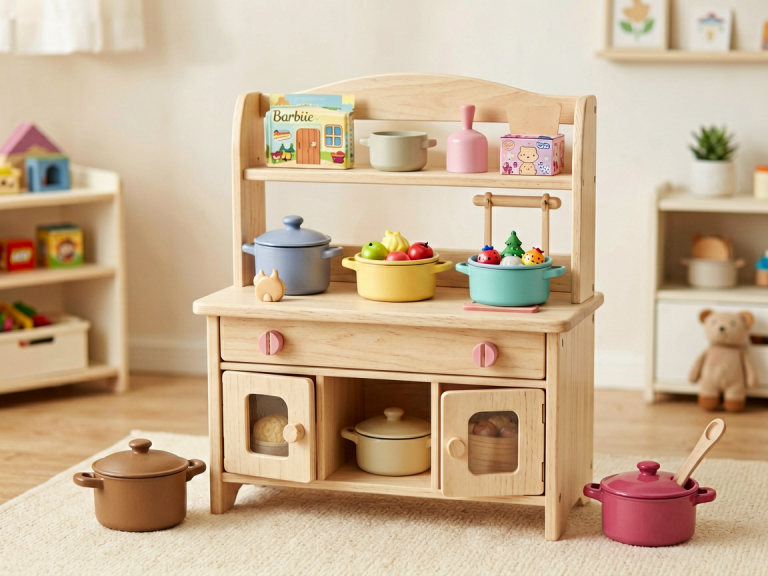
Vocabulary is the raw material of reading comprehension. Children who enter school with a large oral vocabulary find it easier to decode words and grasp meaning. Toys that fuel imaginative storytelling and rich language use are therefore essential. Pretend play sets—such as a kitchen, doctor’s kit, or farm—naturally generate conversations. When a child pretends to cook a meal, they use words like “stir,” “measure,” “simmer,” and “ingredient,” expanding their lexicon in context. Adding storytelling props like puppets, felt boards, or small world figures takes this further. A set of animal figurines and a felt barn, for example, invites the child to narrate a story: “The cow jumped over the fence and went to the pond.” The adult can model more sophisticated vocabulary: “The cow leaped over the fence and waded into the pond.” Another excellent category is interactive storybooks that include character figurines or pop-up elements. These toys turn reading into a three-dimensional adventure. When a child moves a toy character along a story path, they are not just hearing a story; they are actively engaged in sequencing events and inferring cause and effect—both critical for comprehension. Word cards that pair an image with a word (e.g., a picture of an “elephant” beside the written word) can be used in games like “I Spy” or “Memory,” gradually building a sight-word bank. The goal is to create a print-rich environment where words are encountered in meaningful, playful contexts, not as isolated drills.
—
Interactive Electronic Toys and Apps: Digital Aids for Reading Readiness
In moderation, thoughtfully designed electronic toys and apps can powerfully support early reading. The key is interactivity, not passive watching. LeapFrog’s Tag Reading System or similar pen-readers allow children to touch a word or picture on a specially printed page and hear it pronounced, often with sound effects or a related question. This immediate feedback helps children connect print to sound and meaning. Speech-to-text toys, like a children’s microphone that transcribes what a child says, can be used to “write” stories and then read them back—demonstrating that spoken language becomes written language. Electronic alphabet boards that sing the phonics song when a letter is pressed reinforce letter-sound associations through catchy tunes. However, the American Academy of Pediatrics emphasizes that digital toys should be used with adult co-engagement. A parent sitting alongside and commenting (“Oh, the app says that word starts with ‘p’! What else starts with ‘p’?”) transforms a solitary screen experience into a joint literacy activity. Moreover, not all apps are created equal. High-quality literacy apps are research-based, minimize distracting animations, and focus on core skills like letter identification, phoneme blending, and vocabulary. Examples include “Endless Alphabet,” “Moose Math: Reading,” and “Starfall ABCs.” The guiding principle is that the toy should do the teaching—not just entertain—and that it should be one tool among many, not a replacement for hands-on, tactile play.
—
Choosing the Right Toys: Age and Developmental Considerations
Not every toy is appropriate for every stage of early reading development. For infants and toddlers (birth to 2 years), focus on sensory toys that introduce rhythm and sounds: soft alphabet blocks, rattles that make different phoneme-like noises, and board books with flaps or textures. At this age, the goal is exposure to language and print, not explicit instruction. For ages 2 to 3, transition to letter recognition toys like large, chunky puzzles and magnetic alphabets, as well as toys that encourage simple storytelling (e.g., animal puppets). Phonological awareness can be nurtured through nursery rhyme CDs or simple rhyming card games. For preschoolers (3 to 5), introduce phonics-based toys such as talking pens, electronic spelling games, and more complex alphabet puzzles that include both uppercase and lowercase. At this stage, children can begin to blend sounds into simple words. Also, incorporate print-related pretend play—a toy cash register with a “shopping list,” a play mailbox with pretend letters, or a “restaurant” with a printed menu. For children ages 5 and up, chapter book companion toys (like plush characters from a favorite series) can deepen engagement with longer texts. The most important criteria are safety, durability, and open-endedness. A toy that can be used in multiple ways—like a set of letter stamps that can be used for spelling, creating greeting cards, or decorating play dough—will grow with the child and sustain interest.
—
Conclusion
Toys that build early reading are far more than commercial products; they are catalysts for cognitive and emotional growth. By embedding the foundational skills of literacy into the language of play—sounds, symbols, stories, and imagination—these toys transform learning from a chore into a discovery. They honor the developmental truth that children learn best when they are engaged, curious, and having fun. The best toys are not the flashiest or most expensive; they are the ones that invite a child to pick up, handle, explore, and talk. Whether it is a felt alphabet book, a set of rhyming dominoes, or a digital pen that voices a story, each tool contributes a piece to the complex puzzle of reading readiness. As parents and educators, our role is to curate a diverse toy box that balances sensory, auditory, visual, and narrative experiences, and to join children in their play—modeling language, asking questions, and celebrating every scribble and mispronunciation. In doing so, we do not just teach children how to read; we instill a lifelong love of reading, one playful encounter at a time.