Playful Pathways: Engaging Play Ideas for Preschool Girls to Boost Language Development
Introduction
Language development in the preschool years (ages 3–5) is a remarkable journey. During this period, children’s vocabulary expands from a few hundred words to thousands, and they begin to form complex sentences, tell stories, and engage in meaningful conversations. For preschool girls—who often show early strengths in verbal communication—play is not merely entertainment but a powerful, natural classroom. Play provides a low-stress, joyful context where language is practiced, repeated, and refined. By intentionally designing play experiences, parents and educators can nurture vocabulary growth, grammatical skills, narrative ability, and social communication. This article presents five specific play ideas that are especially engaging for preschool girls and explains exactly how each activity supports language development. From dress-up adventures to sensory storytelling, these ideas are easy to implement at home or in a classroom, and they turn everyday moments into rich language-learning opportunities.
—
Dramatic Play: The Magic of “Let’s Pretend”
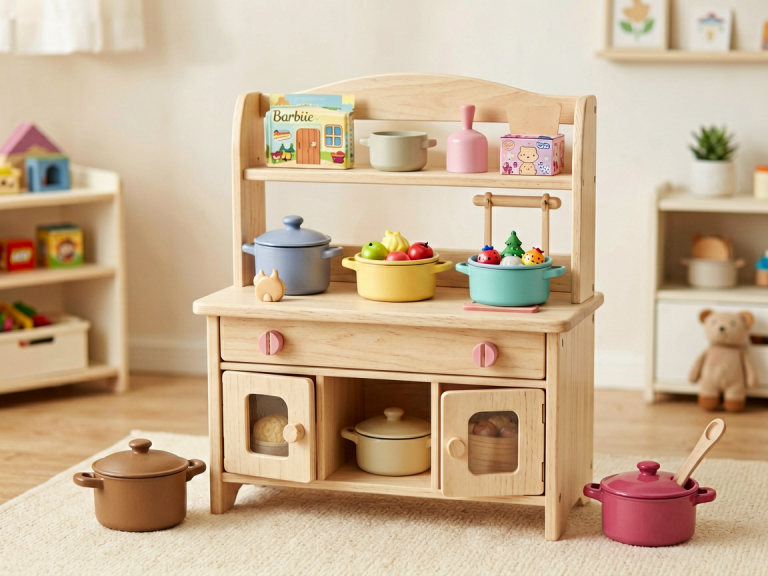
Dramatic play—often called pretend or imaginative play—is one of the richest language-building activities for preschool girls. Whether they are playing “house,” “doctor,” “tea party,” or “supermarket,” girls naturally adopt roles and create dialogue. A simple prop like a toy telephone can spark a ten‑minute conversation between two “friends.” When a child pretends to be a mother making breakfast, she uses sentences like “I’m frying the eggs—do you want them sunny‑side up?” or “Please sit down, the food is ready.” This kind of role‑play forces her to think from another perspective, use appropriate vocabulary (fry, sunny‑side up, plate, napkin), and practice turn‑taking in conversation.
To maximize language development, adults can join in without taking over. Ask open‑ended questions: “What are you cooking? Why is the baby crying? Where should we go after the tea party?” These prompts encourage the child to elaborate, explain, and even negotiate. Additionally, dramatic play introduces social scripts—how to order at a restaurant, how to comfort a baby, how to greet a guest. Repeating these scripts builds syntactic patterns and pragmatic language skills. For example, a girl playing “shopkeeper” learns to say “Can I help you?” and “That costs five dollars.” She also learns to respond to unexpected questions, stretching her language flexibility.
Tip: Keep a dress‑up box with hats, scarves, plastic food, and empty containers. Rotate themes (farm, space, fairy tale) to keep vocabulary fresh. The more varied the scenarios, the more diverse the language.
—
Storytelling with Puppets and Props
Puppets are magical for preschool girls. A simple sock puppet or a hand‑held animal becomes a trusted friend who “needs” to hear a story. Puppet play encourages children to produce extended narratives—not just one‑word answers—because the puppet is waiting for a tale. When a girl makes her puppet “talk,” she often adopts a different voice, which helps her experiment with tone, emotion, and sentence length.
One powerful activity is “Puppet Interview.” The adult puppet asks the child’s puppet questions like “What is your favorite color? Did you go on an adventure today? How did you feel when you saw the dragon?” This forces the child to recall events, describe feelings, and sequence actions. Another variation is to provide a small set of props (a tiny book, a plastic cup, a leaf) and ask the child to create a story that includes all three. For example, a girl might say: “My bunny found a magic leaf. He used the leaf to fly to the moon, and then he drank tea with a moon bear in a cup.” Notice the causal language (because, so, then) and descriptive adjectives (magic, tiny, happy).
Puppet play also naturally supports vocabulary related to emotions—sad, excited, scared—which is crucial for social‑emotional development. And because the puppet is a “separate” character, children often feel freer to try new words without fear of being wrong.
Tip: Make simple puppets from paper bags or old gloves. Encourage the child to name her puppet and give it a backstory. Then retell the story later, asking her to “read” the puppet’s adventure.
—
Art and Craft: Describe, Explain, and Narrate
Art activities—drawing, painting, collage, playdough—are often favorites among preschool girls, and they offer a unique platform for language development. While a child creates, she is not only practicing fine motor skills but also thinking in language. The key is to turn the creative process into a conversation.
Instead of just saying “That’s pretty,” ask specific questions: “Tell me about the purple squiggle—is that a waving arm? Why did you choose blue for the sky? What is the princess doing in your picture?” These prompts require the child to use descriptive vocabulary (curly, bumpy, sparkly) and to construct sentences that explain her choices. For example, a girl might say, “I used yellow because the sun is happy, and the sun makes the flowers grow.” That sentence contains a cause‑effect relationship and an emotional attribution—both advanced language skills.
Another technique is “story art.” After drawing a picture, ask the child to tell a short story about what is happening. Write down her exact words under the drawing. This not only validates her language but also shows her the connection between spoken and written words. For preschoolers, this paves the way for emergent literacy.
Collage making is especially language‑rich because it involves selecting materials. As a girl chooses between shiny paper and rough fabric, she can be encouraged to use comparative language: “This is softer, but this one is more sparkly.” And when she glues pieces down, she explains: “The button is the nose, and the pink yarn is the hair.” By talking about her process, she practices sequencing words such as first, next, then, and finally.
Tip: Set up a “creation station” with recycled materials, glitter glue, felt, and buttons. Let the child decide what to make. Then schedule a “gallery talk” where she presents her artwork to you (or to a stuffed animal) and answers questions.
—
Music, Rhymes, and Word Play
Preschool girls often love singing, dancing, and chanting, and rhythmic language activities are scientifically proven to boost phonological awareness—the ability to hear and manipulate sounds, which is a foundation for reading. Songs, nursery rhymes, and finger plays (like “Itsy Bitsy Spider” or “Five Little Ducks”) reinforce patterns of syllables, rhyme, and alliteration. When a child sings “Twinkle, twinkle, little star, how I wonder what you are,” she is not only learning vocabulary but also internalizing the rhythm of English sentences—and she is learning that words can be broken into sounds (st‑ar, twinkl‑e).
Beyond traditional songs, invent simple call‑and‑response games. For example, say “I see something red” and ask the child to complete the rhyme: “Red like a _______ (bed, head, strawberry).” This encourages her to think of words that share a sound pattern, building phonemic awareness. You can also play “sound‑matching”: “Which word starts with the same sound as boat? Bat, cake, or dog?” For girls who love animals, change the song “Old MacDonald” to include imaginary animals with silly names, prompting new vocabulary and laughter.
Another powerful idea is “story songs.” Sing a very simple narrative tune like “The wheels on the bus” but replace the verses with personalized actions: “The girls on the bus say ‘Let’s play house, play house, play house’ …” The child can invent new verses, which forces her to generate language that fits the rhythmic and melodic pattern. This active creation improves syntactic flexibility and memory.
Tip: Keep a song jar with slips of paper listing favorite songs. Let the child pick one each day. After singing, ask her to change one line (e.g., instead of “itsy bitsy spider,” sing “a great big fuzzy spider”). This small challenge boosts creative language use.
—
Nature Walks and Sensory Play: Talk While You Explore
Outdoor play and sensory bins are not just for gross motor or tactile stimulation—they are gold mines for language development, especially for preschool girls who are often curious about the natural world. A simple nature walk becomes a vocabulary‑building expedition. As you walk, use rich descriptive language: “Look at that rough, brown bark. Can you feel the bumpy texture? The leaves are fluttering in the breeze.” Then invite the child to describe what she sees: “What color is that flower? Is it tall or short? Does the pinecone feel prickly or smooth?” This kind of real‑world conversation introduces adjectives, comparatives, and prepositions (under, behind, next to).
Collect natural objects—acorns, leaves, stones, flowers—and bring them home for a “sensory bin.” Fill a shallow container with rice, sand, or water, and add the treasures. Let the girl explore freely, but guide her language by asking questions: “How does the wet sand feel? Is the acorn lighter than the stone? Tell me a story about this tiny leaf—where did it come from?” When children manipulate textures and objects, their brains are highly receptive to language because they are experiencing multiple senses simultaneously. The words become anchored in physical experience.
A specific activity is “I Spy” with nature objects. “I spy something green and soft.” The child must answer using a full sentence: “You spy a mossy rock.” This reinforces sentence structure and vocabulary retrieval. You can also do a “sound walk”—close your eyes and describe what you hear (birds chirping, wind rustling, feet crunching on gravel). This builds auditory discrimination and expressive language.
Tip: Bring a small notebook on walks. Let the child dictate one or two sentences about what she saw, and draw a picture later. Over time, these dictations become a language‑rich journal.
—
Conclusion
Language development does not require flashcards or formal lessons—it flourishes in the joyful, messy, imaginative world of play. For preschool girls, who often thrive on social interaction, storytelling, and creative expression, the play ideas outlined here—dramatic play, puppet storytelling, art conversations, music and rhymes, and nature exploration—provide natural and powerful contexts for practicing vocabulary, grammar, narration, and social communication. By joining in the play, asking open‑ended questions, and modeling rich language, adults can transform everyday fun into a foundation for lifelong literacy.
The most important ingredient is time and presence. When you sit on the floor for a tea party, chat with a sock puppet, or marvel at a collection of pebbles, you are not just playing—you are building a scaffold for your child’s language mind. And because these activities are so engaging, the learning feels effortless. So go ahead: dress up, sing out loud, collect leaves, and let the words flow. In each playful moment, your preschool girl is not only having fun—she is learning to speak her world into existence.