The Power of Play: How Early Learning Toys and Storytelling Shape Development in 6‑Month‑Olds
—
Introduction
The first year of life is a period of extraordinary brain growth. By six months, infants have begun to transform from passive observers into active explorers of their environment. They reach for objects, babble with intent, and respond to familiar voices with delighted smiles. At this critical juncture, two powerful tools emerge as cornerstones of early development: thoughtfully designed early learning toys and the timeless art of storytelling. While these may seem like separate activities, they are deeply intertwined. Early learning toys for 6‑month‑olds provide the sensory and motor stimulation that builds the neural pathways necessary for later cognition, while storytelling nurtures language, emotional bonding, and narrative comprehension. This article explores how parents and caregivers can harness the synergistic power of toys and storytelling to support a baby’s holistic growth during this remarkable stage.
—
Understanding the Developmental Needs of a 6‑Month‑Old
At six months, babies experience a burst of developmental milestones. Physically, many can sit with support, roll over both ways, and begin to transfer objects from one hand to another. Their vision has sharpened, allowing them to track moving objects and distinguish between colors and patterns. Cognitively, they engage in cause-and-effect exploration—shaking a rattle to hear its sound, or dropping a toy to see it fall. Socially, they start to show stranger anxiety, prefer familiar faces, and enjoy interactive games like peekaboo. Emotionally, they communicate through babbling, laughing, and crying, and they crave responsive interactions.
These milestones are not arbitrary; they reflect the rapid development of the brain’s sensorimotor cortex, language centers, and limbic system. Therefore, any activity designed for a 6‑month‑old must align with these emerging abilities. Early learning toys and storytelling are uniquely suited to meet these needs because they engage multiple senses, encourage repetition (which solidifies neural connections), and foster the warm, secure relationships that buffer stress and promote resilience. Understanding this developmental landscape helps us choose the right tools and techniques.
—
The Role of Early Learning Toys in Sensory and Motor Development
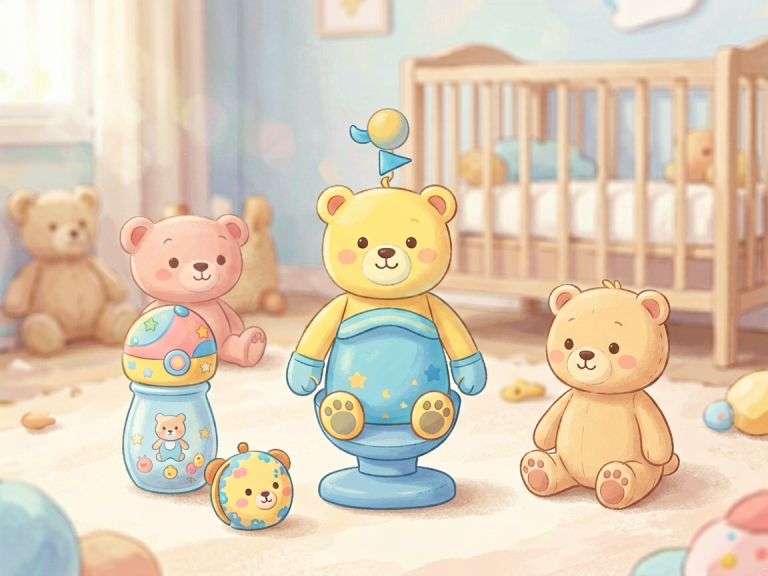
Early learning toys for 6‑month‑olds should be simple, safe, and rich in sensory feedback. At this age, babies learn primarily through their senses: touch, sight, sound, and mouthing. A well‑designed rattle, for example, provides auditory feedback (the sound of beads), tactile variety (smooth plastic versus textured fabric), and visual interest (bright colors or contrasting patterns). When a baby shakes the rattle, they learn that their action produces a predictable result—a fundamental lesson in causality.
Texture balls or soft blocks with crinkly surfaces encourage grasping and transferring, which strengthens hand‑eye coordination and fine motor skills. Teething toys made of safe silicone offer relief for sore gums while also providing a satisfying chewable surface for oral exploration. Activity gyms with dangling toys invite reaching and batting, promoting upper‑body strength and visual tracking. Mirrors are especially powerful: a six‑month‑old is fascinated by the reflection, not yet recognizing themselves, but the back‑and‑forth movement between the mirror image and their own movements promotes self‑awareness and visual convergence.
Beyond motor skills, these toys stimulate the brain’s sensory integration. When a baby touches a textured ball, their tactile cortex sends signals to the motor cortex to coordinate grip strength; simultaneously, their visual cortex processes color and shape. This cross‑modal processing is essential for later skills like reading, where the brain integrates visual symbols with sounds. Moreover, toys that make a gentle sound when manipulated—like a wooden rattle or a soft bell—encourage auditory discrimination, a precursor to phonetic awareness.
—
Storytelling as a Tool for Language and Cognitive Growth
Storytelling with a 6‑month‑old looks very different from telling a story to a toddler or preschooler. At this age, the narrative is secondary; the experience is primary. When a caregiver speaks in a slow, melodic voice while pointing to a simple board book with high‑contrast images, the baby is absorbing the rhythm, intonation, and emotional tone of language. This “parentese” or “motherese” style—characterized by exaggerated pitch changes and repetition—has been shown to attract and hold infant attention more effectively than flat speech.
The content of the story matters less than the interaction itself. A simple tale about a smiling baby or a friendly animal, repeated daily, helps the infant build a mental schema for narrative structure: beginning, middle, and end. Even though the baby cannot understand words, the brain is busy recording patterns. Functional MRI studies reveal that during shared reading, a 6‑month‑old’s brain shows increased activation in the left temporal lobe—the area associated with language comprehension—and in the prefrontal cortex, which governs attention and memory.
Storytelling also fosters emotional bonding. The physical closeness of sitting on a lap, the warmth of a parent’s voice, and the rhythmic sway of being held all release oxytocin, the “bonding hormone.” This biochemical response reduces cortisol (stress) and creates a positive associative memory with books and language. Over time, this foundation will make the child more eager to engage with literacy. Furthermore, storytelling exposes babies to new vocabulary—not through direct instruction, but through contextual repetition. A board book about a dog introduces the word “dog” alongside a colorful image; when the parent says, “Look at the dog! Woof woof!” the baby simultaneously hears the word, sees the picture, and feels the caregiver’s excitement, creating a multisensory learning event.
—
Integrating Toys and Storytelling: A Synergistic Approach
The most powerful early learning experiences occur when toys and storytelling are combined. Imagine a scenario: the caregiver brings out a soft, plush animal toy—say, a small bunny with crinkly ears and a rattling tail. The child reaches for it, grasping the bunny while the caregiver begins a simple, repetitive story: “One day, little bunny went hop, hop, hop. He met a bird. Chirp, chirp! Then he met a fish. Splash, splash!” The parent moves the bunny in the air, making it “hop” against the baby’s tummy, then uses a separate toy bird (or just a finger puppet) to enact the meeting.
In this thirty‑second interaction, the baby is engaging multiple neural pathways simultaneously. The tactile input from the bunny’s soft fur and crinkly ears stimulates the somatosensory cortex; the sound of the rattle and the caregiver’s voice activate the auditory cortex; the visual tracking of the moving animal engages the occipital lobe; and the rhythmic language reinforces pattern recognition in the temporal lobe. The emotional safety of the caregiver’s proximity ensures that these stimuli are encoded as positive, rewarding experiences, which facilitates long‑term memory consolidation.
Such integrated play also supports the development of joint attention—the ability to share a focus on an object with another person. Joint attention is a critical social‑cognitive milestone that typically emerges around six to nine months and predicts later language skills. When the parent points to the bunny and says, “Look!” while the baby’s gaze follows, they are co‑constructing a shared mental space. Toys become props within a story, transforming a static object into a character with agency. This narrative framing encourages the baby to see the world as full of stories waiting to be told, sparking early imaginative thinking.
—
Choosing the Right Toys and Stories for This Age
Not all toys are created equal for a 6‑month‑old. Safety is paramount: toys should be free of small parts that could become choking hazards, made from non‑toxic materials, and easy to clean. They should also be developmentally appropriate. Look for toys that offer at least two sensory channels—for example, a rattle that is also a teether (tactile + auditory) or a soft book with crinkly pages and a mirror (visual + tactile). Avoid electronic toys that produce flashing lights and loud, repetitive sounds; research suggests that these can overstimulate an infant’s developing nervous system and reduce opportunities for caregiver‑baby interaction.
For storytelling, choose board books with high‑contrast illustrations (black‑and‑white patterns are excellent for young infants, but by six months, bright primary colors also attract attention). Books with simple, repetitive text (“Brown Bear, Brown Bear, What Do You See?”) are perfect because the predictability allows the baby to anticipate and respond. Touch‑and‑feel books that incorporate different textures—furry, bumpy, glossy—add a tactile dimension that enhances engagement. Alternatively, you can create your own “stories” using everyday toys: a wooden block becomes a “car” that drives up the baby’s leg, or a spoon becomes a “plane” that flies overhead. The key is to keep the narrative brief, rhythmic, and emotionally warm.
—
Practical Tips for Parents and Caregivers
To maximize the benefits of early learning toys and storytelling, consistency and intentionality matter. Here are actionable strategies:
- Create a daily ritual. Set aside five to ten minutes each day for a dedicated play‑and‑story session. The predictability soothes babies and builds anticipation.
- Follow the baby’s lead. If your six‑month‑old is more interested in chewing the book than looking at it, let them explore. Mouthing is a valid form of learning; you can narrate what they’re doing: “You’re tasting the corner of the book. It feels bumpy!”
- Use toys as story characters. Instead of reading a book passively, use a stuffed animal or a puppet to “act out” the story. The movement keeps the baby’s attention longer than static pictures.
- Incorporate repetition and rhyme. Repeat the same story or toy game several times over days. Infants learn through repetition; each repetition reinforces neural connections.
- Limit screen time. The American Academy of Pediatrics recommends no screen time before 18 months (except video calls). Real‑world, hands‑on interactions with toys and a caregiver’s live voice are far superior for brain development.
- Talk about the toy while using it. A rattle is not just a rattle—it’s a “shaky, shiny, noisy friend.” Labeling objects and actions expands the baby’s receptive vocabulary even before they can speak.
- Rotate toys. Introduce three to four toys per week and rotate them to maintain novelty. Babies become bored with too many options; a limited, curated set encourages deeper exploration.
—
Conclusion
The first six months of life are a whirlwind of change, and the choices we make as caregivers can profoundly shape a child’s developmental trajectory. Early learning toys designed for 6‑month‑olds are not mere distractions; they are tools that build the architecture of the brain—strengthening sensory integration, fine motor skills, and causal reasoning. Storytelling, in its simplest, most intimate form, lays the foundation for language acquisition, emotional security, and a lifelong love of narrative. When these two elements are combined—when a plush bunny becomes the protagonist of a whispered tale, when a crinkly book is explored with hands and voice together—they become more than the sum of their parts. They become a symphony of learning, played out in the safe embrace of a loving adult.
In a world that often rushes toward digital screens and passive entertainment, the humble act of sitting on the floor with a baby, a few toys, and a story is revolutionary. It honors the pace of natural development, respects the infant’s innate curiosity, and celebrates the profound power of human connection. For the six‑month‑old, every rattle, every board book, every silly song is a stepping stone on the path to language, thought, and belonging. And for the caregiver, that shared journey is one of the most meaningful stories ever told.
Sources and further reading
- CDC: Developmental Milestones milestone context for how children play, learn, speak, act, and move.
- American Academy of Pediatrics: Toy Buying Tips for Babies and Young Children general guidance on matching toys to developmental skills.