From Rattle to Narrative: Early Learning Toys for 6-Month-Olds and the Foundation of Storytelling
Introduction
The first six months of life represent a whirlwind of cognitive, sensory, and motor development. A baby who once responded only to reflex now reaches, grasps, and gazes with intent. For parents and caregivers, this age is a golden window for introducing early learning toys that do more than simply entertain. But what if these toys could also serve as the first stepping stones toward storytelling? At first glance, a teething ring or a rattle might seem far removed from the art of narrative. Yet emerging research in developmental psychology and early literacy suggests that the sensory-rich, interactive play experiences of a 6-month-old lay the neural groundwork for comprehension, sequencing, and language structure—the very pillars of storytelling. This article explores how carefully chosen early learning toys for 6-month-olds can be intentionally paired with storytelling practices to foster cognitive growth, emotional bonding, and a lifelong love of narrative.
The Developmental Landscape at Six Months
To understand the connection between toys and storytelling, we must first appreciate what is happening inside a 6-month-old’s mind. At this age, infants are in what Jean Piaget called the sensorimotor stage, primarily exploring the world through their senses and actions. They can hold objects, transfer them between hands, and bring them to their mouths. Visual acuity has improved dramatically; they track moving objects and recognize familiar faces. Auditory development is equally advanced—babies turn toward sounds, distinguish different tones, and begin to babble with repetitive syllables like “ba-ba” or “da-da.” Moreover, they are developing object permanence, the understanding that an object continues to exist even when out of sight. This milestone is crucial for narrative comprehension, since stories rely on characters and events that persist beyond the immediate moment. Socially, 6-month-olds engage in reciprocal interactions—smiling, cooing, and responding to facial expressions. They are primed for back-and-forth communication, the very essence of dialogue in storytelling. Therefore, any toy designed for this age should capitalize on these emerging abilities: it should be graspable, multi-sensory, and responsive to the baby’s actions.
Sensory Toys as the First “Words” of Storytelling
A story begins with words, but for a 6-month-old, the first “vocabulary” is sensory. Early learning toys that provide varied textures, sounds, and colors act as the infant’s initial exposure to symbolic representation. For instance, a soft fabric book with crinkly pages, a plush animal with a rattle inside, or a wooden ring with contrasting black-and-white patterns are not merely diversions—they are tactile narratives. When a baby touches a fuzzy sheep on a toy block, then hears a gentle “baa” sound, a tiny association forms between an object and its auditory signature. This is the beginning of symbolization, a cognitive leap that later allows a child to understand that the word “sheep” stands for the woolly creature. Parents can amplify this by narrating the experience: “Oh, you found the sheep! The sheep says baa. Baa, baa, little sheep.” In this way, the toy becomes a prop in an improvised story. Every sensory input—the cool feel of a silicone teether, the jingle of bells inside a ball—is a “word” in the baby’s emerging lexicon of the world. By intentionally linking these sensory experiences with verbal commentary, caregivers transform simple play into the first chapters of a narrative education.
Interactive Toys That Encourage Turn-Taking and Dialogue
Storytelling is fundamentally a dialogue, even when it is a monologue delivered by a parent. The back-and-forth rhythm of conversation—pause, response, elaboration—is mirrored in the turn-taking games that 6-month-olds love. Toys that invite response are ideal for fostering this skill. Consider a simple cause-and-effect toy: a push-button that plays a melody, or a ball that wobbles when tapped. When the baby touches the button, the toy “answers” with music. The baby then looks at the parent, perhaps smiles or babbles, and the parent can respond: “Yes! You made the music! The little bird is singing.” This exchange is a proto-narrative: action, reaction, and commentary. Another excellent example is a set of soft stacking cups. The baby knocks down a tower, the caregiver says “Crash! All fall down!” and then rebuilds it. The sequence—build, knock, rebuild—introduces the concept of plot: a beginning, a middle, and an end. Moreover, interactive toys that have different faces or simple expressions (e.g., a plush doll with a smiling face and a frowning face) help the baby begin to map emotions onto objects, an essential component of character development in stories. By engaging in these reciprocal play routines, the infant learns that communication is a shared, meaningful exchange—the very heartbeat of storytelling.
The Role of Parental Narration in Toy Play
No toy, no matter how sophisticated, can teach storytelling in isolation. The adult’s voice is the crucial link that transforms a piece of plastic or fabric into a narrative anchor. When a 6-month-old plays with a toy, the parent’s narration provides the linguistic and emotional framework. For example, while the baby explores a textured ball, the parent might say: “The ball is round. It rolls across the floor. Where is it going? It’s rolling to the door! Oh, it stopped. Can you find it?” This running commentary does several things. First, it models language in real time, exposing the infant to vocabulary, sentence structure, and intonation patterns. Second, it creates a story arc: a character (the ball), a setting (the floor), an action (rolling), and a problem (stopping). Third, it invites the baby to participate through gaze or gesture. Research in developmental psychology shows that the sheer amount and quality of parental talk during play significantly predicts later language and narrative abilities. Therefore, when selecting early learning toys for 6-month-olds, parents should prioritize those that lend themselves naturally to descriptive, interactive narration. Toys with clear features (like animal figures or simple vehicles) or toys that produce sounds (like squeaky toys or rattles) make excellent prompts for mini-stories. The toy is the prop; the parent’s voice is the narrator; the baby is the audience and co-creator.
Choosing the Right Toys: Texture, Sound, and Visual Patterns
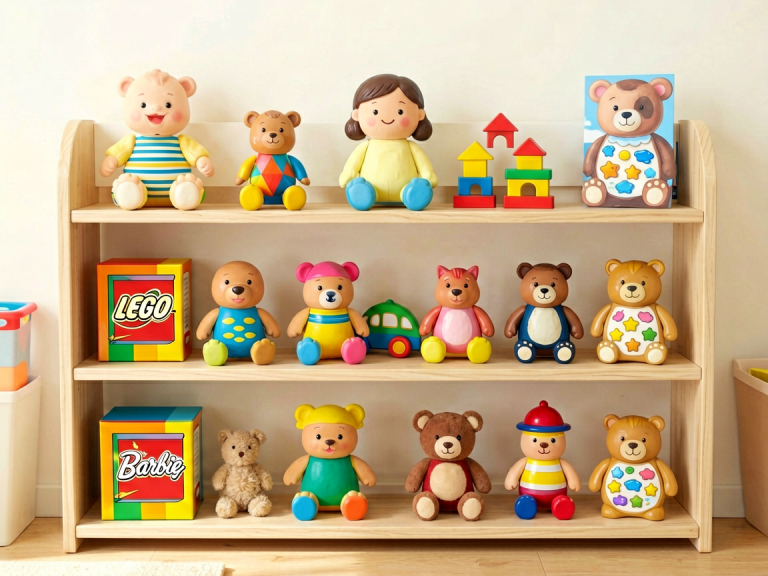
Not all toys marketed for 6-month-olds are equally effective for storytelling development. The best choices stimulate multiple senses and invite manipulation. Texture is paramount: soft fleece, bumpy rubber, smooth wood, and crinkly fabric each provide distinct tactile experiences that can be woven into stories. For instance, a toy with a fuzzy “fur” can be described as “the kitten’s soft coat,” while a bumpy texture becomes “the frog’s bumpy back.” Sound is equally important. Toys that make gentle, varied noises—chimes, rattles, squeaks—allow the parent to assign sound effects to actions in a story: “The bell rings! Ding-a-ling! The fairy is coming.” Visual patterns should include high-contrast colors (black, white, red) as well as simple faces or shapes. Infants at six months are drawn to faces, so a soft toy with a smiling face can become a protagonist. Avoid toys with overwhelming electronic stimuli that babble or sing independently; these can discourage parental narration because the toy “talks” for itself. Instead, choose open-ended toys that rely on adult input to come alive. A set of wooden rings, a soft ball with a bell inside, a silicone teether shaped like a star, and a fabric book with flaps are all excellent choices. Each can be integrated into a parent-created story about a star that fell from the sky, a ball that went on an adventure, or a book that tells a bedtime tale.
Integrating Storytelling into Daily Play Routines
To maximize the benefits, storytelling through toys should be woven into everyday routines, not reserved for special reading times. For a 6-month-old, attention spans are short—typically a few minutes at a time. Short, repeated play sessions are more effective than long ones. For example, during diaper changes, a parent can hold a soft rattle and say, “This is your rattle. It shakes and shakes. Shake, shake, shake! The rattle is dancing.” While the baby is doing tummy time, place a mirror toy in front of them and narrate: “Who is that in the mirror? It’s you! Baby is looking at baby. Baby smiles! Hello, baby!” Bath time offers another opportunity: a floating rubber duck can become the hero of a water story. “Duckie swims in the lake. Splash! Duckie dives. Quack, quack, where is duckie?” By embedding narrative into these ordinary moments, the baby learns that stories are not separate from life; they are life itself. Additionally, parents can create a “story basket” containing two or three toys rotated weekly. Each day, the parent chooses one toy and tells a simple, 30-second story about it, using the same toy and same basic narrative to build familiarity. Repetition is key at this age—it reinforces neural connections and gives the baby a sense of prediction and mastery, which is deeply satisfying and prepares them for more complex narratives later.
Conclusion: Building a Narrative Mind from Infancy
The journey from a 6-month-old’s rattle to a toddler’s first spoken story is longer than it seems, but each step is paved with intentional play. Early learning toys are not merely objects of distraction; they are catalysts for cognitive and linguistic development. When paired with the parent’s nurturing narration, these toys become characters, settings, and plot points in the infant’s first stories. The sound of a crinkle becomes a witch’s cape; the feel of a soft ball becomes a bunny’s belly; the echo of a chime becomes a star twinkling in the night sky. Through this process, the baby develops not only an understanding of causality and sequence but also an emotional connection to the act of storytelling itself. Caregivers who invest in thoughtful, multi-sensory toys and who make storytelling a natural part of play are giving their infants a gift that extends far beyond infancy: the gift of a narrative mind, capable of understanding, creating, and cherishing stories for a lifetime. In the end, every rattle is a story waiting to be told—and every 6-month-old is a storyteller in the making.