The Power of Play: Meaningful Activities for Parents and Babies to Bond and Learn
Introduction
The first year of a baby’s life is a period of extraordinary growth, not just physically but also cognitively, emotionally, and socially. While much attention is given to milestones like rolling over or saying the first word, the foundation for all these achievements is built through everyday interactions—especially play. For parents, playing with their baby is far more than a way to pass the time; it is a powerful tool that strengthens the parent-child bond, stimulates brain development, and builds the baby’s confidence in exploring the world. However, many new parents wonder: what kind of play is appropriate at each stage? How can they engage a newborn who seems to do nothing but sleep and eat? This article offers a practical, stage-by-stage guide to play activities that parents can enjoy with their babies from birth to twelve months, focusing on sensory stimulation, motor development, and joyful connection. Each suggestion is designed to be simple, low-cost, and easily integrated into daily routines, ensuring that playtime becomes a cherished part of every family’s day.
Sensory Awakening: Play for Newborns (0–3 Months)
At this earliest stage, a baby’s world is primarily one of sensation. Their vision is blurry, their hearing is sharp, and touch is their most reliable sense. Play activities for newborns should be gentle, repetitive, and focused on introducing the baby to their own body and immediate environment.
One of the simplest yet most effective activities is tummy time. Placing the baby on a soft mat on their stomach for a few minutes several times a day strengthens their neck, shoulder, and arm muscles—essential for later crawling. Parents can lie face-to-face with the baby, making eye contact, smiling, and talking softly. This not only exercises the baby’s muscles but also provides emotional security. Another wonderful activity is singing and rhythmic swaying. Holding the baby close while singing a lullaby or a simple nursery rhyme, and gently rocking or bouncing, stimulates the vestibular system (the sense of balance) and creates a calming, predictable rhythm. Parents can also offer contrasting visual stimuli: black-and-white picture cards, a simple mobile with high-contrast patterns, or even a parent’s own face moving slowly from side to side. Because babies at this age prefer faces over objects, exaggerated facial expressions—raising eyebrows, opening the mouth wide, sticking out the tongue—are fascinating to them and encourage imitation later on.
Touch is equally important. A gentle baby massage using a small amount of unscented oil can be a soothing play activity. Parents can talk or sing during the massage, naming each body part (“This is your little hand, and this is your tiny foot”). This deepens the parent-child connection and helps the baby become aware of their body. Even something as simple as letting the baby grasp a parent’s finger—the palmar grasp reflex—can be turned into a playful game: gently pulling the baby up a few inches (if the baby’s neck is stable) and praising their “strong grip.”
Responsive and Interactive Play (3–6 Months)
During these months, babies become more alert and social. They begin to smile deliberately, coo, and reach for objects. Play activities should now encourage interaction and cause-and-effect learning.
A classic activity is peek-a-boo. Covering your face with your hands or a cloth and then revealing it with a cheerful “Peek-a-boo!” triggers delight and teaches the concept of object permanence—the understanding that things exist even when not visible. Parents can vary this by hiding a soft toy under a blanket and letting the baby pull it off. Another engaging activity is mirror play. Hold an unbreakable mirror a few inches from the baby’s face. At first, they may not recognize themselves, but they will be fascinated by the reflection. Encourage them to touch the mirror, and point to their own nose, eyes, and mouth. This builds self-awareness and language skills.
Rattles and grasping toys become essential at this stage. Parents can shake a rattle to the left or right of the baby’s head, encouraging them to turn toward the sound. Then, hand the rattle to the baby and cheer when they shake it themselves. This simple back-and-forth is the beginning of turn-taking, a foundation for social communication. Tummy time should continue, but now parents can place a few toys just out of reach to motivate the baby to lift their chest and even pivot on their belly. Rolling a soft ball slowly toward the baby and watching them try to bat it is another excellent game that builds hand-eye coordination.
Exploration and Mobility (6–9 Months)
Around six months, many babies learn to sit up unsupported, and soon after they begin to scoot, crawl, or even pull up. Their curiosity explodes, and they want to explore everything. Play activities should support this new mobility and provide safe opportunities for discovery.
Treasure baskets are a wonderful Montessori-inspired activity. Fill a low basket with everyday objects that are safe for mouthing: wooden spoons, silicone teething rings, fabric scraps with different textures, a soft brush, a metal measuring cup. Let the baby sit and explore each item, picking them up, shaking them, and inevitably putting them in their mouth. Parents should sit nearby, naming each object (“That’s a cold spoon” or “Feel how soft this fabric is”) and describing what the baby is doing. This builds vocabulary and sensory understanding.
Another favorite is the “drop and retrieve” game. Babies love to drop objects from their highchair or play area and watch them fall. Parents can sit opposite the baby, catch the toy, and hand it back, saying, “You dropped it! Here it comes again!” This reinforces cause and effect and also provides a fun social interaction. For babies who are beginning to crawl, tunnel play is ideal. A simple pop-up tunnel (or even a row of chairs draped with a sheet) encourages crawling through, which builds gross motor strength and confidence. Parents can sit at one end, calling the baby’s name and clapping, making it a rewarding journey.
The “pat-a-cake” and “so big” rhymes are also perfect. Sitting face-to-face, clap hands rhythmically while singing “Pat-a-cake, pat-a-cake, baker’s man,” then gently guide the baby’s hands through the motions. When the song reaches “So big!” lift the baby’s arms high. These games develop coordination, rhythm, and social imitation.
Active Play and Emerging Independence (9–12 Months)
As the first birthday approaches, babies become increasingly mobile—crawling quickly, pulling to stand, and often taking their first steps. Their play becomes more purposeful, and they begin to imitate the actions of adults. This stage is all about active, physical play combined with early problem solving.
Obstacle courses are a thrill. Arrange cushions, pillows, and a low stool to create a simple course. Encourage the baby to crawl over, under, and around the obstacles. Parents can demonstrate by crawling alongside, cheering and giving gentle assistance. This builds muscle strength and spatial awareness. Ball play reaches a new level: roll a larger, soft ball back and forth while sitting on the floor. The baby may try to push it or chase after it. Eventually, they may attempt to throw it—though with little control, and that’s fine. Celebrate every attempt.
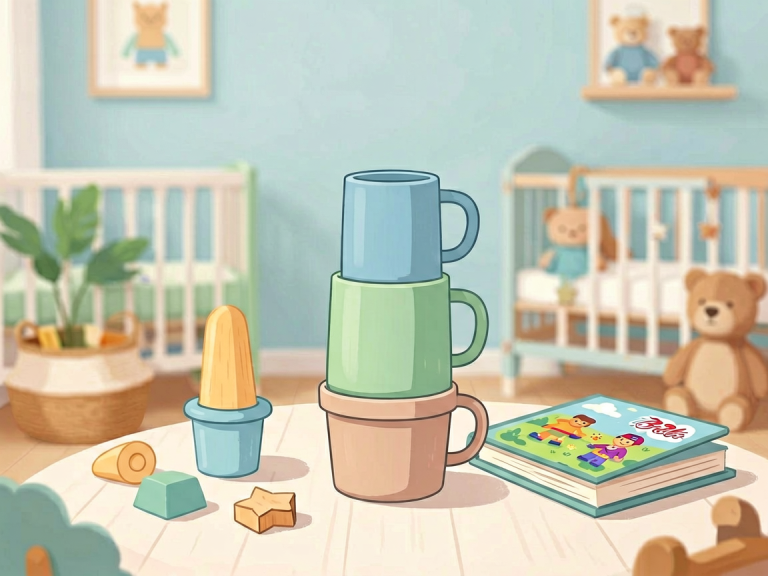
Shape sorters and stacking cups become excellent tools. While the baby may not yet be able to correctly match shapes, they will enjoy banging the pieces together, dumping the cups out, and trying to stack them. Parents can model stacking two cups, then let the baby knock them down. This cause-and-effect play is both satisfying and educational, teaching early concepts of size and balance.
Interactive books with flaps, textures, and sounds are invaluable. Read together with the baby on your lap. Let them point at pictures, turn the pages (even if they bend them), and lift the flaps. Describe what you see in simple words: “Look, the cow says moo! Can you touch the cow’s fuzzy tummy?” This nurtures a love of reading and language development.
For babies who are pulling to stand, dancing together is a joyful activity. Hold the baby’s hands while they stand, and gently sway or bounce to music. This strengthens leg muscles and provides a sense of rhythm. Alternatively, parents can sit on the floor with legs apart, forming a “boat,” and let the baby climb onto their lap and bounce.
Tips for Making Parent-Baby Play Successful
Regardless of the baby’s age, a few principles can maximize the benefits of play. First, follow the baby’s lead. If a baby turns away, looks fussy, or loses interest, it is time to change activity or take a break. Play should never feel forced. Short, frequent sessions (5–15 minutes) are far more effective than long, exhausting ones. Second, be present and attentive. Put away the phone, get down on the floor, and maintain eye contact. The baby will feel your full attention, which is the greatest reward of all. Third, use a warm, encouraging tone. Praising effort (“You tried so hard to grab that toy!”) builds resilience, while specific commentary (“You’re shaking the rattle so fast!”) enriches language learning. Finally, embrace mess and imperfection. Babies will drool on toys, knock down structures, and make chaotic noise. Let them. The goal is not a perfect game but a joyful, shared experience that fosters trust and curiosity.
Conclusion
Play is the language of babies. Through simple, loving interactions—singing a lullaby, rolling a ball, hiding under a blanket—parents provide the richest possible environment for their baby’s development. These activities do not require expensive toys or elaborate planning. They require only time, attention, and a willingness to be silly and playful. In those precious moments of shared laughter, eye contact, and gentle touch, the parent-baby bond deepens, and the foundation for a lifetime of learning is laid. So put down the to-do list, get on the floor, and play. You are giving your baby—and yourself—one of the greatest gifts imaginable.