The Power of Play: How Science Toys for 8-Year-Olds Ignite Lifelong Curiosity
Science toys are far more than mere distractions or gifts that keep children busy. For an 8-year-old, these tools represent a gateway to understanding the world—a hands-on, tangible way to explore concepts that textbooks only hint at. At this age, children are developmentally primed for logical thinking, cause-and-effect reasoning, and the kind of open-ended questioning that drives scientific discovery. The right science toys do not just teach facts; they cultivate a mindset of inquiry, resilience, and creativity. In this article, we will explore why science toys matter for 8-year-olds, what features to look for, and how to choose toys that will nurture a genuine love for learning.
The Developmental Sweet Spot: Why Age 8 Matters
At eight years old, children typically enter what developmental psychologists call the "concrete operational stage." This means they can think logically about concrete events, understand the concept of conservation, and grasp reversibility (the idea that a process can be undone). However, they still struggle with abstract, hypothetical thinking. This makes science toys ideal: they provide concrete, physical experiences that illustrate abstract principles. For example, a simple circuit kit allows an 8-year-old to see that connecting a wire completes a path for electricity, making a bulb glow. That cause-and-effect relationship is powerfully learned through touch, sight, and even trial and error—far more memorably than from a diagram.
Moreover, 8-year-olds are intensely curious and energetic. They ask "why" constantly, but they also want to *do*. They have the fine motor skills to manipulate small parts, the patience to follow multi-step instructions (with occasional guidance), and the social awareness to enjoy collaborative projects. Science toys that involve building, mixing, observing, and recording tap directly into this developmental sweet spot. They channel natural curiosity into structured discovery, building both knowledge and executive function skills like planning and self-regulation.
Key Characteristics of Effective Science Toys for 8-Year-Olds
Not every toy labeled "science" is equally valuable. When selecting a science toy for an 8-year-old, parents and educators should consider several criteria to ensure the toy promotes genuine learning rather than passive entertainment.
Hands-On Experimentation Over Passive Observation
The best science toys require the child to actively manipulate materials, make predictions, and observe outcomes. A chemistry set that includes test tubes, safe powders, and a guide to mixing colors to create reactions is far superior to a pre-assembled display of "crystals." The goal is for the child to ask, "What happens if I add more vinegar?" and then test that hypothesis. Hands-on experimentation also builds fine motor skills and hand-eye coordination, while teaching patience and careful measurement.
Open-Ended Possibilities Versus Rigid Instructions
While instructions are helpful for beginners, the best science toys allow for open-ended play. A building set like a magnetic tile system or a simple robotics kit with sensors and motors can be reconfigured in countless ways. The child is not limited to building one specific model; they can create a car that moves, a crane that lifts, or a creature that follows a line. This flexibility encourages creativity and problem-solving, as well as persistence when a design fails. Failure, in fact, becomes a learning opportunity rather than a source of frustration.
Safety and Durability
For an 8-year-old, safety is paramount. Science toys should be made from non-toxic materials, have no sharp edges, and avoid small parts that could be choking hazards (though 8-year-olds are generally past the mouthing stage, some still put things in their mouths). Durable construction is also important because children at this age can be enthusiastic—they drop things, spill liquids, and apply force. A toy that breaks easily will lead to disappointment and a lost learning opportunity. Look for toys with sturdy plastic, reinforced corners, and easy-to-clean surfaces.
Age-Appropriate Complexity
The toy should be challenging but not frustrating. If a project requires reading dense technical manuals or performing calculations beyond a typical third-grader’s ability, the child may give up. Conversely, if the toy is too simple, boredom sets in. The sweet spot is a toy that has a low entry barrier but offers increasingly complex projects as the child gains skill. For example, a snap-together electronics kit might start with lighting a single LED and advance to building a radio receiver. This progression keeps the child engaged for months or even years.
Categories of Science Toys That Deliver Results
To help navigate the vast market, it is useful to categorize science toys by the type of scientific thinking they promote. Below are several categories with examples that are particularly effective for 8-year-olds.
Chemistry and Physics Kits: Messy, Smelly, and Memorable
Chemistry sets have fallen out of favor in some circles due to safety concerns, but modern versions are both safe and incredibly engaging. Look for sets that use household ingredients like baking soda, vinegar, and citric acid, plus safe indicators like red cabbage juice. The "Mindblown" chemistry sets from Discovery, for instance, offer dozens of experiments that create fizzing, color changes, and even small eruptions. These activities teach concepts like acids and bases, chemical reactions, and the conservation of mass. Physics kits, such as those involving pulleys, levers, and ramps, allow children to explore force, motion, and gravity. The classic "Simple Machines" set from Learning Resources is excellent—children can build a seesaw, a wheelbarrow, and a ramp, then test how changing the angle or weight affects movement.
Robotics and Coding Toys: Building Logic and Sequencing
In the digital age, coding and robotics are essential science skills. For 8-year-olds, block-based coding platforms like Scratch can be paired with physical robots. The "Sphero BOLT" is a programmable robot ball that rolls, changes color, and responds to sensors. Children use a tablet app to drag and drop code blocks, learning loops, conditionals, and variables. Another fantastic option is the "Lego Boost" kit, which combines classic Lego building with a programmable motor and sensors. Children build a robot that can shoot, drive, or even walk, then program it using an icon-based interface. These toys teach computational thinking—breaking problems into small steps, debugging errors, and iterative design—while also providing instant, visible results that keep motivation high.
Earth and Space Science: Rocks, Fossils, and Stars
An 8-year-old is fascinated by the vastness of space and the history of the Earth. Rock and fossil digging kits allow children to excavate "fossils" from a plaster block, then identify them using a guide. The "National Geographic" series offers high-quality kits with real fossils (like shark teeth and ammonites) hidden in a dig block. This hands-on activity introduces paleontology, geology, and the concept of deep time. Similarly, a simple telescope (like the "Celestron FirstScope") can open the night sky. Children can observe the moon's craters, Jupiter's moons, and Saturn's rings, sparking questions about orbits, light, and the solar system. Combine this with a star chart or an app like SkyView, and the child begins to understand patterns and movement in the sky.
Biology and Nature Exploration: Magnifying the Everyday
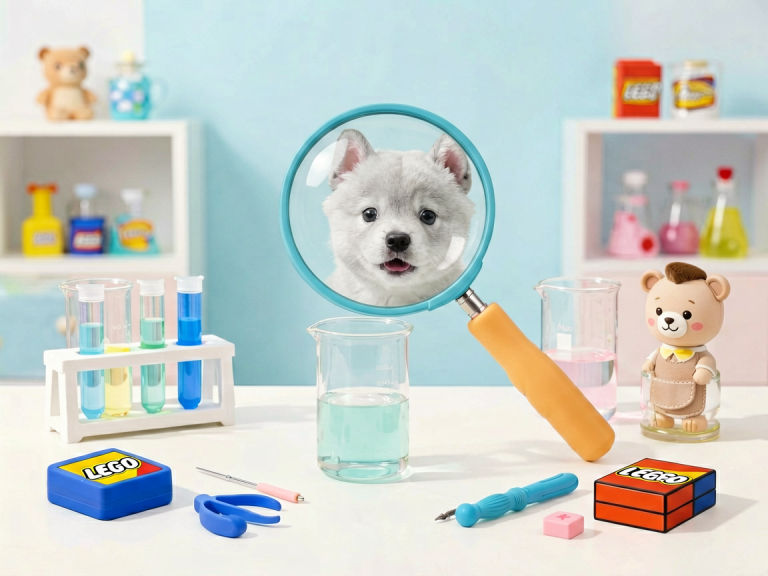
Biology toys help children appreciate the living world around them. A high-quality magnifying glass or a microscope (like the "AmScope" beginner microscope with prepared slides) allows a child to examine the veins of a leaf, the scales of a butterfly wing, or the cells of an onion skin. Nature exploration kits that include a bug catcher, a bird identification guide, and a journal encourage outdoor observation. The "Backyard Safari" line is perfect: it comes with a field guide, a magnifying lens, and tweezers for collecting specimens. Children learn classification, observation skills, and respect for living things. They also develop patience as they wait for a ladybug to crawl onto a leaf or watch a caterpillar transform. This kind of slow, sustained attention is a skill that translates directly to scientific inquiry.
How to Maximize the Learning Experience from Science Toys
Owning a science toy is not enough; the way it is used greatly affects how much a child learns. Parents, teachers, and caregivers can play a crucial role in guiding the experience without taking over.
Ask Open-Ended Questions
Instead of telling a child what to do, ask questions that prompt thinking. For example, when a child is building a circuit, ask, "What do you think will happen if you flip the battery?" or "Why do you think the bulb is dimmer with this wire?" These questions encourage hypothesis formation and verbal reasoning. They also turn a solitary activity into a shared dialogue, strengthening the child's communication skills.
Encourage Journaling and Drawing
Science is not just about doing; it is about documenting. Provide a simple notebook or a "science journal" where the child can draw their observations, write down predictions, and record results. For an 8-year-old, even a few sentences and a diagram are valuable. This habit teaches organization, reflection, and the importance of evidence. Over time, the journal becomes a personal record of discovery that the child can look back on with pride.
Embrace Failure as a Learning Tool
When an experiment fails—a rocket doesn't launch, a crystal doesn't form, a robot doesn't move—resist the urge to fix it immediately. Instead, ask the child what they think went wrong. Help them systematically test one variable at a time. This process of debugging is at the heart of scientific thinking. A child who learns to troubleshoot and iterate will develop resilience and a growth mindset that serves them in all areas of life, not just science.
Connect Toy Play to Real-World Phenomena
Whenever possible, link what the child does with a toy to something they see in daily life. If the child builds a pulley system, point out how a crane at a construction site works the same way. If they mix baking soda and vinegar, explain how volcanoes erupt (with a caveat about magma). These connections make science feel relevant and exciting, not like a separate subject that only happens in a lab.
Conclusion: Planting Seeds for a Scientific Future
Science toys for 8-year-olds are not mere whimsical gifts; they are investments in a child's cognitive and emotional development. By providing hands-on, open-ended, and safe tools for exploration, we give children the chance to become active learners who ask questions, test ideas, and embrace mistakes. Whether it is a chemistry set that fizzes, a robot that follows a code, or a telescope that reveals the moons of Jupiter, these toys create moments of wonder that can last a lifetime. The goal is not to turn every child into a scientist, but to equip every child with the curiosity, resilience, and critical thinking skills that science inherently teaches. So the next time you choose a present for an 8-year-old, consider a science toy—not just as a toy, but as a key to unlock a world of discovery.