Raising Little Scientists: A Parent’s Guide to Science Play That Sparks Lifelong Curiosity
Introduction
Every child is born a scientist. Watch a toddler drop a spoon from the high chair for the tenth time, examine the splatter of yogurt on the floor, or stare at a raindrop sliding down the window. That instinct to observe, test, and ask “what if?” is the foundation of scientific thinking. Yet as children grow, structured schedules and screen time often crowd out this natural exploration. Parents, however, hold a unique power: the ability to turn everyday moments into rich science play. This guide will help you embrace your role as a science play facilitator, offering practical strategies, age-appropriate activities, and mindset shifts that transform your kitchen, backyard, and living room into laboratories of wonder. The key is not to teach facts, but to cultivate a habit of questioning, experimenting, and delighting in discovery.
Why Science Play Matters: More Than Just Fun
Science play is not a luxury; it is a cognitive necessity. When children engage in unstructured, hands-on exploration, they develop critical skills that extend far beyond the classroom. Problem-solving, pattern recognition, cause-and-effect reasoning, and perseverance all emerge naturally when a child tries to build a tower that won’t fall or wonders why ice melts faster in salt water.
Research in developmental psychology shows that early exposure to scientific thinking predicts later academic success in STEM fields, but more importantly, it fosters a growth mindset. A child who learns that a failed experiment is simply data collecting is better equipped to handle setbacks in life. For parents, the beauty of science play is its low barrier to entry: you don’t need a lab coat or a degree. You need only curiosity, a willingness to say “I don’t know, let’s find out,” and a few household materials. This guide will show you how to structure that play without over-structuring it, keeping the joy alive while layering in genuine learning.
Setting Up a Science-Friendly Home Environment
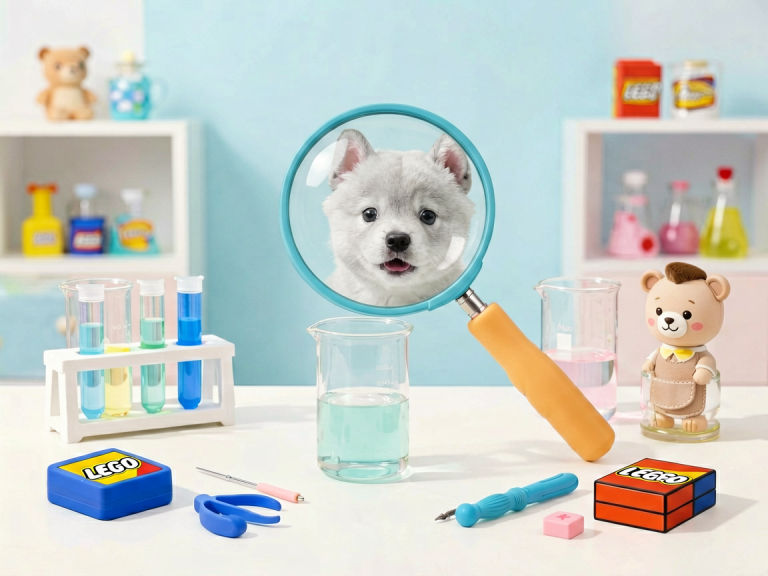
You don’t need a dedicated science corner (though it helps). Instead, think of your home as a resource hub. Start by gathering a “science play kit” in a clear plastic bin: a magnifying glass, a set of measuring cups, a small scale, a flashlight, magnets of various strengths, a pipette or turkey baster, food coloring, baking soda, vinegar, and a collection of empty jars. Rotate items seasonally to maintain novelty.
Equally important is the emotional environment. Create a culture where questions are celebrated, not answered too quickly. When your child asks, “Why is the sky blue?” resist the urge to deliver a textbook explanation. Instead, reply, “That’s a great question. How could we find out? Maybe we can look at sunlight through a prism later.” This shifts the dynamic from passive reception to active investigation. Display a whiteboard or a large sheet of paper where family members can post “mysteries of the week,” such as “Do ants prefer sugar or salt?” or “What happens to a plant if we water it with juice?” This simple practice normalizes curiosity as a family value.
Age-Appropriate Science Play: From Toddler to Teen
For Toddlers and Preschoolers (Ages 2–4): Sensory Foundations
At this stage, science is all about sensory input and simple cause and effect. Focus on texture, sound, motion, and change. Water play is a classic: provide cups, funnels, and sponges in the bathtub or a shallow tray. Let your child pour, squeeze, and splash. Narrate what you see: “The water goes *down* the funnel. The sponge is *heavy* now because it soaked up water.” This builds vocabulary and observational skills.
Another powerful activity is “sink or float.” Gather a collection of objects: a cork, a stone, a plastic toy, a leaf. Fill a basin with water. Ask your child to guess which will sink and which will float, then test each one. Don’t correct wrong predictions immediately; instead, let them re-test and notice patterns. For preschoolers, the goal is not classification but wonder. Use simple magnets to explore what sticks (metal keys) and what doesn’t (wooden blocks). Talk about “attract” and “repel” in a playful tone, as if the magnets are dancing.
For Elementary School Kids (Ages 5–9): Experimentation and Measurement
Children at this age can handle multi-step processes and love to be “scientists.” Introduce the concept of a hypothesis: “What do you think will happen if we mix baking soda and vinegar?” Let them measure, pour, and observe the fizz. Guide them to record results with drawings or simple charts. A favorite is making slime or oobleck (cornstarch and water). The non-Newtonian fluid that behaves like both a solid and a liquid prompts endless questions: “Why does it break when I punch it, but drip when I hold it?” Encourage them to change variables: add more cornstarch, colder water, or food coloring. Each change is a mini-experiment.
Kitchen chemistry is especially rich. Bake cookies together and ask, “What if we leave out the baking powder?” or “What if we double the sugar?” Let them taste the results. For physical science, build simple machines: a lever using a ruler and a pencil, a pulley with a spool and string. Challenge them to lift a heavy book using the lever vs. without it. Ask them to measure how much easier it is.
For Tweens and Teens (Ages 10–14): Hypothesis-Driven Projects
Older children can engage in more systematic inquiry. Help them design a “fair test” at home. For example, “Does the brand of paper towel absorb more water?” They can cut identical strips, dip them for the same time, and measure the water weight. Use a kitchen scale for precision. Introduce the idea of controls and variables. Document the process in a simple lab notebook.
Another excellent area is electronics and coding. Snap circuits or Arduino kits allow teens to build alarms, light sensors, or even a weather station. Encourage them to design a project that solves a household problem: a reminder to water plants when soil is dry, or a light that turns on automatically at dusk. The engineering design process—ask, imagine, plan, create, test, improve—mirrors scientific inquiry. Don’t shy away from failure; a circuit that doesn’t work is a puzzle to solve, not a mistake.
The Art of Asking Questions: Guiding Without Giving Answers
The most critical skill for a parent science guide is questioning technique. Avoid closed questions like “Did it sink?” Instead, use open-ended prompts:
- “What did you notice?”
- “What changed when we added more vinegar?”
- “How is this similar to what happened yesterday?”
- “What would happen if we tried it in a different way?”
- “Can you think of another way to test that idea?”
These questions encourage metacognition—thinking about thinking. They also build resilience: a child who says “I don’t know” is not failing; she is at the threshold of discovery. When your child makes a surprising observation, validate it: “Wow, that’s interesting. I didn’t expect that. Let’s write that down.” This models the scientific attitude of openness to unexpected data.
Use the “five whys” technique for deeper probing. If your child asks, “Why does the balloon inflate when we add baking soda to the bottle?” keep asking “why?” at each level: because gas is produced; why does baking soda and vinegar produce gas? because an acid-base reaction occurs; why does that happen? You may not know the answer, but the journey of wondering together is the point. YouTube and children’s science books are your allies—watch a short video together afterward to confirm or expand your ideas.
Outdoor Science Adventures: Learning from the Natural World
Nature is the ultimate science lab, available for free every day. Take a “science walk” with a focus: “Today we are searching for patterns.” Look at leaves—vein patterns, symmetry. Examine bark textures with a magnifying glass. Collect rocks and sort them by color, weight, or hardness. Bring a simple compass and let your child navigate: “If we walk north, where will we end up?”
Seasonal observations are rich. In fall, ask, “Why do leaves change color? Let’s collect green, yellow, and red leaves and put them in jars with rubbing alcohol to extract the pigments.” In winter, explore frost formation: “Why does ice form on the car windshield but not on the house roof?” In spring, germinate bean seeds in a transparent cup against the glass so roots are visible. Measure growth daily.
Cloud watching becomes a meteorology lesson: identify cumulus, stratus, and cirrus clouds. Discuss what each predicts about weather. Keep a simple weather journal—temperature, wind direction, cloud cover—and look for patterns over a week. For older children, use a plastic bottle to create a cloud in a jar: fill the bottle with hot water, light a match, drop it in, seal, and squeeze. The condensation forms a visible cloud. This activity never fails to inspire awe.
Using Technology Wisely: Apps, Videos, and Virtual Labs
Technology can amplify science play when used intentionally. Choose apps that encourage creation rather than passive consumption. For example, “The Elements: A Visual Exploration” lets children spin and examine 3D models of atoms. “Toca Lab: Elements” is a playful app where kids experiment with fictional elements in a periodic table. For biology, “Seek by iNaturalist” uses the camera to identify plants and animals, then provides fun facts—perfect for outdoor walks.
YouTube channels like “SciShow Kids,” “Mystery Doug,” and “The Spangler Effect” offer short, experiment-based episodes that you can watch before trying at home. Establish a routine: watch a 5-minute video, then replicate the activity. For older children, “Khan Academy” and “Crash Course Kids” provide deeper explanations without being dry.
However, set boundaries. Screens should not replace hands-on experience. Use the 60/40 rule: 60% of science play time should be hands-on, with devices used only to research, record, or watch a demonstration. When using a tablet, sit beside your child and engage in dialogue: “What did you just see? Do you think that would work here?”
Conclusion: The Parent as Co-Explorer
The most powerful thing you can do is to model curiosity. When you encounter something you don’t understand, say “I wonder why that happens” aloud. Let your child see you looking up information, asking questions, and trying again after a failure. Science play is not about turning your child into a prodigy; it is about building a relationship with the world that is based on wonder, humility, and joy. You don’t need to know all the answers. You just need to be willing to ask questions alongside your child, to celebrate the unexpected, and to treat every spilled baking soda or splashed water as a data point in the grand experiment of life.
Start small. Choose one activity from this guide for this week. Maybe it’s a sink-or-float session in the kitchen sink. Or a cloud-in-a-jar magic trick. Or simply asking your child, “What did you wonder about today?” You may be surprised by the depth of their thoughts. Remember: the goal is not to teach science but to live scientifically. And the best part? You will rediscover the world through their eyes—a place of endless questions, tiny explosions, and quiet miracles. That is the true gift of science play.