The Smart Parent’s Toy Guide: Fostering Learning at Home Through Purposeful Play
Introduction
In an age of screens, structured lessons, and academic pressure, it’s easy for parents to feel that learning at home must look like a miniature classroom: flashcards, worksheets, and quiet study time. Yet decades of child development research tell a different story. The most powerful, enduring learning happens when children are actively engaged, curious, and—above all—playing. Toys are not mere distractions; they are the tools through which children explore concepts of physics, language, empathy, logic, and creativity. This guide is designed for parents who want to support learning at home without turning playtime into homework. By choosing the right toys and using them intentionally, you can create an environment where your child learns naturally, joyfully, and deeply.
1. The Science of Play-Based Learning
Before diving into specific toy recommendations, it’s helpful to understand *why* play is such an effective vehicle for learning. Neuroscientists have found that during play, children’s brains are in a state of optimal receptivity. The stress hormone cortisol is low, while dopamine—associated with motivation and reward—is high. This neurochemical cocktail makes children more likely to persist through challenges, make connections, and remember what they discover.
Play also encourages what psychologist Lev Vygotsky called the “zone of proximal development.” When a child plays with a toy that is slightly beyond their current ability—say, a puzzle with a few more pieces than they are used to—they stretch their skills with the support of the toy’s design (and sometimes a parent’s gentle guidance). The best educational toys are those that provide just the right level of challenge, allowing children to experience both success and productive struggle.
Additionally, play builds executive function skills: impulse control, working memory, and cognitive flexibility. A child building a tower must plan, remember the rules of balance, and adapt when the structure wobbles. These are the same skills that predict academic success, career readiness, and even social well-being in adulthood.
2. Age-by-Age Toy Recommendations for Home Learning
Every developmental stage has unique learning needs. Below are curated toy categories that support cognitive, motor, language, and social-emotional growth, organized by age range.
2.1 Infants (0–12 months): Sensory Exploration and Cause-Effect
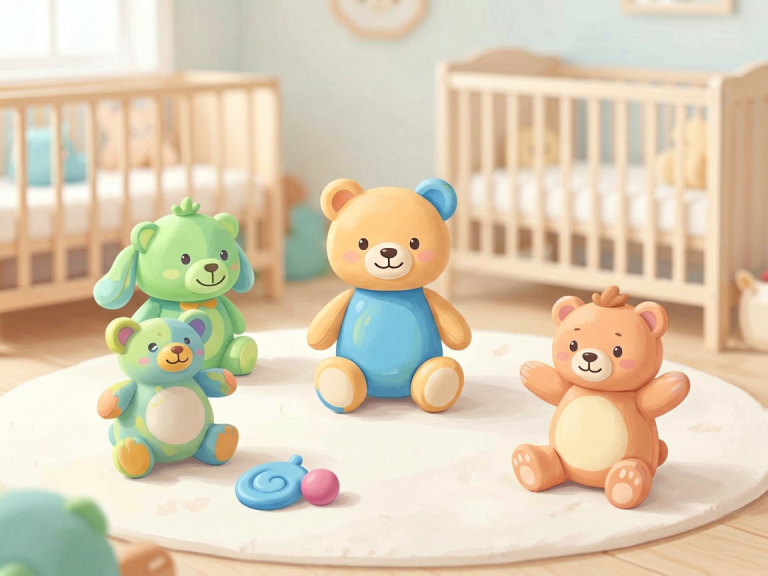
At this stage, learning is all about sensory input and the discovery that actions produce reactions. The best toys are simple, safe, and rich in texture, sound, and contrast.
- High-contrast black-and-white cards and mobiles stimulate visual tracking and focus, laying the foundation for reading and math patterns.
- Soft sensory balls with different surfaces (crinkly, bumpy, smooth) build tactile discrimination.
- Rattles and grasping rings develop hand-eye coordination and the understanding that shaking produces sound.
- Activity gyms with hanging toys encourage reaching and kicking, which strengthens muscles and spatial awareness.
Parent tip: Narrate what your baby sees and does. “You shook the rattle! It made a loud sound.” This simple language input is early literacy support.
2.2 Toddlers (1–3 years): Language, Motor Skills, and Early Problem-Solving
Toddlers are natural explorers. They are learning to walk, talk, and assert their independence. Toys that invite open-ended play and imitation of real life are especially valuable.
- Shape sorters and simple puzzles (2–4 pieces) teach shape recognition, spatial reasoning, and the concept of trial and error.
- Stacking cups or nesting blocks introduce size, order, and balance. They also double as pretend “cups” or “towers,” encouraging symbolic thinking.
- Push-and-pull toys (like a wooden animal on wheels) support gross motor development and the understanding of cause and effect (pulling makes it follow).
- Play kitchens, tool sets, or doll strollers build vocabulary, social scripts, and empathy. A child “cooking” a meal is practicing sequencing, naming foods, and role-playing caregiving.
Parent tip: Follow your toddler’s lead. If they want to stack blocks on their head instead of the floor, laugh and ask questions. This flexibility fosters creativity and language.
2.3 Preschoolers (3–5 years): Imagination, Logic, and Pre-Academic Skills
The preschool years are a golden window for developing foundational literacy, numeracy, and social skills. Toys that combine imagination with structure work best.
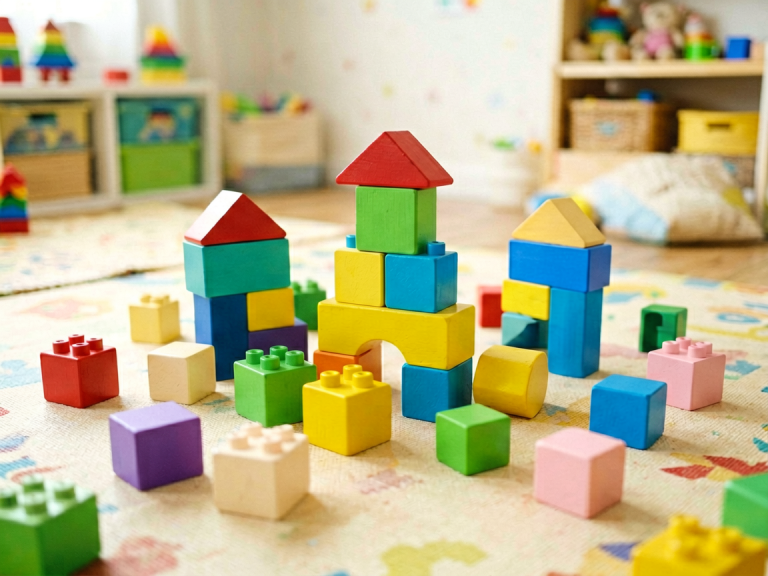
- Building sets like LEGO Duplo or magnetic tiles (e.g., Magna-Tiles) teach geometry, symmetry, and early engineering. Children learn that a square base can support a triangular roof—an intuitive lesson in stability.
- Memory matching games and simple board games (like Candy Land or Zingo) build turn-taking, visual memory, and number recognition without pressure.
- Alphabet and number puzzles or magnetic letters reinforce letter-sound correspondence and counting in a hands-on way.
- Dress-up costumes and puppets encourage storytelling, emotional expression, and perspective-taking. A child pretending to be a doctor practices empathy and develops a narrative structure: “First I check your temperature, then you get a bandage.”
- Water tables, sand tables, or play dough offer sensory-rich opportunities to explore volume, texture, and cause-effect—plus they calm the nervous system.
Parent tip: Ask open-ended questions during play. “What will happen if you put the green block under the red one?” This encourages prediction and problem-solving, core components of scientific thinking.
2.4 Early Elementary (6–8 years): Reading, Math, and Complex Thinking
By age six, many children are ready for more structured learning through play. The key is to maintain the playful spirit while introducing concepts that align with school curricula.
- Advanced building sets (LEO STEM kits, K’NEX) introduce gears, pulleys, and simple machines. A child who builds a working crane is learning mechanical physics.
- Math dice games and card games (like Uno, Qwirkle, or Sum Swamp) practice addition, subtraction, pattern recognition, and strategy—all without worksheets.
- Science kits (grow crystals, make slime, simple circuits) satisfy curiosity about the natural world and teach the scientific method step by step.
- Chapter books with activity companions (e.g., a book about dinosaurs paired with a dinosaur excavation kit) integrate literacy with hands-on discovery.
- Strategy board games (like Sequence, Blokus, or Ticket to Ride) develop spatial reasoning, planning, and resilience when losing.
Parent tip: Let your child lose sometimes—then talk about it. “That was tough! What could you try differently next time?” This builds a growth mindset and emotional regulation.
3. Key Features of Effective Learning Toys
Not every toy marketed as “educational” actually deserves that label. Look for these qualities when shopping:
- Open-endedness. A toy that can be used in many ways (blocks, clay, loose parts) grows with the child and invites creativity. Avoid toys with only one correct outcome—they quickly become boring.
- Multisensory engagement. Toys that involve touch, sight, sound, and sometimes smell or movement create stronger neural connections.
- Gradual complexity. The best toys have a low floor (easy to start) and a high ceiling (can be used in advanced ways). Magnetic tiles are a perfect example: a two-year-old can stack them; a ten-year-old can build a geodesic dome.
- No right/wrong answers (or only constructive failure). Toys that punish mistakes (like electronic toys that beep “wrong!”) create anxiety. Instead, choose toys where errors are simply part of the process—a puzzle piece that doesn’t fit, a tower that falls—prompting the child to try again.
- Social potential. While independent play is valuable, toys that can be shared with siblings or parents facilitate language, negotiation, and cooperation.
4. Practical Tips for Parents: Maximizing the Learning Potential
Having the right toys is only half the battle. How you interact with your child during play determines the depth of learning.
- Create a “yes” space. Dedicate a low shelf or bin where toys are accessible and displayed invitingly. Rotate toys every two weeks to maintain novelty without clutter.
- Use the language of play. Instead of “Let’s learn numbers,” say, “I wonder how high we can stack these blocks before they tumble?” This frames learning as exploration.
- Limit screen-based toys. Electronic toys that talk or flash lights often do the thinking for the child. The best learning happens when the child is the active agent, not a passive observer.
- Embrace boredom. If your child says “I’m bored,” resist the urge to offer a new toy. Boredom is the mother of creativity; it pushes children to invent their own games.
- Join in—but don’t take over. Sit on the floor and play alongside your child. Ask questions, model problem-solving, and then step back. Your presence signals that play matters.
5. Conclusion: Play is the Curriculum
Supporting learning at home does not require expensive gadgets, workbooks, or a strict schedule. It requires a mindset shift: seeing every toy as a potential learning tool and every play session as an opportunity for growth. By choosing toys that align with your child’s developmental stage and by interacting with curiosity and patience, you are building not just academic skills, but a lifelong love of learning. The toy aisle can feel overwhelming, but remember: the best toy is one that invites your child to wonder, experiment, and connect. And the most powerful learning tool in the room is you, sitting beside them, ready to marvel at what they discover.