The Thoughtful Parent’s Guide to Choosing Age‑Appropriate Toys for Toddlers
Introduction
Walking into a toy store with a toddler in tow can feel like stepping into a kaleidoscope of colors, sounds, and tempting packaging. Every shelf promises fun, learning, or both. Yet for parents, the real challenge is not picking the shiniest box—it is choosing a toy that matches a toddler’s unique developmental stage. An age‑appropriate toy does more than entertain; it nurtures motor skills, sparks curiosity, builds social‑emotional understanding, and keeps little hands safe. This guide will help you navigate the noisy aisles and make informed decisions that support your child’s growth from the first wobbly steps through the magical third year of life.
—
Understanding Toddler Development: A Quick Overview
Before diving into specific toy categories, it helps to understand what toddlers are learning at different ages. The toddler years (roughly 12 to 36 months) are a period of explosive growth.
- 12–18 months: Children are refining their gross motor skills (walking, climbing) and beginning to use their hands deliberately. They love cause‑and‑effect games, stacking objects, and exploring textures.
- 18–24 months: Language explodes, pretend play starts, and toddlers become fascinated with sorting, matching, and simple puzzles. They are also learning about boundaries.
- 24–36 months: Imagination blooms. Toddlers engage in more complex pretend scenarios, enjoy cooperative play with peers (though parallel play is still common), and can follow two‑step instructions. Their fine motor skills allow for crayons, buttons, and basic construction sets.
Keeping these milestones in mind is the first step toward selecting toys that challenge without frustrating and engage without overwhelming.
—
Safety First: Non‑Negotiables for Every Toy
Age‑appropriateness is inseparable from safety. However clever or educational a toy looks, if it poses a risk, it does not belong in a toddler’s hands.
No small parts. Anything that can fit inside a toilet paper roll is a choking hazard for children under three. Always check the manufacturer’s age label, and be especially cautious with toys that have button eyes, loose batteries, or detachable pieces.
Non‑toxic materials. Toddlers explore with their mouths. Choose toys made from BPA‑free plastic, untreated wood finished with water‑based paints, or certified organic fabrics. Avoid anything with a strong chemical smell.
Sturdy construction. A toy that breaks easily can create sharp edges or splinters. Look for solid joins, tightly sealed seams, and parts that do not wobble.
No long cords or strings. Cords longer than 12 inches can become strangulation hazards. Pull‑toys are fine if the string is short and the toy is light. Battery compartments should be secured with a screw, not a snap.
Supervision reminder. No toy replaces an adult’s watchful eye. Even the safest choice needs oversight during active play.
—
By Age: Recommended Toy Types and Their Benefits
12–18 Months: The Sensorimotor Explorer
At this stage, toddlers are sensory scientists. They drop, bang, shake, and mouth everything to understand how the world works.
Toys to choose:
- Stacking rings and nesting cups. They teach size relationships and hand‑eye coordination. A simple ring stacker with a wobbling base adds a delightful cause‑and‑effect surprise.
- Push‑and‑pull toys. A sturdy wooden push cart or a pull‑along animal on a short string supports walking balance. Choose one that makes a gentle sound (clicking wheels, a bell) to reinforce the connection between action and effect.
- Soft blocks. Lightweight fabric or foam blocks allow safe stacking and knocking‑down, which is a toddler’s first lesson in physics.
- Board books with textures. Books that include fuzzy, bumpy, or crinkly pages encourage tactile exploration and early literacy.
- Activity cubes or busy boards. A cube with beads to slide, doors to open, and buttons to press occupies a toddler for long stretches while building fine motor control.
What to avoid: Complex puzzles, small figurines, toys that require precise fine‑motor manipulation (e.g., threading beads), or anything with loud electronic noises that might overwhelm a sensitive toddler.
18–24 Months: The Emergent Thinker and Talker
Now toddlers are using simple words and beginning to make mental connections. They love toys that let them sort, match, and imitate daily routines.
Toys to choose:
- Simple shape sorters. A classic cube with cutouts for circles, squares, and triangles. Look for one with a lid that opens, so the child can also dump the shapes and start over—an early lesson in cause and effect.
- Basic puzzles. Two‑ to four‑piece wooden puzzles with large knobs help develop pincer grasp and spatial reasoning. Choose themes like farm animals or vehicles that match your child’s interests.
- Pretend‑play starter sets. A plastic telephone, a child‑safe mirror, or a soft doll with a blanket. This is the beginning of symbolic thinking—the doll “sleeps,” the phone “rings,” and the child practices social roles.
- Large stringing beads. Beads with holes wide enough for a chunky lace help strengthen hand muscles and patience. Choose wooden beads with non‑toxic paints.
- Musical instruments. A small drum, maracas, or a xylophone (with a soft mallet) encourage rhythm, cause‑and‑effect, and auditory discrimination.
What to avoid: Toys with many tiny pieces that can be scattered or lost, complex electronic toys that do all the work for the child, and anything that requires reading or numbers—these will cause frustration rather than learning.
24–36 Months: The Imaginative Architect and Social Learner
Two‑ and three‑year‑olds are bursting with creativity and a growing sense of self. They love to build, pretend, and interact with others.
Toys to choose:
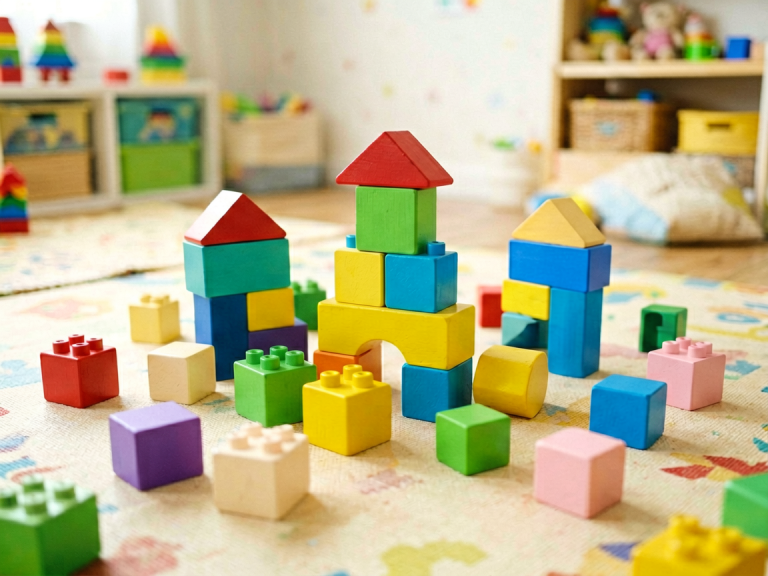
- Building sets. Large interlocking blocks (like Duplo or wooden unit blocks) allow toddlers to construct towers, houses, and bridges. Building teaches planning, balance, and spatial awareness.
- Dress‑up gear. A simple cape, a firefighter hat, or a pair of plastic binoculars invites pretend roles. These props boost language development as the child narrates their play.
- Art supplies. Thick, washable crayons, non‑toxic finger paints, and large paper. Art develops fine motor skills, color recognition, and self‑expression. Be prepared for mess—lay down newspaper or a vinyl tablecloth.
- Play kitchens and tool benches. A mini kitchen with pots, plastic food, and utensils lets toddlers imitate adult activities. A workbench with a hammer and pegs serves the same purpose for children who prefer construction.
- Cooperative games. Simple matching games (e.g., “find the pair of socks”) or a memory game with just a few card pairs can be played together. Focus on turn‑taking, not winning.
- Ride‑on toys. A sturdy, foot‑powered car or a balance bike (with no pedals) builds leg strength and large motor coordination. Ensure the toy is low to the ground and stable.
What to avoid: Electronic tablets or apps designed for older children—toddlers need real‑world interaction. Also avoid sets with hundreds of tiny bricks (they are frustrating and unsafe) or toys that promote passive watching over active doing.
—
Five Guiding Principles for Any Toy Purchase
- Follow the child, not the label. Manufacturer age ranges are helpful guidelines, but your toddler may be ahead or behind in a specific skill. Watch how your child plays. If a toy is too simple, they will ignore it; if too hard, they will become frustrated. Adjust accordingly.
- Prioritize open‑ended toys. Toys that can be used in many ways—blocks, clay, scarves, cardboard boxes—grow with the child. A cardboard box can become a car, a cave, or a rocket ship. These toys stimulate creativity far more than a plastic robot that only does one thing.
- Less is more. A room overflowing with toys can overwhelm a toddler’s developing attention span. Rotate toys every few weeks: put some away and bring out a few new choices. This keeps interest high and reduces decision fatigue.
- Value process over outcome. When a toddler stacks blocks and the tower falls, the learning is in the trying, not the standing. Choose toys that allow trial and error, and resist the urge to “fix” the play. Let your child explore at their own pace.
- Include the whole family. Some toys are meant for solitary play, but many work beautifully with a parent or sibling. Simple board games, musical instruments, and building sets create shared moments of laughter and connection. These interactions teach social skills that no app can replicate.
—
When to Say No: Common Pitfalls to Avoid
- Don’t buy “educational” toys that claim to teach reading or math to one‑year‑olds. Toddlers learn through movement, sensory play, and human interaction, not flashcards.
- Avoid toys that require batteries for constant sound and light. Such toys often over‑stimulate and leave little room for the child’s own imagination.
- Skip “collectible” sets that pressure children to have the whole series. These encourage materialism, not joyful play.
- Resist the urge to buy years ahead. A toy labeled for ages 5+ may have small parts or complex rules that a toddler cannot handle—and could be dangerous.
—
Conclusion: The Best Toy Is a Thoughtful Parent
Armed with this guide, you are now ready to shop with confidence. Remember that children do not need a mountain of toys to thrive—they need a few carefully chosen objects that match their abilities, spark their curiosity, and keep them safe. The most valuable gift you can give your toddler is your presence: sitting on the floor, stacking blocks together, pretending to drink from a plastic teacup, and marveling at the magic of a single cardboard box.
Age‑appropriate toys are tools, but the real play happens in the relationship between you and your child. So choose wisely, play freely, and enjoy every wobbly, giggling, messy moment of these precious early years.