The Ultimate Toy Path for Hands-On Learning: From Sensory Play to Real-World Mastery
Introduction
In an age dominated by screens and passive entertainment, the value of hands-on learning has never been more critical. Hands-on learning—where children actively manipulate, build, experiment, and create—engages multiple senses, fosters deep understanding, and cultivates problem-solving skills that no app can replicate. But not all toys are created equal. The *best toy path for hands-on learning* is not a single product but a developmental journey: a thoughtfully curated sequence of toys that evolves with a child’s cognitive, motor, and emotional growth. This article outlines a research-backed, stage-by-stage toy roadmap—from infancy through adolescence—that maximizes tactile exploration, creative thinking, and real-world competence. By following this path, parents and educators can ensure that every play session becomes a powerful learning opportunity.
—
The Foundational Years: Sensory and Manipulative Toys (0–3 Years)
During the first three years, the brain develops at an astonishing rate, forming neural connections through sensory input and motor actions. The best toys for this stage are those that invite touch, taste, sight, sound, and movement—without complex instructions.
Key Toy Categories
- Sensory Balls and Textured Blocks: Soft, knobby balls and blocks with varied surfaces (smooth, bumpy, ridged) stimulate tactile awareness and encourage grasping, rolling, and stacking. These simple objects teach cause and effect: “When I push this ball, it rolls away.”
- Peg Pounding Benches and Shape Sorters: These classic toys require a child to coordinate hand-eye movement—pounding a peg with a wooden mallet or fitting a triangle into a triangle hole. They build fine motor control and early spatial reasoning.
- Water and Sand Play Sets: Scooping, pouring, and digging involve both gross and fine motor skills. Water tables and sandboxes are open-ended, allowing endless experimentation with volume, weight, and texture.
Why They Work for Hands-On Learning
At this age, children are sensorimotor learners, in Piaget’s terms. They understand the world by acting on it. A shape sorter does more than teach shapes; it teaches persistence (try again if the square doesn’t fit the circle), spatial relationships, and the satisfaction of mastery. The key is to choose toys that are *responsive*—they change in a direct, predictable way when the child acts. This feedback loop is the essence of hands-on learning.
—
The Preschool Phase: Building Blocks and Pretend Play (3–5 Years)
Around age three, children begin to represent objects mentally and engage in symbolic play. This is the golden age of construction and imagination. The best hands-on toys here are those that bridge physical manipulation with mental storytelling.
Key Toy Categories
- Unit Blocks (e.g., wooden building blocks): Unlike plastic snap-together bricks, unit blocks (standardized wooden cubes, cylinders, arches) require balancing, alignment, and an understanding of gravity. Children learn engineering basics—a wide base supports a taller tower—while inventing castles, bridges, and cities.
- Play Dough and Modeling Clay: Rolling, pinching, and sculpting develop hand strength and creativity. Adding simple tools (plastic knives, rollers, cookie cutters) introduces planning (“I’ll make a snake first, then coil it into a snail”).
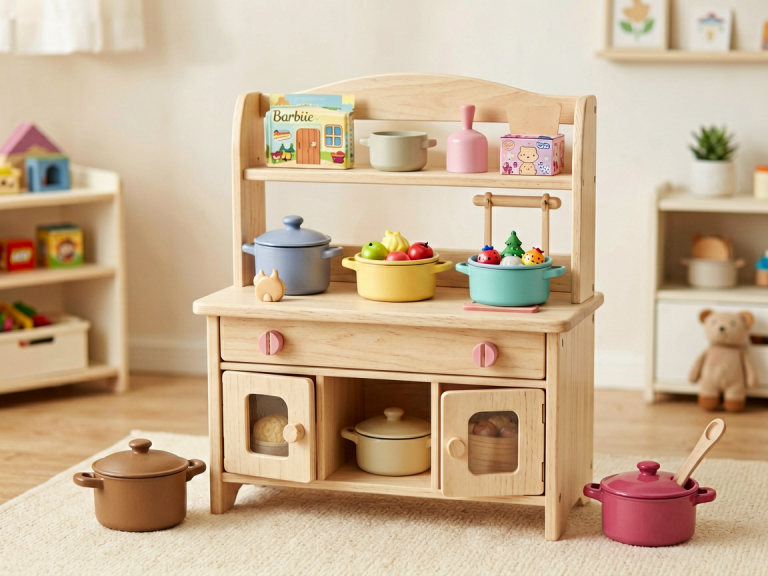
- Dress-Up Costumes and Play Kitchens: Pretend play becomes a hands-on laboratory for social roles. A toy kitchen with pots, pans, and play food teaches sequencing (first cut, then cook, then serve) and cooperation when playing with peers.
Why They Work for Hands-On Learning
Preschoolers need toys that allow them to *transform* their environment. A set of unit blocks can become a dinosaur park or a spaceship. This flexibility forces the child to make decisions, test hypotheses (“If I put this arch here, will it collapse?”), and adapt. Moreover, pretend play integrated with physical objects strengthens language development as children narrate their actions. The toy path at this stage should prioritize *open-endedness* over electronic bells and whistles.
—
Early School Age: Construction Kits and STEM Toys (5–8 Years)
As children enter formal schooling, their attention spans lengthen and they can follow multi-step instructions. However, hands-on learning remains vital for consolidating abstract concepts like math and physics. The best toys now introduce mechanical principles, simple engineering, and basic coding.
Key Toy Categories
- Construction Systems (e.g., LEGO Classic, K’NEX, Magna-Tiles): While LEGO is ubiquitous, the classic brick sets—without themed instructions—offer the richest hands-on experience. Children design their own structures, learning about symmetry, load-bearing, and friction. Magnetic tiles (Magna-Tiles) are especially good for exploring 3D geometry and magnetism through tactile assembly.
- Simple Machines Kits: Toys like the “Learning Resources Gears! Gears! Gears!” set or a basic pulley-and-lever kit allow children to physically *feel* how gears mesh, how a lever multiplies force, and how a pulley changes direction. This kinesthetic understanding is far stickier than reading about it in a textbook.
- Robot Kits for Beginners (e.g., littleBits, Botley the Coding Robot): These modular systems let children snap together circuits or code through tactile blocks. They see immediate physical results—a light turns on, a robot moves forward. The hands-on debugging process (why isn’t the motor spinning?) teaches logic and troubleshooting.
Why They Work for Hands-On Learning
At this stage, the brain is primed for cause-and-effect reasoning. Construction kits demand *iterative design*: build, test, break, rebuild. A child who builds a bridge and watches it collapse under a toy car learns about structural integrity more deeply than any worksheet could teach. Additionally, these toys introduce failure as a natural part of learning—a crucial emotional skill. The toy path should gradually increase complexity while still allowing the child to work at their own pace.
—
Middle Childhood: Advanced Kits and Creative Tools (8–12 Years)
Pre-adolescents crave autonomy and mastery. They are ready for projects that require sustained attention, planning, and more sophisticated tools. The best hands-on toys for this age blend art, science, and technology, often with real-world applications.
Key Toy Categories
- Advanced Robotics and Electronics Kits (e.g., LEGO Mindstorms, Arduino Starter Kits): These kits involve building programmable robots or circuits. Children write code, wire sensors, and test mechanical designs. The feedback is immediate and complex—a robot that follows a line or a light that responds to sound. This mirrors professional engineering workflows.
- Chemistry and Biology Experiment Sets (e.g., Thames & Kosmos, Snap Circuits): Quality science kits with real lab equipment (test tubes, beakers, microscopes) let children conduct actual experiments: growing crystals, building a simple radio, or dissecting a flower. The hands-on component includes measuring, mixing, and observing changes—scientific method in action.
- Woodworking and Crafting Tools (e.g., X-Acto knife sets, hand drills, sewing machines): Using real tools under supervision fosters precision and patience. Building a birdhouse, sewing a pillow, or carving a piece of soap stone teaches measurement, spatial visualization, and the satisfaction of creating a functional object.
Why They Work for Hands-On Learning
Middle childhood is a time when children can combine multiple domains—math, physics, design, art. A robotics project forces them to integrate coding logic with mechanical assembly. A woodworking project requires reading plans, measuring accurately, and using tools safely. These toys cultivate *project-based learning*: the child sets a goal, encounters obstacles, solves them, and sees concrete results. The toy path should now emphasize *authenticity*—toys that feel like real-world problem-solving.
—
Adolescence: Complex Projects and Real-World Tools (12+ Years)
Teenagers are capable of abstract reasoning and long-term commitment. For them, the best hands-on learning path moves beyond toys into *tools and systems* that mirror professional disciplines. This is where passion projects take off.
Key Toy Categories
- 3D Printers and CNC Machines (e.g., Creality Ender, Glowforge): Designing a 3D model in CAD software and then watching it materialize layer by layer is a profound hands-on experience. It connects digital design with physical fabrication, teaching trial and error, material science, and patience.
- Full Robotics and Drone Kits (e.g., RoboMaster, DJI RoboMaster S1): These advanced kits involve complex programming, computer vision, and mechanical engineering. They require weeks of assembly and coding, culminating in a functional robot that can compete in challenges.
- Electronics Workbenches and Repair Kits (e.g., soldering stations, component sets): Teens can learn to solder, build amplifiers, or repair old electronics. This practical skill not only teaches electricity and circuit theory but also instills a sense of independence—they can fix things themselves.
- Cooking, Gardening, and Carpentry Projects: Real-world activities with adult tools (kitchen knives, soil, hammers) provide the ultimate hands-on education. Following a recipe is applied chemistry; building a planter box is applied geometry and physics.
Why They Work for Hands-On Learning
Teens need to feel a sense of purpose. The best hands-on toys for this age are those that produce *authentic artifacts*—a working robot, a custom piece of furniture, a delicious meal. These projects demand planning, resourcefulness, and resilience. They also often involve digital fabrication, bridging the physical and digital worlds—a critical skill for the 21st century. The toy path should culminate in tools that allow teens to pursue their own interests, whether in engineering, art, or food science.
—
Conclusion: Designing Your Child’s Hands-On Learning Journey
The best toy path for hands-on learning is not a shopping list but a philosophy: choose toys that invite active manipulation, foster open-ended exploration, and grow with the child. Start with simple sensory objects for infants, progress to block play and pretend for preschoolers, then introduce construction kits and basic STEM for early school years. In middle childhood, advance to robotics, chemistry, and real tools. Finally, in adolescence, embrace fabrication tools and real-world projects.
Throughout this journey, remember that less is often more. A well-chosen set of wooden blocks can engage a child for years, while a shelf of flashy electronic toys may be quickly abandoned. Hands-on learning thrives on *depth*, not breadth. By following this developmental toy path, you equip your child with the most powerful learning tool of all: their own hands and mind, working together to understand and shape the world.