The Transformative Power of Educational Early Learning Toys for Kids: Nurturing Minds Through Play
In the bustling, fast-paced world of modern parenting, one question consistently occupies the minds of caregivers and educators alike: How can we give our children the best possible start in life? While countless answers exist—from enriched nutrition to early music exposure—few are as joyful, accessible, and scientifically grounded as the deliberate use of educational early learning toys. These are not mere distractions or pacifiers; they are carefully designed tools that transform the natural, spontaneous play of childhood into a profound foundation for lifelong learning. As research in neuroscience and developmental psychology continues to unveil the unparalleled plasticity of the young brain, the role of purpose-driven playthings becomes increasingly clear: they are the silent teachers that shape curiosity, resilience, creativity, and critical thinking from the very first years of life.
The Neuroscience Behind Play: Why Educational Toys Matter in the Early Years
The human brain undergoes its most explosive growth during the first five years, forming over one million neural connections every second. This period, often called the "critical window," is when foundational cognitive, social, and emotional architectures are laid down. Educational early learning toys are uniquely positioned to capitalize on this window because they engage multiple senses simultaneously and require active participation. Unlike passive entertainment such as television or tablet games, high-quality educational toys demand that the child manipulate, experiment, solve problems, and make decisions. For instance, a simple set of wooden blocks does more than occupy hands—it teaches spatial reasoning, balance, cause and effect, and even basic physics through trial and error. When a toddler stacks a block too high and watches it tumble, their brain is not just experiencing a moment of frustration; it is actively mapping the relationship between weight, angle, and gravity. This is learning that sticks, and it happens because the toy is designed to invite exploration rather than simply to reward consumption.
Key Categories of Educational Early Learning Toys and Their Unique Benefits
While the market overflows with colorful products claiming educational value, parents and educators benefit from understanding the distinct categories that address different developmental domains. Recognizing these categories helps in selecting toys that target specific skills without overwhelming a child’s natural pace of growth.
Sensory and Motor Development Toys
The earliest educational toys focus on the senses and physical coordination. Items such as textured rattles, soft fabric cubes with crinkly sounds, stacking rings, and grasping beads are deceptively simple but profoundly important. They stimulate tactile, auditory, and visual perception while building fine motor skills. For infants, a high-contrast black-and-white mobile encourages visual tracking; for older toddlers, a pegboard set requires precise hand-eye coordination to place pegs into holes. Montessori-inspired sensory bins filled with rice, sand, or water offer open-ended exploration that strengthens neural pathways associated with touch and proprioception. These toys are the building blocks for later abilities like writing, drawing, and even sports.
Construction and Problem-Solving Toys
Once children begin to display intentional manipulation, construction toys become invaluable. Classic wooden blocks, LEGO Duplo, magnetic tiles, and interlocking gears all fall into this category. They teach foundational STEM concepts—balance, symmetry, leverage, and design—while simultaneously fostering perseverance. A child attempting to build a tower that does not fall learns to adjust their strategy, test hypotheses, and tolerate failure. These toys are inherently self-correcting: if the structure collapses, the child knows something went wrong and must try again. This process builds a growth mindset far more effectively than any worksheet or lecture ever could. Moreover, construction play often becomes social, as children collaborate to build cities, bridges, or spaceships, learning negotiation, sharing, and cooperative problem-solving.
Language and Literacy Toys
Language acquisition is one of the most remarkable achievements of early childhood, and toys can serve as powerful accelerators. Alphabet puzzles, magnetic letters, story sequencing cards, and simple rhyming games introduce phonemic awareness in a playful context. More sophisticated items like talking books or interactive story cubes encourage vocabulary expansion and narrative thinking. Importantly, educational language toys should never replace human interaction—the rich back-and-forth of conversation, the warmth of a parent reading aloud—but they can supplement and reinforce these experiences. For example, a set of picture cards depicting emotions helps toddlers name and understand feelings, building emotional intelligence alongside language skills. Toys that incorporate multiple languages, such as bilingual matching games, also lay the groundwork for future multilingualism during the period when the brain is most receptive to different sound patterns.
Mathematical and Logical Reasoning Toys
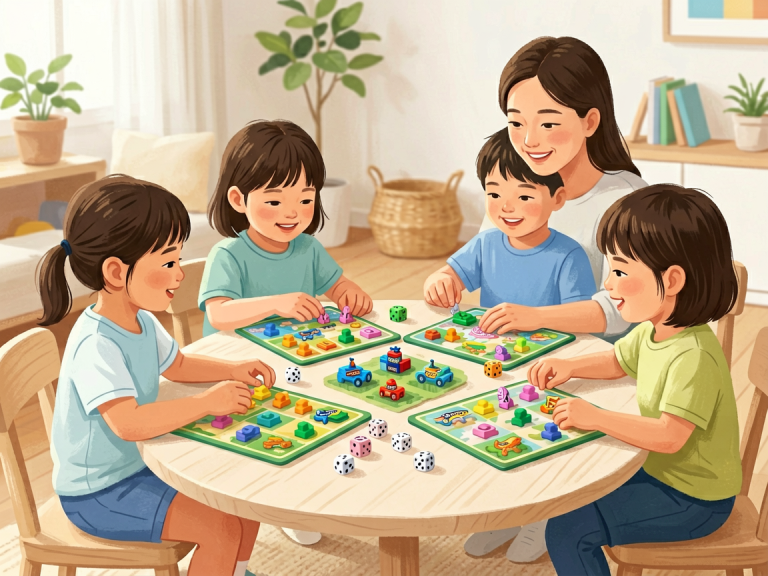
Many parents mistakenly believe that math skills emerge only in formal schooling, but the foundations of numeracy are formed much earlier. Sorting and classifying toys—colorful bears, shape sorters, counting beads, and pattern blocks—introduce concepts like one-to-one correspondence, categorization, and sequencing. A simple board game with dice teaches counting and number recognition while also building patience and turn-taking. More advanced preschoolers can explore balance scales, simple abacuses, or Montessori golden bead materials that visually represent quantities up to thousands. These toys make abstract mathematical ideas concrete and tangible. When a child physically moves beads from one side to another while counting, they are not just memorizing numbers; they are internalizing the logic of addition and subtraction.
Creative and Imaginative Play Toys
Finally, no discussion of educational early learning toys would be complete without acknowledging the power of creativity and imagination. Dress-up costumes, puppet theaters, play kitchens, pretend tool sets, and art supplies like washable paints, modeling clay, and child-safe scissors allow children to enact stories, experiment with roles, and express emotions. This type of play is deeply educational because it develops narrative intelligence, empathy, and flexible thinking. A child who pretends to be a doctor caring for a stuffed animal is practicing empathy and learning about the human body; a child who builds a fort out of blankets and chairs is engaging in engineering and design. Open-ended creative toys, those that do not dictate a single right answer, are particularly valuable because they encourage divergent thinking—the ability to generate multiple solutions to a problem, a skill highly correlated with later academic and professional success.
How to Choose the Right Educational Toys for Your Child: A Practical Guide
With an overwhelming array of choices, selecting the right educational toys can feel daunting. However, a few guiding principles can simplify the process and ensure that the toys you bring home truly support development rather than merely clutter the playroom.
First and foremost, consider age appropriateness. A toy that is too advanced will frustrate a child, while one that is too simple will bore them. Reputable manufacturers clearly label age ranges, but parents should observe their own child’s unique abilities and interests. A two-year-old who shows advanced fine motor skills might enjoy a simple puzzle meant for a three-year-old, while a four-year-old who is still working on basic hand strength may benefit from larger, chunkier blocks.
Second, prioritize open-ended toys over single-purpose ones. A toy that can be used in many different ways—such as a set of wooden logs, a box of colored scarves, or a collection of natural stones—offers far more learning opportunities than a battery-powered robot that performs only one action. Open-ended toys grow with the child, supporting different stages of development and encouraging creativity.
Third, safety is non-negotiable. Check for non-toxic materials, rounded edges, and the absence of small parts that could pose choking hazards. Look for certifications such as ASTM (American Society for Testing and Materials) or CE (Conformité Européenne) marks. For very young children, avoid toys with long strings or cords that could cause strangulation.
Fourth, consider the toy’s ability to engage multiple senses and promote active manipulation. The best educational toys require the child to do something—touch, move, stack, sort, build, or create—rather than simply watch or listen. Passive toys have limited developmental benefit, while active ones forge stronger neural connections.
Finally, trust your child’s lead. Observe what captures their attention during free play. If they are constantly fascinated by patterns, a set of mosaic tiles might be perfect. If they love pretending to cook, a play kitchen with real-looking utensils will invite hours of imaginative storytelling. The most effective educational toys are those that align with a child’s intrinsic curiosity, because genuine engagement is the engine of deep learning.
The Cognitive and Social-Emotional Benefits of Educational Play
The advantages of educational early learning toys extend far beyond academic readiness. Research consistently shows that children who engage regularly with well-designed developmental toys demonstrate stronger executive function skills—the set of mental processes that include working memory, flexible thinking, and self-control. For example, a child playing a memory card game must hold multiple images in mind while resisting the impulse to flip cards randomly; this directly trains the prefrontal cortex, the brain’s command center for higher-order thinking. Similarly, construction play that requires following a visual plan—such as building a specific model from magnetic tiles—teaches sustained attention and goal-directed behavior.
Social-emotional development is equally enriched. Many educational toys are designed for collaborative use. Board games teach children how to take turns, manage disappointment when they lose, and celebrate others’ successes. Dramatic play sets encourage empathy as children step into the shoes of different characters. Even solitary play with educational toys teaches emotional regulation: a child who works on a challenging puzzle must learn to manage frustration, persist through difficulty, and experience the satisfaction of mastery. These small victories build resilience and self-esteem that will serve them in school and in life.
Furthermore, educational toys can bridge gaps in early childhood development. For children with special needs—including those on the autism spectrum or with speech delays—specific toys like sensory bins, weighted stuffed animals, or picture exchange communication systems can be powerful therapeutic tools. Occupational therapists and speech-language pathologists routinely incorporate such toys into their sessions because they naturally motivate children to practice skills in a low-pressure, enjoyable context.
Integrating Educational Toys into Daily Routines Without Overwhelm
Parents often worry that they need to orchestrate elaborate learning sessions to maximize the value of educational toys. In reality, the most effective approach is subtle and organic. Rather than scheduling a "learning time," consider creating a play environment that invites spontaneous engagement. Place a few carefully chosen toys at a low shelf within easy reach, rotating them every week or two to maintain novelty. Allow the child to explore independently, but also join them occasionally—not to direct, but to model curiosity. Ask open-ended questions: "What do you think will happen if we put this piece here?" or "Can you tell me a story about what your doll is doing today?" This kind of supportive interaction enhances learning without turning play into a chore.
It is equally important to balance educational toys with unstructured time. The child who spends all day with structured learning materials may miss out on the benefits of free, imaginative play without any pre-defined goal. Sand, water, sticks, leaves, and boxes—non-toy objects—offer some of the richest learning opportunities. Educational toys should supplement, not replace, this vital raw material of childhood.
Finally, resist the pressure to amass a large collection. A small number of high-quality, versatile toys used thoughtfully is far more valuable than a room crammed with gadgets that overwhelm and overstimulate. A classic set of unit blocks, a few puzzles, a simple art station, and a dress-up box can provide a complete early learning curriculum for years.
Conclusion
Educational early learning toys for kids are far more than consumer products; they are tools of empowerment, catalysts for wonder, and companions on the journey of discovery. From the first rattle that sparks an infant’s awareness of cause and effect, to the complex building set that challenges a preschooler’s spatial reasoning, these toys shape the very architecture of the developing mind. They teach children not only what to think, but how to think—how to question, experiment, fail, and try again. In an era when early childhood education is increasingly formalized and pressured, educational toys remind us that the deepest learning occurs through joy, curiosity, and the simple, timeless act of playing. By choosing wisely and engaging lovingly, parents and educators can give children the greatest gift of all: a strong, flexible, and joyful foundation for a lifetime of learning.