Unlocking Early Numeracy: The Best Beginner Toys for a Strong Math Foundation
Introduction: Why Early Math Matters
Mathematics is often perceived as a daunting subject, but its foundations are built long before a child enters a classroom. From sorting socks by color to counting steps on a staircase, young children naturally encounter mathematical concepts in their daily lives. The key to fostering a positive relationship with math lies in making these early encounters playful, concrete, and hands-on. Beginner toys designed for early math development do exactly that: they transform abstract ideas like numbers, shapes, and patterns into tangible, engaging experiences.
Research in cognitive development, particularly from theorists like Jean Piaget and Maria Montessori, emphasizes that children learn best through sensory exploration and manipulation. Between the ages of two and five, the brain is exceptionally receptive to concepts such as one-to-one correspondence, classification, and spatial reasoning. Providing the right toys at this stage does not mean drilling flashcards or forcing worksheets. Instead, it means offering open-ended, purposefully designed materials that invite discovery. This article explores five categories of beginner math toys, each targeting a specific foundational skill, and explains how they support early numeracy in a joyful, natural way.
1. Counting and Number Recognition Toys
The most obvious starting point for early math is counting. But true number sense involves more than reciting “one, two, three.” It includes understanding that the last number said represents the total quantity, and that numbers have a consistent order. Beginner toys that excel in this area often combine visual, tactile, and auditory cues.
*Examples and Benefits:*
Classic counting bears are a staple. These small, colorful plastic bears come in different sizes and can be used for counting, sorting, and simple addition. A child placing one bear in each cup of a muffin tin is practicing one-to-one correspondence—the idea that each object corresponds to exactly one count. Similarly, wooden number puzzles, where a child fits a number-shaped piece into its matching slot, reinforce both numeral recognition and fine motor skills.
More interactive options include counting caterpillars with segments that snap together, or stackable rings that correspond to numbers. Electronic toys like the “Count and Learn” cash register add auditory reinforcement: when a child presses a number button, the toy says the number and sometimes repeats it. However, the most effective toys remain those that require physical manipulation because the brain forms stronger connections when hands and eyes work together.
Parents and educators should look for toys that offer multiple representations of a number. For instance, a toy that shows the numeral “5” alongside five dots or five objects helps children connect the symbol to the quantity. This multisensory approach prevents rote memorization and builds genuine understanding.
2. Shape, Pattern, and Spatial Awareness Toys
Geometry is math too, and it is often the most intuitive branch for young children. Shapes, symmetry, and patterns are everywhere—in tiles, windows, and even the arrangement of food on a plate. Toys that focus on these elements lay the groundwork for later geometry, measurement, and even algebra through pattern recognition.
*Examples and Benefits:*
Building blocks are the quintessential shape toy. Traditional wooden unit blocks (cubes, cylinders, arches) encourage children to experiment with balance, symmetry, and spatial relationships. A child stacking a cylinder on top of a cube is subconsciously learning about stability and center of gravity. Pattern blocks, with their distinct shapes (triangles, rhombuses, hexagons), can be arranged to create larger designs, teaching part-whole relationships.
Tangram puzzles are another excellent tool. By rearranging seven geometric pieces to form a picture, a child develops spatial visualization and problem-solving skills. Similarly, pegboards with colored pegs allow children to copy patterns or create their own, reinforcing the concept of a repeating unit—a precursor to algebraic thinking.
Magnetic shape tiles are particularly engaging because they snap together easily, allowing children to build 2D and 3D structures. This freedom to create without frustration encourages persistence and experimentation. For parents, the key is to model pattern language: “I see a pattern: red, blue, red, blue. What comes next?” Over time, children internalize these structures and begin to create their own, a skill that directly translates to mathematical reasoning.
3. Measurement and Comparison Toys
Measurement is a daily life skill that often goes unnoticed. Comparing sizes, weights, volumes, and lengths helps children develop a sense of estimation and logical reasoning. Toys that invite pouring, stacking, and comparing are ideal for this domain.
*Examples and Benefits:*
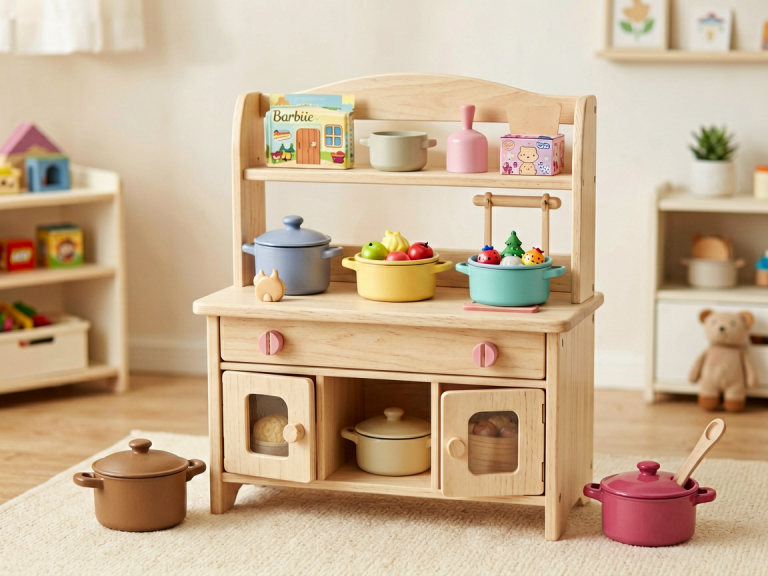
Play kitchens with measuring cups and spoons are math goldmines. When a child fills a one-cup measure with rice and pours it into a two-cup measure, they are intuitively grasping volume conservation—the idea that the amount of material remains the same even if its container changes shape. Similarly, balance scales allow children to compare weights by placing toys on each side. A simple two-pan balance with colorful counters teaches heavier/lighter relationships and can even introduce the concept of equality (when both sides balance).
Nesting cups or Russian dolls are classic toys that teach size seriation—arranging objects from smallest to largest. This skill is a direct prerequisite for understanding number lines and measurement scales. Sand timers, water tables with different-sized containers, and measuring tapes that snap together also provide rich opportunities for exploration.
Parents can enhance these experiences by asking open-ended questions: “Which cup holds more water?” “Can you find a toy that is heavier than the red car?” Such conversation not only builds vocabulary but also encourages children to test hypotheses. Measurement toys turn the abstract concept of “how much” into a concrete, hands-on investigation.
4. Sorting, Classifying, and Graphing Toys
Classification is a fundamental mathematical process. Before children can add or subtract, they must be able to group objects by attributes such as color, size, shape, or function. Sorting activities also lay the foundation for data analysis and early graphing.
*Examples and Benefits:*
Sorting trays with compartments and a collection of buttons, beads, or animal figures are simple yet powerful. A child sorting farm animals by type (cows vs. pigs) and then by color within each type is performing a two-tier classification. Attribute blocks—sets of pieces that vary in shape, color, thickness, and size—can be sorted by one attribute at a time, gradually increasing complexity.
Lacing beads combine sorting with fine motor practice: children can string beads according to a pattern or sort them into bowls by color. Once sorting is mastered, introducing simple graphing toys—like a horizontal bar graph made with stackable cubes—allows children to represent their data visually. For example, after sorting a handful of toy dinosaurs by color, the child can build a column of cubes for each color, then compare which column is tallest.
These activities cultivate logical thinking and the ability to organize information—skills that are essential for later work with Venn diagrams, tables, and statistics. Moreover, because sorting toys are often open-ended, children can invent their own categories, fostering creativity and ownership of their learning.
5. Problem-Solving and Pattern Logic Toys
While all math toys involve some degree of problem-solving, certain toys are explicitly designed to challenge a child’s reasoning. Puzzles, sequencing games, and simple board games introduce the concept of rules, strategy, and cause-and-effect—all critical for mathematical thinking.
*Examples and Benefits:*
Jigsaw puzzles are perhaps the most accessible problem-solving toy. As a child tries to fit a piece into the correct spot, they are using spatial reasoning and trial-and-error. The number of pieces should be age-appropriate—start with 4–6 pieces for a two-year-old and gradually increase. Floor puzzles with large pieces are particularly good for developing gross motor coordination and the concept of the whole picture.
Sequencing cards or story sequence toys (e.g., “first, next, last”) teach temporal order, which parallels the sequential nature of counting and arithmetic. A toy like a wooden train with numbered cars that must be arranged from 1 to 10 explicitly combines order with number sense.
Simple board games that involve counting spaces, such as “Candy Land” or “Hi Ho! Cherry-O,” are excellent for older preschoolers. They teach turn-taking, one-to-one movement (each space equals one step), and the emotional resilience of winning and losing. Logic puzzles like “ColorCode” or “SmartMax” where children must follow a visual pattern to build a structure also develop executive function and planning.
The best problem-solving toys are those that allow for multiple solutions or that can be adjusted in difficulty. Magnetic maze puzzles, where a child uses a wand to guide a ball through a path, also strengthen visual tracking and planning. These toys encourage persistence and the “aha” moment when a solution is found—a feeling that builds confidence and a love of challenge.
Conclusion: Play with Purpose
Early math toys are not about rushing academic milestones. They are about providing rich, sensory environments where mathematical ideas emerge naturally through play. The best beginner toys are open-ended, allow for repetition and variation, and invite adult participation. A parent sitting beside their child, commenting on what they see (“You made a pattern: big, little, big, little!”), transforms a simple activity into a meaningful learning experience.
When selecting toys, quality matters more than quantity. A few versatile sets—such as wooden blocks, counting bears, pattern blocks, and a balance scale—can cover multiple skills across years of development. Avoid toys that are overly prescriptive or electronic; the ones that require children to move, touch, and think are far more valuable.
In a world increasingly driven by screens, hands-on math toys ground children in the physical reality of numbers and shapes. They build not only skills but also a mindset: that math is something you do, explore, and enjoy. By investing in these beginner toys, we give our children the gift of numeracy wrapped in the joy of play. And that foundation will serve them long after the blocks are put away.