Unlocking Imagination: Play Activities That Build Creative Thinking in Babies
Introduction
From the moment a baby enters the world, their brain is a sponge, absorbing every sight, sound, and sensation. While traditional milestones like crawling and babbling often steal the spotlight, an equally vital development is unfolding: the foundation of creative thinking. Creativity isn’t just about art or music; it is the ability to connect ideas, solve problems in novel ways, and see multiple possibilities in a single situation. For babies, whose neural pathways are forming at an astonishing rate, the right play activities can spark this cognitive flexibility. Contrary to popular belief, you don’t need expensive gadgets or structured lessons. The simplest, most joyful interactions—a rattle shaken differently, a blanket draped over a box—can become powerful tools for creativity. This article explores a range of play activities specifically designed to nurture creative thinking in babies, from newborns to toddlers, and explains the science behind why they work.
—
The Power of Sensory Play: Building Neural Bridges
Sensory play is the bedrock of creative thought. When babies touch, taste, smell, see, and hear, their brains forge connections between different sensory inputs. These connections are the raw material for later abstract thinking. For instance, a baby who pats a wet sponge feels resistance, hears a squish, and sees water drip—these disparate experiences merge into a mental model of “wetness” and “absorbency.”
Activities to try:
- Texture baskets: Fill a shallow container with safe, varied textures: a silk scarf, a wooden spoon, a rubber spatula, a crumpled piece of parchment paper. Let the baby sit (or lie) beside it and explore hands-on. Describe what they’re feeling: “That’s smooth and cool. This is bumpy.” Avoid directing their actions; let them decide to pinch, pound, or mouth each item.
- Water play (supervised): Fill a small tub with lukewarm water and add cups, funnels, and floating toys. Babies learn cause and effect: when they tip a cup, water spills; when they push a toy under, it pops up again. These discoveries cultivate divergent thinking—the ability to generate multiple solutions for a single problem (e.g., “How can I make the water move?”).
- Edible finger painting: For babies who still mouth everything, mix yogurt with natural food coloring (beet juice, turmeric). Spread it on a high-chair tray and let them smush, swirl, and taste. This unstructured activity allows them to create without any expected outcome—pure experimentation.
Research from the University of Washington shows that sensory-rich environments increase the density of synapses in the cortex. By offering varied sensory inputs, you are literally building a more connected brain, which is the biological foundation of creativity.
—
Encouraging Exploration with Open-Ended Toys
Open-ended toys are those that have no single “correct” use. Unlike a shape-sorter that dictates a specific action, an open-ended toy—a set of stacking cups, a collection of wooden blocks, a cardboard box—invites the baby to invent their own purposes. This flexibility is crucial for creative thinking because it forces the baby to generate possibilities rather than follow instructions.
Recommended open-ended toys and how to use them:
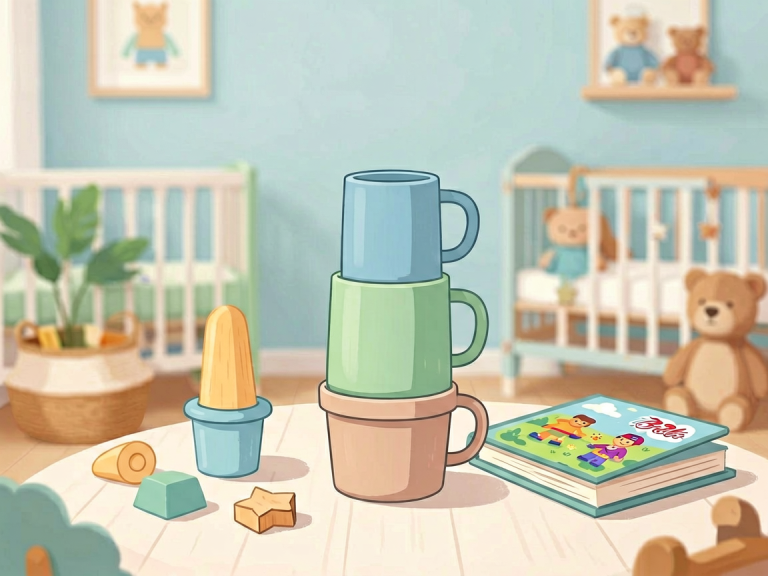
- Stacking cups or nesting bowls: A baby might first bang two cups together (auditory exploration), then stack them (spatial reasoning), then hide a small ball under one (object permanence and cause-effect), and later use them as “hats” on a teddy bear. Each use is a creative leap.
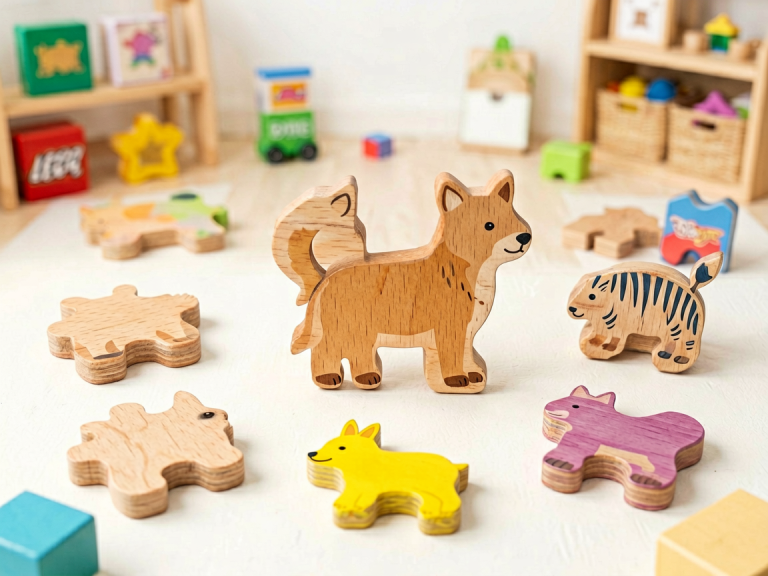
- Wooden blocks (large, lightweight): A three-month-old might swipe at a block and watch it roll. A ten-month-old may try to balance one on another. A fifteen-month-old might line them up as a “train.” The baby’s evolving abilities lead to new creative strategies, and the adult’s role is simply to provide the materials and observe.
- Cardboard boxes of various sizes: A box can become a hiding cave, a drum, a vehicle, a tunnel, or a storage bin for treasures. The baby’s imagination transforms it moment by moment.
The key is to resist the urge to “teach” the intended function. If you show a baby how to stack blocks, you inadvertently limit their experimentation. Instead, model curiosity: pick up a block, turn it over, tap it gently, and then set it down. The baby will imitate and innovate.
—
The Magic of Imitation and Pretend Play
Around the first birthday, babies begin to imitate actions they’ve observed—brushing a doll’s hair, talking into a toy phone. This is the earliest form of pretend play, and it directly stimulates creative thinking because the baby must mentally simulate a scenario that is not physically present.
Activities to foster early pretend play:
- Toy phone conversations: Hand your baby a play phone (or a real one that is turned off and cleaned). Hold another to your ear and say, “Hello! Yes, I’d like a banana, please.” Pause, then look expectantly at your baby. They might babble back or hold the phone to their ear. This teaches symbolic representation—a skill essential for later storytelling and problem-solving.
- Simple role play with props: A blanket can be a cape, a towel can be a picnic mat, a bowl and spoon can become a cooking set. Sit on the floor with your baby and pretend to “stir soup” in the bowl, then “feed” a stuffed animal. After a few demonstrations, your baby will start to offer the spoon to you or to the toy, initiating their own scenarios.
- Dress-up with scarves and hats: For babies who can sit and reach, drape a bright scarf over your head and say, “Peek-a-boo!” Then offer it to them. They may pull it off, wrap it around their own head, or fling it into the air. The unpredictability of their actions is part of the creative process.
Imitation is not mindless copying; it is the baby’s way of testing hypotheses: “When I put the cup to my mouth, Mom smiles. When I put it on the doll’s mouth, what happens?” This hypothesis testing is the engine of creativity.
—
Music and Movement for Creative Expression
Babies are naturally rhythmic—they bounce to a beat, shake a rattle with abandon, and vocalize in response to songs. Music and movement provide an outlet for emotional expression and motor creativity, both of which are intertwined with cognitive flexibility.
Playful musical activities:
- DIY instrument making: Fill a small plastic bottle with dry rice or beans and seal it tightly. Let your baby shake it, roll it, or throw it (safely). Vary the sounds by changing the container or filler—a metal can with pasta, a cardboard tube with pebbles. The baby learns that different actions produce different sounds, and they begin to intentionally create patterns.
- Dancing with objects: Turn on a simple, upbeat song and hold your baby facing you, gently swaying. Then give them a ribbon or a lightweight scarf and let them wave it as they move. They will experiment with fast vs. slow, up vs. down, and even pause listening for the music’s cues.
- Call-and-response vocal play: When your baby coos or babbles, echo them. Then change your pitch or add a new syllable. Wait for them to imitate back. This conversational turn-taking is a precursor not just to language but to improvisation—thinking on your feet.
Studies in early childhood music education suggest that infants who engage in structured (yet flexible) musical play show enhanced divergent thinking scores later in preschool. The rhythmic structure provides a safe framework, while the open-ended nature of “making your own song” encourages originality.
—
Nature and Outdoor Adventures
The outdoors is the ultimate open-ended playroom. Leaves, sticks, stones, sand, and water offer endless possibilities for manipulation and discovery. Nature is inherently unpredictable—a breeze moves a leaf, an ant crawls across a rock—which forces a baby to adapt and reinterpret their surroundings creatively.
Ideas for nature-based play:
- Sensory garden time: Lay a blanket on the grass and let your baby feel the blades, pick up a fallen flower (check for safety), or watch shadows shift. Point out textures: “The bark is rough. The leaf is smooth.” Let them hold a pinecone and observe how they turn it, tap it, and perhaps try to bite it. Each action is a mini-experiment.
- Treasure walks: Once your baby can sit or cruise, take them on a slow walk (in a stroller or carrier) but stop frequently to let them look at interesting objects. Hand them a large, clean stick or a smooth pebble. Back home, you can create a “nature box” where the baby can revisit these items. The act of collecting and sorting builds categorization skills, a form of logical creativity.
- Sand and water play at the park: A bucket and spade are classic open-ended tools. The baby can fill, dump, dig, and mold. The fluidity of sand—it can be a mountain, a cake, a hole—teaches that matter can be transformed by intention.
Outdoor play also fosters executive functions like attention shifting and impulse control, which are closely linked to creative problem-solving. The constant stimuli from nature (bird calls, moving clouds, uneven terrain) train the baby to notice novelty and respond flexibly.
—
The Role of Everyday Objects and Loose Parts
One of the most powerful creativity-building strategies is to offer “loose parts”—everyday objects that can be moved, combined, and transformed. For a baby, a wooden clothes peg, a cardboard tube, a set of plastic measuring spoons, and a few fabric scraps are far more valuable than a single-purpose toy.
How to present loose parts safely:
- Ensure all items are large enough to not be swallowed and have no sharp edges. Supervise closely.
- Rotate the objects regularly to sustain novelty.
- Resist the urge to demonstrate a “correct” use. If your baby starts stacking spoons, let them; if they instead wave them like a fan, that’s equally valid.
Example loose parts play:
Place a tray with three different items (a small box, a scarf, and a plastic ring) in front of your baby. They may put the scarf in the box, take it out, wrap the ring in the scarf, or drop the ring into the box. Each combination is a creative solution to an unspoken question: “What can I do with these things?” Over time, this kind of free experimentation builds neural networks that support innovation.
Dr. Alison Gopnik, a developmental psychologist, calls babies “the research and development division of the human species.” Loose parts play gives them the lab space to conduct that research.
—
Parental Involvement and the Art of Not Interfering
The most important element in any play activity is the caregiver’s attitude. Creative thinking flourishes when babies feel safe to explore without judgment or direction. This means resisting the temptation to correct, praise too specifically, or take over the activity.
Principles for creative play facilitation:
- Be a narrator, not a director. Instead of saying, “Stack the red block on the blue one,” say, “I see you’re holding the red block. It feels smooth. Now you’re touching the blue one.” This validates their exploration without imposing an agenda.
- Follow the baby’s lead. If your baby is fascinated by the sound of a spoon hitting the floor, let them drop it repeatedly. That repetition is how they refine their understanding of gravity and sound—a scientific and creative process.
- Allow struggle. If a baby is trying to fit a cup inside a slightly too-small box and gets frustrated, don’t immediately intervene. Wait a few seconds. They may try a different angle, rotate the cup, or give up and try something else. Each attempt builds perseverance and creative problem-solving.
- Limit screen time. Passive screen exposure (even “educational” shows) reduces opportunities for active, creative play. The American Academy of Pediatrics recommends no screens for babies under 18 months (except video chatting). Instead, prioritize real-world interactions.
When parents become co-creators rather than instructors, the play space transforms into a crucible for imagination. Your smile, your occasional gentle questions (“Oh, where did the block go?”), and your willingness to sit on the floor and be silly are the most potent catalysts for creative thinking.
—
Conclusion
Building creative thinking in babies does not require advanced degrees or expensive curricula. It requires time, presence, and a willingness to see the world through their eyes—a world where a cardboard tube is a telescope, a puddle is an ocean, and a spoon is a drumstick. The play activities described here—from sensory exploration to loose parts, from music to outdoor discovery—all share a common thread: they honor the baby’s innate drive to experiment, hypothesize, and create. By providing a rich, responsive environment and then stepping back, we give our babies the greatest gift: the confidence and cognitive flexibility to think beyond the obvious. And that is the very essence of creativity. As they grow, these early seeds will blossom into the ability to imagine new solutions, tell original stories, and see beauty in the unexpected. So put down the remote, pick up a scarf, and let the play begin.