Unlocking the Potential: The Best Early Learning Toys for Kids
Introduction: Why Early Learning Toys Matter
The first few years of a child’s life are a period of astonishing brain development. During this time, neural connections are formed at an unprecedented rate, laying the foundation for future learning, behavior, and health. While a nurturing environment, loving interactions, and quality nutrition are paramount, the role of play cannot be overstated. Toys are not merely sources of entertainment; they are the tools through which children explore the world, develop essential skills, and make sense of complex concepts. When chosen wisely, early learning toys become powerful catalysts for cognitive, physical, social, and emotional growth.
However, the modern market is flooded with flashy, battery-operated gadgets that promise educational benefits but often deliver little more than passive stimulation. The true gems are the toys that invite active engagement, encourage problem-solving, and spark curiosity. This article delves into the best early learning toys for kids, organized by developmental domains and age appropriateness, to help parents, educators, and caregivers make informed choices that will nurture a lifelong love of learning.
Section 1: The Cornerstones of a Quality Early Learning Toy
Before exploring specific toys, it is essential to understand what makes a toy genuinely educational. Not every brightly colored plastic item qualifies. A superior early learning toy typically possesses several key attributes:
- Open-endedness: Toys that can be used in multiple ways, such as wooden blocks, play dough, or loose parts, encourage creativity and divergent thinking. They adapt to the child’s developmental stage and interests.
- Active rather than passive engagement: Toys that require the child to manipulate, build, sort, or create promote active learning. In contrast, toys that simply sing songs or flash lights in response to a button press often lead to passive observation.
- Sensory stimulation: Children learn through their senses. Toys that engage touch, sight, hearing, and even smell and taste (safely) help build neural pathways. Natural materials like wood, cotton, and wool offer rich sensory experiences.
- Age-appropriateness and challenge: The best toys are not too easy (which leads to boredom) nor too difficult (which leads to frustration). They should be within the child’s zone of proximal development, offering a manageable challenge that encourages persistence.
- Safety and durability: Young children explore with their mouths and hands. Non-toxic materials, rounded edges, and sturdy construction are non-negotiable.
Keeping these principles in mind, let us examine the top categories of early learning toys.
Section 2: Toys for Cognitive Development and Problem-Solving
Cognitive skills include memory, attention, logical reasoning, and cause-and-effect understanding. Toys that foster these abilities are foundational for academic success.
2.1 Wooden Building Blocks
A classic that never goes out of style. Simple wooden blocks (in various shapes, sizes, and colors) are arguably the most versatile early learning toy. Infants as young as six months can explore the texture and weight, while toddlers learn to stack, balance, and knock down. Preschoolers create complex structures, practicing spatial awareness, symmetry, and early engineering. Blocks also teach patience and resilience: a tower that falls is a lesson in gravity and perseverance. Look for sets made from sustainably sourced, unpainted or non-toxic painted wood.
2.2 Shape Sorters and Puzzles
Shape sorters, whether the classic cube with cutouts or more elaborate versions, teach object permanence, shape recognition, and fine motor control. As children manipulate the pieces, they learn trial and error. Puzzles, from simple peg puzzles with large knobs to more complex floor puzzles with 24 pieces, strengthen visual-spatial reasoning and hand-eye coordination. The sense of accomplishment a child feels when a piece clicks into place is a powerful motivator. For older toddlers, puzzles depicting numbers, letters, or animals also introduce early literacy and numeracy concepts.
2.3 Cause-and-Effect Toys
Toys that respond to a child’s action—such as a hammering bench where tapping a peg makes another pop up, or a simple push-car that moves forward when pushed—teach that actions have consequences. These toys are especially valuable for babies around 8–12 months. Look for toys that require deliberate effort, like a ball ramp where the child must place the ball at the top and watch it roll, or a simple jack-in-the-box. They build attention span and logical thinking.
Section 3: Toys for Fine and Gross Motor Skills
Physical development is a critical component of early learning. Toys that encourage movement help children gain control over their bodies.
3.1 Stacking Rings and Nesting Cups
Stacking rings require a child to coordinate their eyes and hands to place progressively larger rings onto a central post. On the surface, it seems simple, but it teaches size discrimination, sequencing, and fine motor precision. Nesting cups (cups that fit inside one another) offer even more possibilities: they can be stacked into a tower, nested, used for scooping and pouring in the bath, or as molds for sand play. Both toys are excellent for infants as young as 9 months.
3.2 Push and Pull Toys
Once a child begins to walk, push toys (like a wooden cart with blocks or a metal shopping cart) provide stability and encourage walking. Pull toys (such as a wooden animal on wheels that wobbles when pulled) strengthen balance and coordination. They also teach cause and effect: pulling the string makes the toy move. Choose toys with a sturdy handle and a short string to avoid tripping.
3.3 Art Supplies for Purposeful Grasping
Crayons, chunky pencils, and washable markers are more than just creative outlets. Gripping them strengthens the small muscles in the hands and fingers, which are essential for writing. Finger painting, stamping, and using play dough also develop hand strength and dexterity. For babies, edible finger paints (made from yogurt and food coloring) allow safe sensory exploration. Older toddlers can practice cutting with safety scissors, an activity that builds bilateral coordination.
Section 4: Toys for Language and Communication
Language development begins long before a child speaks their first word. Toys that expose children to words, sounds, and conversations are invaluable.
4.1 Board Books with Texture
Books for babies and toddlers should be durable, bright, and interactive. Lift-the-flap books, touch-and-feel books (like “Pat the Bunny”), and books with simple rhymes introduce vocabulary, phonemic awareness, and the concept that symbols carry meaning. Reading together also fosters a love of stories and strengthens the parent-child bond. Look for books that depict everyday objects and actions, as well as books with diverse characters.
4.2 Musical Instruments (Simple)
Shakers, tambourines, small drums, and xylophones teach rhythm, cause and effect (shaking makes sound), and auditory discrimination. Singing along with instruments exposes children to language patterns and new vocabulary. Even a simple homemade shaker (a sealed container with rice) works wonders. Music also supports memory and emotional expression.
4.3 Picture Cards and Matching Games
Simple matching games (like pairs of animal cards) improve visual memory and vocabulary. An adult can name the animal and make its sound, then encourage the child to find its match. As children grow, they can play memory games by flipping cards and trying to remember locations. These activities support concentration and language recall.
Section 5: Toys for Social-Emotional Learning
Perhaps the most overlooked aspect of early learning is emotional intelligence. Toys that encourage imitation, role play, and empathy help children navigate relationships.
5.1 Dolls, Stuffed Animals, and Miniature Figures
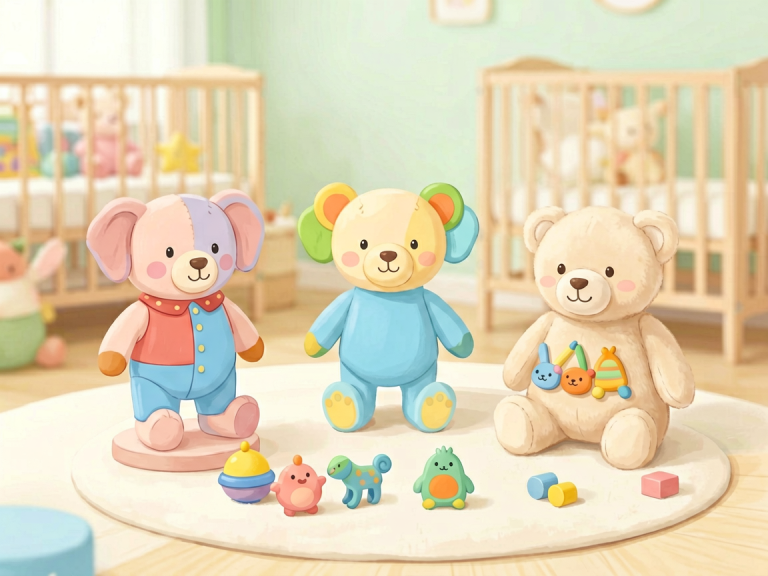
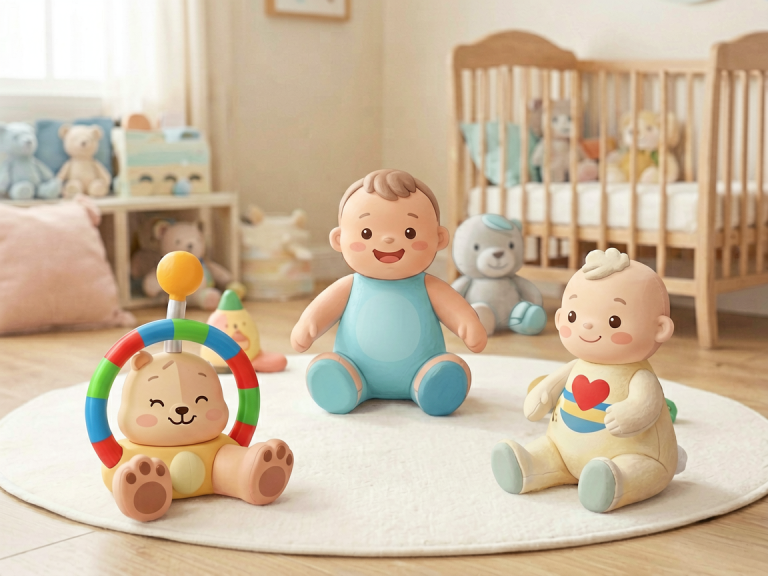
A simple doll or stuffed animal becomes an object of care. Children dress them, feed them (with pretend food), and put them to bed. This imaginative play helps process emotions and develop empathy. Miniature figurines (people, animals, vehicles) allow children to create their own narratives, role-playing real-life situations (a trip to the doctor, a birthday party) that build social understanding. Look for diverse dolls that represent different races, genders, and abilities.
5.2 Pretend Play Sets
Kitchen sets, tool benches, doctor kits, or grocery store scenarios invite children to imitate adult roles. Through pretend play, children practice social scripts: taking turns, negotiating roles, and learning about cooperation. A simple wooden kitchen with pots, pans, and play food is a long-term investment that can be used from age two through early elementary. The language skills developed during pretend play—negotiating who will be the “customer” and who will be the “shopkeeper”—are immense.
5.3 Cooperative Games
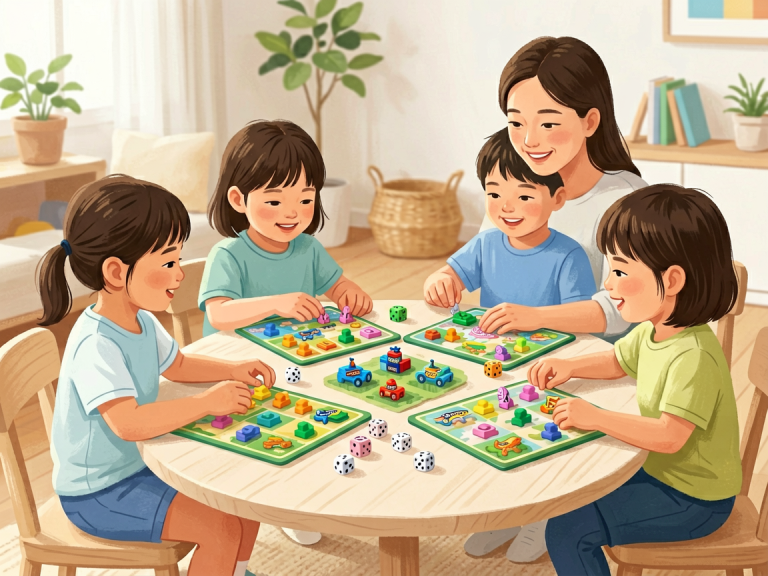
Traditional board games often have winners and losers, which can be stressful for young children. Cooperative games where all players work together against a common challenge (e.g., a puzzle that must be completed before a timer runs out, or a game that requires moving pieces together) teach teamwork and shared joy. Such games build resilience and reduce the emotional turmoil of losing.
Section 6: Toys for STEM (Science, Technology, Engineering, Math) Foundations
Early exposure to STEM concepts does not require screens or robots. Simple, hands-on toys spark curiosity about how the world works.
6.1 Magnet Tiles
Magnetic building tiles (like Magna-Tiles or Picasso Tiles) have become a favorite in homes and preschools. The translucent, colorful squares and triangles can be connected by magnets to form 2D patterns or 3D structures. They teach geometry, symmetry, magnetism, and cause and effect. Children experiment with balance, try to build tall towers, and create enclosures for toy animals. The open-ended nature means they can be used for years.
6.2 Simple Science Kits for Toddlers
For children aged 3 and up, simple kits that allow water play (pipettes, funnels, measuring cups) or nature exploration (magnifying glass, bug catcher, rock collection) lay the groundwork for scientific observation. Mixing colors with food coloring and water teaches about color theory and chemical reactions. Even a set of weigh scales and counting bears introduces early math concepts like measurement, sorting, and one-to-one correspondence.
6.3 Counting and Number Toys
Counting abacuses, number puzzles, and simple board games that require counting spaces (like Chutes and Ladders) introduce numeracy. However, the best “math toys” are everyday objects: buttons, coins (with supervision), or pasta for sorting and counting. The key is to make math hands-on and visual.
Section 7: How to Choose the Best Toys for Your Child
With so many excellent options, how do you decide? Here are some practical tips:
- Follow the child’s interests. A child fascinated by dinosaurs will learn more from a dinosaur-themed puzzle than from a generic shape sorter. Observe what captivates your child and choose toys that align with that passion.
- Rotate toys. Children can become overwhelmed by too many choices. Rotating a selection of toys every few weeks keeps them fresh and engaging. Store the rest out of sight.
- Prioritize simplicity. The most educational toys are often the simplest. A cardboard box can become a car, a cave, or a castle. Do not underestimate the power of everyday items.
- Resist the urge to buy “educational” gadgets. Many electronic toys that claim to teach letters or numbers actually limit interaction. Your child learns far more from a conversation with you than from a talking robot.
- Consider durability and longevity. A quality wooden train set may cost more initially but will last for years and be enjoyed by multiple children. Cheap plastic toys often break quickly and may not provide the same sensory experience.
- Involve the child in the selection process when appropriate. For older toddlers, allowing them to choose between two safe options gives them a sense of agency and investment.
Conclusion: Play is the Work of Childhood
The best early learning toys are not necessarily the most expensive or the most technologically advanced. They are the ones that invite a child to think, create, move, and connect. Whether it is a set of wooden blocks, a basket of pinecones, or a simple mirror, the value lies in the interaction—between the child and the toy, and between the child and the caring adult who plays alongside them. Remember that a toy is only as good as the time spent with it. Your presence, your questions, and your encouragement transform a simple object into a gateway to discovery.
Invest in toys that spark curiosity rather than provide answers, that encourage exploration rather than passive consumption, and that grow with your child. In doing so, you are not just fostering early learning—you are building a foundation for a lifetime of confident, joyful, and resilient thinking. After all, as the saying goes, “Play is the work of childhood.” And with the right toys, that work becomes a delightful adventure.