Unlocking Words: Engaging Activities to Boost Language Development in Toddlers
Language development in the toddler years is nothing short of miraculous. Between the ages of one and three, children transform from babbling infants into budding conversationalists, acquiring hundreds of words and the rudiments of grammar. While every child develops at their own pace, the environment parents and caregivers provide plays a crucial role in accelerating this process. The good news is that you don't need flashcards, expensive apps, or formal lessons. The most powerful tools are already in your hands: daily routines, playful interactions, and a willingness to follow your child's lead. This article explores a series of research-backed, easy-to-implement activities that turn ordinary moments into rich language-learning opportunities for toddlers. Each activity is designed not only to build vocabulary but also to nurture a love for communication, listening, and storytelling.
—
1. Interactive Storytelling and Picture Books
Reading with a toddler is far more than just reciting words on a page. Interactive storytelling transforms a passive listening experience into an active dialogue. When you sit down with a colorful picture book, pause after each page to ask simple questions: “Where is the dog?” “What color is the ball?” This technique, called dialogic reading, encourages the toddler to become the storyteller themselves. For very young toddlers (12–18 months), choose board books with high-contrast images and few words. Point to objects and label them clearly: “Look, a car! Vroom vroom!” As the child grows, invite them to turn the pages and point to familiar items. Older toddlers (24–36 months) can be asked to predict what happens next: “What do you think the bunny will do?” This builds narrative skills and cause-and-effect thinking.
Another powerful variation is “retelling.” After reading a favorite book several times, encourage your toddler to “read” it to you. They may not recite the exact words, but they will mimic your intonation, hold the book correctly, and use some memorized phrases. This is a key milestone in understanding that print carries meaning. To maximize the benefit, choose books with repetitive phrases (e.g., *Brown Bear, Brown Bear, What Do You See?*) and rhyming text. The rhythm and repetition make it easier for toddlers to anticipate and join in. Even a 20-month-old will start filling in the last word of a familiar sentence, demonstrating both memory and emerging language production.
—
2. Singing Songs and Nursery Rhymes with Actions
Music engages multiple areas of the brain simultaneously, making it one of the most effective tools for language acquisition. Toddlers are naturally drawn to melody and rhythm, and when you pair songs with hand motions or body movements, you create a multisensory learning experience. Classic nursery rhymes like “Itsy Bitsy Spider,” “Wheels on the Bus,” and “Twinkle, Twinkle, Little Star” are ideal because they contain simple, repetitive vocabulary and predictable patterns. As you sing, exaggerate your facial expressions and slow down the tempo so your child can see your mouth moving.
The magic lies in the pauses. After singing a song several times, stop right before a key word and give an expectant look. For example, in “The Wheels on the Bus,” after “the wheels on the bus go round and …” pause for your toddler to say “round.” If they don’t, simply fill it in cheerfully and continue. Over time, they will eagerly supply the missing word. This builds turn-taking skills and auditory memory. For even more engagement, create simple homemade instruments — a plastic container filled with rice becomes a shaker for “Shake Your Sillies Out.” Action songs that require following directions, such as “Head, Shoulders, Knees, and Toes,” also reinforce vocabulary for body parts while encouraging motor coordination. Language and movement are deeply linked in early childhood; when a child raises their arms while singing “the itsy bitsy spider climbed up the water spout,” they are encoding the meaning of the words into muscle memory.
—
3. Pretend Play and Role-Playing Scenarios
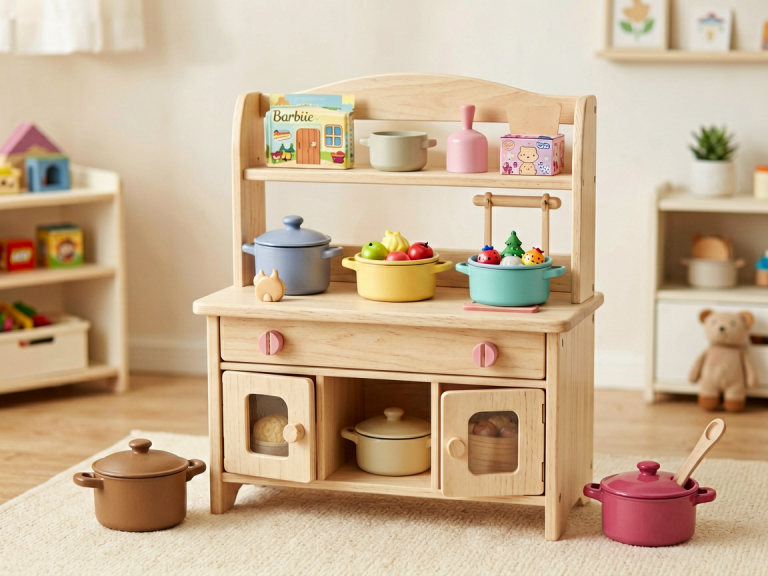
Between 18 and 36 months, toddlers enter a golden age of imaginative play. A cardboard box becomes a car, a banana becomes a telephone, and a stuffed animal becomes a patient in need of a checkup. This is not just cute — it is a sophisticated rehearsal of real-world language. When you join your child’s pretend play, you have a golden opportunity to model new vocabulary in context. For instance, if your toddler is “cooking” in a play kitchen, you can say, “I’m hungry! Can you make me a soup? I’d like some carrots and potatoes. What are you stirring with?” Use descriptive words: “This spoon is big,” “The soup is hot,” “I need a bowl.” By narrating the play, you introduce adjectives, prepositions, and action verbs naturally.
Role-playing specific scenarios is especially effective. Pretend to be a customer at your toddler’s “shop.” Ask for items: “I’d like an apple, please. How much does it cost?” This encourages your child to respond with a phrase — even a simple “Here you go” or “That’s two dollars.” As they grow more comfortable, you can extend the exchange: “Do you have any oranges?” “What else do you sell?” This practice builds conversational turn-taking and pragmatic language skills (e.g., using polite words, asking questions). For toddlers who are shy, use puppets or stuffed animals as intermediaries. A puppet can “talk” to the child, asking questions in a silly voice, which lowers the pressure and invites participation. Pretend play also doubles as emotional regulation practice — a child who acts out a doctor’s visit with a doll may be processing their own feelings about a recent checkup, and labeling those feelings (“The bear is scared. It’s okay, the doctor is gentle”) expands emotional vocabulary.
—
4. Descriptive Walks and Nature Exploration
Taking a walk with a toddler is rarely a straight line from point A to point B, and that’s exactly what makes it a rich language activity. The world outside is a giant classroom filled with novel stimuli. Turn a simple stroll into a “listening walk” or an “I wonder” walk. Before you leave, tell your child: “Today we’re going to use our ears. Let’s listen for a bird, a car, and the wind.” As you walk, name everything you see: “Look at the big, red truck! What color is that leaf? It’s yellow. Feel this rough bark.” Use a running commentary that is not too overwhelming but intentionally highlights a few new words each time.
One powerful technique is “self-talk plus expansion.” For example, if your child points to a dog and says “doggie,” you can say, “Yes, that’s a big brown dog. He is wagging his tail. Do you think he’s happy?” This affirms the child’s attempt while adding grammatical complexity and new vocabulary (brown, wagging, happy). Also, incorporate sensory language: “This pinecone is bumpy. The grass is wet. The flower smells sweet.” When you return home, extend the experience by drawing a picture of what you saw and talking about it again. This repetition strengthens neural connections. Additionally, “nature treasure hunts” work wonders: ask your toddler to find a “round rock” or a “long stick.” Following these instructions sharpens listening comprehension and encourages them to use the same descriptive words later. Even a 15-minute walk can yield dozens of new words when approached with intention.
—
5. Simple Games: “I Spy” and Simon Says
Games are inherently motivating for toddlers, and they provide a structured yet playful context for language use. “I Spy” is a classic that builds vocabulary for colors, shapes, and objects. Start with an easy version: “I spy with my little eye… something blue.” Then pause and look around expectantly. Your toddler may point at a blue block or a blue shirt. When they do, say, “Yes! A blue block!” As their skills improve, make the clues more specific: “I spy something that is round and bounces” (a ball). This game teaches descriptive vocabulary and encourages question-asking: “Is it the car? No? Is it the cup?” Over time, let your toddler be the “spyer.” They may say, “I spy… um… red!” even if nothing red is visible. That’s fine — celebrate their effort and help them find a red object. The goal is language practice, not accuracy.
Simon Says is another excellent activity for listening comprehension and following multi-step directions. Start with simple commands: “Simon says touch your nose.” “Simon says clap your hands.” Then add adjectives or prepositions: “Simon says put the red block under the table.” “Simon says hop like a bunny.” When you deliberately leave out “Simon says” and your toddler still performs the action, you can laugh and say, “Oh no, Simon didn’t say that! You have to listen carefully!” This playful correction is far more effective than a stern lesson. The game also introduces verbs in imperative form and reinforces body part vocabulary. For children who need extra support, pair words with gestures — point to your nose as you say “touch your nose.” Gradually fade the gesture as the child becomes more confident. Both games can be played anywhere: in the car, at the grocery store, or during bath time. They require zero materials and deliver high returns in language growth.
—
6. Daily Routine Narration and Conversation
Perhaps the most underrated language-boosting activity is simply talking with your toddler throughout the day. The concept is often called “parallel talk” or “self-talk.” While you are changing a diaper, say, “Now I’m going to take off the wet diaper. It’s yucky! Now we need a clean, soft diaper. Let’s put it on. You are kicking your legs! Ready? One, two, three, up!” This running commentary exposes your child to complete sentences, varied vocabulary, and the rhythm of conversational speech. Similarly, during meals, describe the food: “This apple is crunchy and sweet. The yogurt is cold and smooth.” Ask open-ended questions when possible (though very young toddlers may not answer, they are still absorbing the language): “Which spoon do you want, the red one or the blue one?” “Should we put the banana in the bowl or on the plate?”
Another powerful technique is “wait time.” When you ask a question or invite your toddler to say something, resist the urge to jump in with the answer. Count to ten in your head. Many toddlers need extra processing time, especially when they are still learning to coordinate thoughts and mouth movements. If they struggle, model the answer and then ask again later: “You wanted the red spoon? Here is the red spoon.” Over time, they will learn that communication involves a back-and-forth exchange, not just a one-way stream of instructions. Bath time, mealtime, and dressing are natural opportunities for these mini-conversations. Even a 12-month-old who only babbles is learning the social rules of conversation — the pause, the eye contact, the turn-taking. By narrating your shared reality, you are laying the foundation for a lifetime of confident communication.
—
Conclusion: The Power of Playful Presence
Language development in toddlers is not a race; it is a journey of discovery that unfolds through connection. The activities described above — interactive reading, singing, pretend play, nature walks, simple games, and daily narration — all share a common thread: they are joyful, low-pressure, and centered on the relationship between you and your child. There is no need to drill vocabulary or correct every mispronunciation. Instead, focus on creating a language-rich environment where your toddler feels safe enough to experiment with new sounds and words. Listen more than you talk, follow your child’s interests, and turn everyday moments into conversations. Remember, every time you describe the color of a leaf, sing a silly song, or ask “What do you think?” you are not just teaching words — you are showing your child that their voice matters. And that is the greatest gift of all.