The Art of Learning Through Play: A Guide to Screen-Free Toy-Based Education
In an era dominated by glowing screens and endless notifications, the idea of using toys as tools for learning may seem almost nostalgic. Yet research in child development consistently underscores what parents and educators have known for generations: play is the brain’s favorite way to learn. Screen-free learning with toys is not just a retreat from technology; it is a proactive, research-backed approach that nurtures creativity, problem-solving, and emotional intelligence. This article explores how to deliberately use toys to create rich, educational experiences—without a single pixel in sight.
The Cognitive Foundations of Toy-Based Learning
Before diving into specific methods, it is essential to understand why toys are such effective learning instruments. Unlike passive screen time, which often delivers information in a linear, ready‑digested format, toy‑based learning is active, multisensory, and self‑directed. When a child manipulates wooden blocks, for instance, they are not just stacking—they are subconsciously exploring balance, geometry, and cause and effect. The tactile feedback of different textures, weights, and shapes engages the brain in ways that a touchscreen cannot replicate.
Moreover, toys allow for open-ended exploration. A set of colorful counting bears can be sorted by color, used for simple addition, arranged into patterns, or even become characters in an improvised story. This flexibility encourages divergent thinking—the ability to generate multiple solutions to a single problem. Neuroscientific studies show that such unstructured play strengthens neural connections in the prefrontal cortex, the area responsible for executive functions like planning, impulse control, and flexible thinking.
Choosing the Right Toys for Developmental Stages
Not all toys are created equal when it comes to learning. To maximize educational value, choose toys that match a child’s developmental stage and offer multiple ways to play.
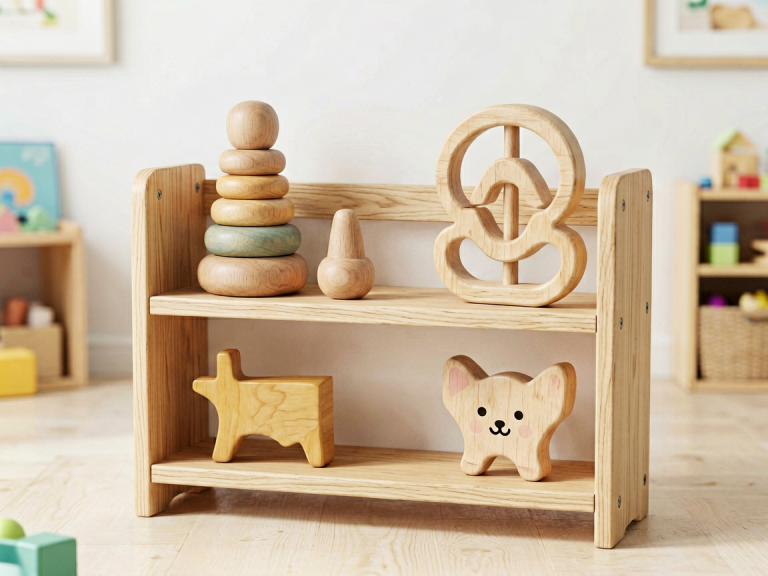
For infants and toddlers (0–2 years), sensory toys are ideal. Soft fabric books with different textures, rattles, and nesting cups help develop fine motor skills and object permanence. A simple set of stacking rings can teach size sequencing, while sensory bins filled with rice or sand (supervised) encourage exploration of textures and cause-and-effect pouring.
Preschoolers (3–5 years) thrive with construction toys like LEGO Duplo, magnetic tiles, or wooden building blocks. These toys introduce basic engineering concepts such as stability, symmetry, and weight distribution. Puzzles with increasing piece counts boost spatial reasoning and patience. Pretend-play kits—kitchen sets, tool benches, doctor kits—build narrative skills and social understanding as children imitate adult roles.
School‑age children (6–12 years) benefit from more complex toys: advanced LEGO sets with moving parts, marble runs, chemistry sets, or programmable robots (note: some technology may be involved, but the core learning is hands‑on and screen‑free if the programming is done with physical code cards or a simple remote). Strategy games like chess, tangrams, and logic puzzles sharpen deductive reasoning. Model kits (solar system, human body, bridges) combine fine motor work with scientific literacy.
Structuring Learning Moments Without Lesson Plans
One common misconception is that “learning with toys” requires formal instruction—a parent hovering with a checklist of skills. In reality, the most powerful learning happens when adults facilitate, not dictate. Here are three practical strategies to integrate toy‑based learning into daily routines.
1. The “Invitation to Play” Method. Instead of telling a child to “learn math with these blocks,” set up an inviting scenario. Place a balance scale, a basket of small toys, and a few numbered cards on a table. Let the child discover the relationship between weight and quantity on their own. You can ask open questions: “I wonder if the dinosaur weighs more than three marbles?” This approach sparks curiosity and self-directed investigation.
2. Story‑Driven Challenges. Combine literacy and play by creating a narrative. For instance, after reading a book about a bear’s journey, challenge the child to build a bridge for the bear using LEGOS. This integrates reading comprehension, engineering, and creative problem-solving. The story provides context, making the learning feel purposeful rather than abstract.
3. Collaborative “Toy Projects.” Set aside a weekly “family toy challenge.” Everyone—including adults—works together to build a city out of cardboard boxes, design a marble run that lasts at least ten seconds, or create a board game using a dice and colored tokens. This not only teaches cooperation and communication but also models the idea that learning is a lifelong, joyful process.
Fostering Executive Functions Through Imaginative Play
Imaginative play—also called pretend or dramatic play—is arguably the richest screen‑free learning tool. When children invent scenarios, assign roles, and negotiate rules, they are practicing a host of executive functions: working memory (remembering who is the “customer” and who is the “shopkeeper”), cognitive flexibility (adapting when the plot changes), and self-regulation (waiting for their turn to speak).
To encourage this, provide open‑ended props rather than scripted toys. A cardboard box can become a spaceship, a castle, or a time machine. A set of fabric scraps can serve as capes, bandages, or treasure maps. Avoid toys that dictate a single narrative—battery‑operated characters that only say prescripted phrases can limit creativity. The most educational toy is one that is 90% child and 10% object.
STEM Learning Without a Screen: Engineering and Experimentation
STEM (science, technology, engineering, and mathematics) is often associated with coding apps and digital simulations, but many foundational STEM concepts are best learned through physical toys. For example:
- Marble runs teach gravity, momentum, and trajectory. Children learn to hypothesize: “If I raise the starting point, will the marble go faster?” Then they test, observe, and refine.
- Magnetic building tiles (like Magna‑Tiles) introduce polarity, geometry, and structural integrity. Trying to build a cube that doesn’t collapse teaches trial‑and‑error, which is the heart of engineering.
- Simple machines kits (pulleys, levers, gears) allow children to experience mechanical advantage firsthand. They can lift a heavy toy using a pulley system and see why a ramp is easier than a vertical lift.
- Cooking and measuring toys (play dough, measuring cups, kitchen scales) sneakily teach fractions, volume, and ratio. A child making “pretend soup” with a recipe (e.g., “add 1/2 cup of blue beads and 1/4 cup of yellow beads”) internalizes math without a worksheet.
For older children, consider a crystal growing kit or a small microscope (with real slides, not a digital screen). The tactile process of watching sugar crystals form over several days teaches patience and scientific observation in a way that a time‑lapse video cannot.
Building Social and Emotional Intelligence
Toys also serve as powerful tools for social‑emotional learning. Board games, for instance, teach turn‑taking, gracious winning and losing, and strategic thinking. Cooperative board games (where everyone wins or loses together) reduce competition anxiety and highlight the value of teamwork. Role‑playing with puppets or dolls allows children to work through emotions—a child who is afraid of going to the dentist might re‑enact the visit with a stuffed animal, gaining a sense of control.
Furthermore, toy‑based learning naturally fosters resilience. When a tower of blocks falls, the child has to decide: cry, give up, or try a different base design. With gentle guidance from an adult (“What do you think made it wobble?”), the child learns that failure is not the end but data for improvement—a mindset critical for academic and life success.
Creating a Screen‑Free Learning Environment at Home
Toys alone do not guarantee learning; the environment matters. Designate a clutter‑free, accessible play space where toys are organized by type (building, pretend, puzzles) rather than by theme. Rotate toys every few weeks to maintain novelty. Avoid the temptation to “teach” too much—let the child lead. And most importantly, model screen‑free behavior yourself. When a child sees you reading a book, building with LEGOs, or playing a card game, they internalize that learning through physical play is valuable and enjoyable.
Finally, remember that screen‑free does not mean tech‑free forever. The goal is balance. By intentionally incorporating toy‑based learning into daily life, we give children the gift of deep focus, creative autonomy, and the joy of discovery—all without a single notification. The toys themselves are merely instruments; the real magic lies in the active, engaged mind of the child, and in the patient presence of the adults who join them on the floor.