Building Early Math Foundations: Play Activities for 6-Month-Olds
Introduction: The Surprising Beginnings of Mathematical Thinking
When we think of mathematics, we often picture complex equations, geometric proofs, or the anxiety of timed multiplication tests. Yet the seeds of mathematical understanding are sown much earlier—in the first year of life. For a six-month-old, every sensory experience, every interaction with objects, and every moment of play is a chance to build what developmental psychologists call "early numeracy." This encompasses concepts such as quantity, size, spatial relationships, patterns, and cause-and-effect. At six months, babies are not yet counting or solving problems in a conscious way, but their brains are actively wiring neural pathways that will later support logical reasoning and number sense.
The key to nurturing these early math skills is not through flashcards or structured lessons—far from it. Instead, it lies in intentional, responsive play activities that leverage a baby’s natural curiosity and developing motor skills. This article provides a comprehensive guide to play activities designed specifically for six-month-olds, each carefully aligned with foundational mathematical concepts. Each activity is described in detail, including the materials needed, steps to follow, and the specific early math skills being developed. By integrating these activities into daily routines, parents and caregivers can lay a robust foundation for future mathematical thinking, all while strengthening the bond with their child.
Understanding the Six-Month-Old’s Developmental Landscape
Before diving into activities, it is essential to understand what a typical six-month-old is capable of. At this age, most babies can:
- Sit with support or briefly without support.
- Reach for and grasp objects intentionally.
- Transfer objects from one hand to the other.
- Explore objects by mouthing, shaking, banging, and dropping them.
- Show beginning awareness of object permanence (that objects continue to exist even when out of sight).
- Respond to their own name and familiar voices.
- Show interest in patterns, faces, and contrasting colors.
These milestones are critical because they define the types of play that are both safe and stimulating. Activities must be large enough not to be swallowed, free of sharp edges or small parts, and supervised at all times. Moreover, a six-month-old’s attention span is short—typically a few minutes per activity—so variety and repetition are key. The goal is not to force learning but to create an environment rich in mathematical concepts that the baby can absorb through natural exploration.
Activity 1: Object Permanence Box and the Concept of "All Gone"
Materials needed: A small cardboard box (like a shoebox) with a lid, or a purpose-made object permanence box; several small, safe objects such as large wooden rings, fabric balls, or soft blocks (ensure they are larger than a toilet paper roll to prevent choking).
How to play:
- Sit facing your baby, either on the floor or in a high chair with a tray.
- Show the baby one of the objects, let them hold it, mouth it, and explore it for a few seconds.
- Then, slowly place the object into the box and close the lid (or slide it into the box’s opening if using a Montessori-style permanence box). Say clearly, "The ball is gone! Where is it?"
- Wait a few seconds to see if the baby reaches for the box or looks at it with curiosity. Then, open the lid and reveal the object with an enthusiastic, "There it is!"
- Repeat with different objects, gradually increasing the pause before revealing.
Early math skills developed:
- Object permanence is a precursor to understanding that quantities can remain the same even when hidden—a foundational idea for counting and conservation of number.
- The concept of "absence" and "presence" introduces cause-and-effect (I drop the object → it disappears; I open the box → it reappears), a logical relationship that underpins mathematical reasoning.
- The repetition of hiding and revealing helps the baby begin to anticipate patterns, which is early pattern-recognition—a core math skill.
Variation: Use two boxes. Hide the object under one, then switch the boxes’ positions before asking the baby to find it. This adds a simple spatial reasoning challenge appropriate for older six-month-olds.
Activity 2: Stacking and Knocking Down: Size and Spatial Relationships
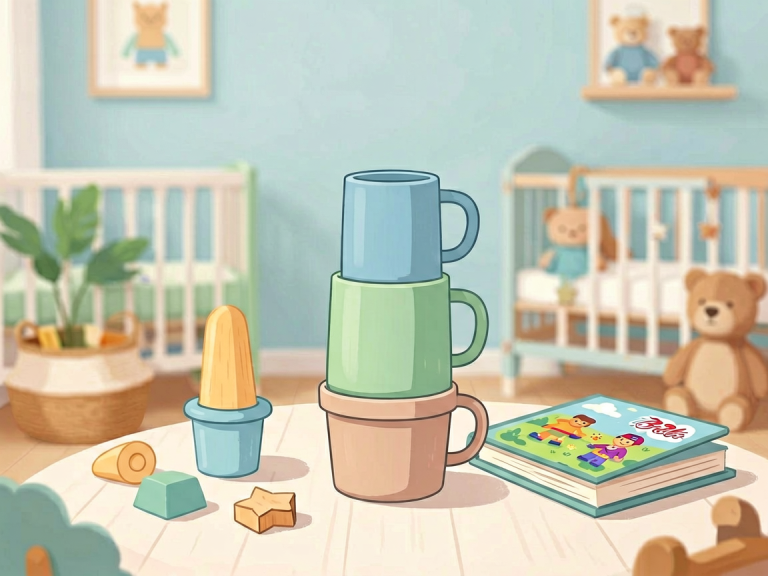
Materials needed: 3–4 soft, lightweight blocks or nesting cups that are easy for small hands to grasp. Avoid hard plastic blocks that could injure the baby if knocked over. Fabric blocks or foam blocks are ideal.
How to play:
- Sit on the floor with your baby in a supported sitting position. Place the blocks in front of them.
- Slowly stack two blocks on top of each other while the baby watches. Say, "Look, I’m putting the big block on top of the little block. Up, up, up!"
- Encourage the baby to reach out and touch or grab the stack. They will likely knock it over, which is perfect. Celebrate the fall with a cheerful, "Boom! Down they go!"
- Repeat, this time placing one block beside the other, or partially overlapping them. Vary the sizes: "This block is small. This block is big. Let’s put the small one on the big one."
Early math skills developed:
- Size comparison: The baby begins to differentiate between "big" and "small" through visual and tactile exploration.
- Spatial relationships: Understanding "on top of," "beside," "under," and "falling down" builds spatial vocabulary that is crucial for geometry and later problem-solving.
- Cause-and-effect: Knocking a tower down reinforces the idea that actions produce predictable outcomes—a basic mathematical logic.
- One-to-one correspondence: When the baby picks up one block and tries to place it on another, they are practicing the matching of one object to another, a precursor to counting.
Variation: Use nesting cups of different sizes. Show the baby how a smaller cup fits inside a larger one. Let them try to do it themselves (they may not succeed, but the attempt builds spatial reasoning). Narrate: "This cup is too big for that cup. Let’s try another."
Activity 3: Sensory Bags and Patterns: Visual and Tactile Math
Materials needed: Two or three resealable quart-sized freezer bags; hair gel, baby oil, or clear shampoo; small, safe items like large glitter flakes, colorful pom-poms, or smooth pebbles (ensure they cannot fit through the bag seal); strong duct tape to seal the bag’s top shut (to prevent leaks and choking hazards).
How to play:
- Fill each bag with a small amount of gel or oil, then add a few items of different colors or shapes. Press out excess air and seal tightly, then reinforce the top with duct tape.
- Lay the bags flat on the floor or tape them to a high chair tray. Ensure the baby is supervised and cannot bite into the bag.
- Let the baby press, pat, and slide the items inside the bag. Describe what they see: "Look, the red pom-pom is moving to the right! Now it’s going down. Can you find the blue one?"
- For a pattern activity, use two bags: one with only red items, one with only blue. Show the baby one bag at a time, then alternately, to create a visual pattern. Say, "Red, blue, red, blue. Can you see the red one?"
Early math skills developed:
- Pattern recognition: The alternating colors or shapes provide a simple repeating pattern. Even though the baby cannot verbalize it, their brain is beginning to detect regularity, a cornerstone of algebraic thinking.
- Spatial vocabulary: Words like "up," "down," "left," and "right" are used during play, helping the baby associate sounds with spatial positions.
- Cause-and-effect: The baby learns that pressing on one part of the bag makes an item move to another part—an early introduction to force and motion.
- Sorting and classification: If you use different colored items, the baby is implicitly introduced to the idea that objects can be grouped by attributes (color, size, shape).
Safety note: Always supervise sensory bag play. If the bag leaks, discard immediately. Never leave the baby alone with the bag.
Activity 4: Rhythm and Sequence: Musical Math
Materials needed: A simple wooden rattle, a small drum (or an overturned plastic bowl), or any safe noise-making toy.
How to play:
- Sit facing your baby and hold the rattle or drumstick (or use your hand on the bowl). Tap it once, then pause. Say, "One tap." Wait for the baby’s reaction—they may smile, coo, or try to grab the instrument.
- Tap twice in quick succession, saying, "Two taps. One, two." Then tap three times slowly, counting out loud.
- After a few repetitions, hand the rattle to the baby. Let them shake or tap however they wish. Mirror their rhythm: if they tap twice, you tap twice back. This creates a turn-taking pattern.
- Introduce a simple, repeating rhythm: tap… tap… tap… (steady beat) or tap-tap, pause, tap-tap (a pattern). Sing a nursery rhyme while tapping, such as "Twinkle, Twinkle, Little Star" or "Row, Row, Row Your Boat."
Early math skills developed:
- Counting and sequencing: Saying numbers aloud during tapping reinforces the verbal sequence of numbers, even if the baby does not understand quantity yet. The rhythm itself is a form of pattern—one tap, two taps, three taps.
- One-to-one correspondence: Each tap corresponds to one spoken number, building the link between auditory count and motor action.
- Turn-taking: This is a social precursor to mathematical logic—the understanding that actions follow a predictable order (my turn, your turn), which is akin to understanding a simple algorithm.
- Temporal patterning: The baby begins to differentiate between fast and slow rhythms, a concept of time intervals that will later become important for measurement and even fractions.
Variation: Use two different sounds—e.g., tap a block on the floor and then shake a rattle. Create a pattern: tap, shake, tap, shake. The baby will start to anticipate the pattern, which is early recognition of alternation.
Activity 5: Treasure Baskets: Sorting by Properties
Materials needed: A shallow, sturdy basket or box; 6–8 safe household objects of different textures, shapes, and sizes. Examples: a wooden spoon, a silicone spatula, a crinkly fabric ball, a smooth stone (large enough to not be a choking hazard), a plastic egg, a metal measuring spoon (ensure no sharp edges), a small cardboard tube.
How to play:
- Place all items in the basket and set it in front of the baby (with you seated nearby for supervision).
- Allow the baby to reach in and pull out items one by one. Do not direct their choices—let them explore freely.
- As they pick up an item, name it and describe its properties: "You found the wooden spoon. It’s long and smooth. Now you have the crinkly ball. Feel the bumps!"
- After the baby has explored each item, you can gently model sorting. For example, pick up the two round items (the ball and the egg) and put them together, saying, "These are both round. Round things go together." Then pick up the two long items (the spoon and the cardboard tube) and put them together, saying, "These are long. Long things together."
- Let the baby imitate your grouping (they may not succeed, but the exposure matters).
Early math skills developed:
- Classification and sorting: By grouping objects with similar attributes (size, shape, texture, material), the baby learns that objects can be organized into categories—a fundamental mathematical process.
- Comparison: Holding two objects side by side naturally invites comparison of size, weight, and shape.
- Vocabulary building: Words like "round," "long," "bumpy," "smooth," "big," and "small" are mathematical descriptors that will later be used in geometry and measurement.
- Sensory integration: The more senses engaged, the stronger the neural connections. Math is not just abstract; it is deeply sensory for infants.
Variation: Each week, change the contents of the basket to focus on a specific property. For example, one week all items are yellow (color sorting); another week all items are rough to the touch (texture sorting).
Activity 6: Mirror Play and Symmetry: Early Geometry
Materials needed: An unbreakable safety mirror (acrylic or plastic) that is large enough for the baby to see their full face; optionally, a small self-adhesive sticker or piece of colored tape.
How to play:
- Place the mirror upright against a wall or on the floor, propped securely. Sit your baby in front of it, supporting them if needed.
- Point to the baby’s reflection and say, "Who is that? That’s you! Look, here is your nose, and here is your nose in the mirror. They look the same!"
- Place a small sticker on the baby’s forehead (use a safe, removable sticker). Point to the sticker in the mirror and then on the baby’s actual forehead. Say, "The sticker is here, and it’s also there in the mirror. They match!"
- Move your own face close to the mirror and then away, letting the baby see changes in size. Say, "Look, Mama’s face is getting bigger! Now it’s smaller."
- Hold a toy behind the baby, out of their direct line of sight but visible in the mirror. Ask, "Where is the toy? Look in the mirror! It’s behind you."
Early math skills developed:
- Symmetry and reflection: The mirror introduces the concept of symmetry—the baby sees that their left hand appears as the right hand in the reflection. While too young to understand the concept, they are exposed to a visual pattern that is mathematically symmetrical.
- Spatial awareness: Using the mirror to locate objects behind them develops an understanding of spatial relationships and perspective.
- Size comparison: Watching faces and objects get larger as they approach the mirror and smaller as they move away is an intuitive introduction to scale and relative size.
- Self-recognition: This is an important developmental milestone that also supports the understanding of "sameness" and "difference," which underlies classification.
Integrating Math into Daily Routines
While structured play activities are valuable, the most powerful early math learning happens organically during everyday interactions. Here are simple ways to weave mathematical language into your day with a six-month-old:
- During diaper changes: Count toes, fingers, or the number of snaps on a onesie. "One, two, three snaps! Let’s snap them shut."
- During feeding: Describe the shape of the spoon, the size of the bowl, or the number of peas on the tray. "You have three peas. Let’s count them: one, two, three."
- During bath time: Use cups to pour water, talking about "full" and "empty." Compare temperatures: "The water is warm. The tile is cool."
- During dressing: Compare sizes of clothes—"This sock is too big for your tiny foot. Let’s find a smaller one."
- During walks: Point out patterns in nature—leaves, bricks, stripes on a shirt. "Look at the fence: up, down, up, down."
These small, consistent exposures build a rich mathematical vocabulary and conceptual foundation. The key is to speak naturally and enthusiastically, without pressure. The baby will absorb far more through positive, playful interactions than through formal instruction.
Conclusion: The Long-Term Impact
It is easy to dismiss the mathematical potential of a six-month-old, but research in developmental psychology and neuroscience shows that the brain’s architecture for number sense is being constructed during the first year. Children who experience rich, responsive, math-infused play in infancy tend to have stronger number skills in preschool and beyond. But the benefits go beyond academics—these activities also foster curiosity, persistence, problem-solving, and the joy of discovery.
Remember that every baby develops at their own pace. Some six-month-olds may eagerly grasp and explore objects; others may prefer quiet observation. Follow your baby’s cues. If they seem fussy or disinterested, put the activity away and try again another day. The goal is not to teach math per se, but to create an environment where mathematical thinking can naturally blossom. By engaging in these simple, loving play activities, you are giving your child one of the greatest gifts: a mind ready to see patterns, compare sizes, understand sequences, and ultimately, appreciate the beauty of mathematics.
So go ahead—stack those blocks, shake that rattle, and hide that ball. You are not just playing; you are building a mathematician.