From Solitary Play to Collaborative Mastery: The Stages of Toy Progression for Social Skills
Introduction
Play is the language of childhood, and toys are its vocabulary. While many parents and educators focus on the cognitive or motor benefits of toys—puzzles for problem‑solving, blocks for spatial reasoning—the role of toys in shaping social skills is equally profound and often underestimated. Social skills—such as turn‑taking, negotiation, empathy, and conflict resolution—do not emerge in a vacuum. They are cultivated through carefully designed interactions with objects and people. A deliberate toy progression can scaffold a child’s journey from solitary amusement to sophisticated group collaboration. This article explores how different categories of toys, introduced in a developmentally appropriate sequence, can nurture social competence from infancy through early adolescence.
—
1. The Foundation: Solitary and Sensory Toys (Ages 0–2)
Why Solitary Play Matters for Social Development
At first glance, solitary play seems unrelated to social skills. Yet the earliest months of life are when a child learns the fundamental patterns of interaction: cause and effect, imitation, and emotional regulation. Sensory toys—rattles, textured balls, soft mirrors, and teething rings—help infants discover that their actions produce responses. This rudimentary feedback loop is the birthplace of intentionality, which later translates into understanding that other people also have intentions.
Key Toy Types for this Stage
- Mirror toys: A baby gazing at their own reflection begins to develop self‑awareness—a prerequisite for recognizing others as separate beings.
- Rattles and shakers: Shaking a rattle and hearing its sound teaches contingency (“I did this, and that happened”). This is the precursor to taking turns in conversation.
- Soft building blocks: Even when no other child is present, stacking and knocking down blocks introduces the concept of shared attention. A caregiver who says “boom!” when the tower falls is modeling joint engagement.
By the end of this stage, a child who has experienced responsive toy play with an adult will be more likely to seek eye contact and smile during social exchanges.
—
2. Parallel Play Facilitators: Simple Manipulatives and Duplicates (Ages 2–3)
The Bridge Between Me and You
Toddlers are famously egocentric, yet they begin to notice peers. Parallel play—playing alongside another child without direct interaction—is a critical stepping‑stone. The toys themselves must support this fragile coexistence. For instance, having two identical toy telephones rather than one reduces conflict and allows children to imitate each other’s pretend conversations.
Recommended Toy Progressions
- Duplicate vehicles and animals: Two identical cars encourage “me too” behavior. One child pushes a car; the other copies. No words are needed, yet a shared script emerges.
- Simple cause‑and‑effect toys (pop‑up boxes, marble runs): These toys have predictable outcomes that can be observed by both children. A child who watches a peer press a button to make a puppet pop up learns to anticipate actions and reactions in another person.
- Large floor puzzles with few pieces: While toddlers cannot truly cooperate, having a puzzle on the floor invites them to work in the same space. One may pick up a piece, the other may point. The caregiver can model cooperative language: “You found the cow! Can you put it here?”
The crucial principle at this stage is abundance—having enough toys to prevent fierce rivalry—combined with simple designs that require no complex rules.
—
3. Cooperative Game‑Based Toys: Structured Interaction (Ages 3–5)
Learning the Rules of the Social Game
Preschoolers are ready for toys that require turn‑taking, waiting, and shared goals. Competitive games are still too advanced for many 3‑year‑olds, but cooperative games—where the group works together against a non‑player challenge—are ideal.
Best Toy Examples for This Stage
- Cooperative board games (e.g., *Hoot Owl Hoot!* or *The Sneaky, Snacky Squirrel Game*): In these games, players move pieces together toward a common objective. Children must negotiate who goes next, offer help, and celebrate collective wins.
- Dress‑up costumes and props: Pretend play with a shared theme (like a doctor’s clinic or a grocery store) forces children to assign roles, coordinate actions, and improvise dialogue. A toy stethoscope becomes a tool for empathy: “Let’s listen to your teddy bear’s heart.”
- Large construction sets (Duplo, Magna‑Tiles): When two children build a castle together, they must communicate where each block goes. Conflicts over a single piece become opportunities to practice compromise: “You use it first, then I use it.”
Why Structured Play Works
At this age, children are developing theory of mind—the ability to understand that others have different thoughts and feelings. Toy‑mediated cooperative play provides a safe laboratory for testing this new understanding. A child who knocks over a peer’s block tower learns about anger and regret; a child who helps rebuild learns about forgiveness and collaboration.
—
4. Complex Rule‑Based Games and Team Challenges (Ages 5–8)
From Cooperation to Healthy Competition
As children enter elementary school, they can handle more nuanced social dynamics. Competitive games with clear rules—but not excessive luck or complexity—teach graceful winning and losing. The toy progression now shifts from purely cooperative to a blend of cooperative and mildly competitive.
Recommended Toys and Activities
- Simple board games (Candy Land, Chutes and Ladders): These teach turn‑taking, following instructions, and emotional regulation when a slide sends you back. Parents can use the game as a conversation starter: “It’s okay to feel frustrated. Want to take a deep breath before your next turn?”
- Card games (Uno, Go Fish): These require strategic thinking and social interaction. A child must ask direct questions (“Do you have any sevens?”) and handle rejection without meltdowns.
- Team sports equipment (kickball, badminton sets): While not a “toy” in the traditional sense, a ball and a net become tools for division into teams, agreeing on rules, and cheering for each other.
Developing Advanced Skills
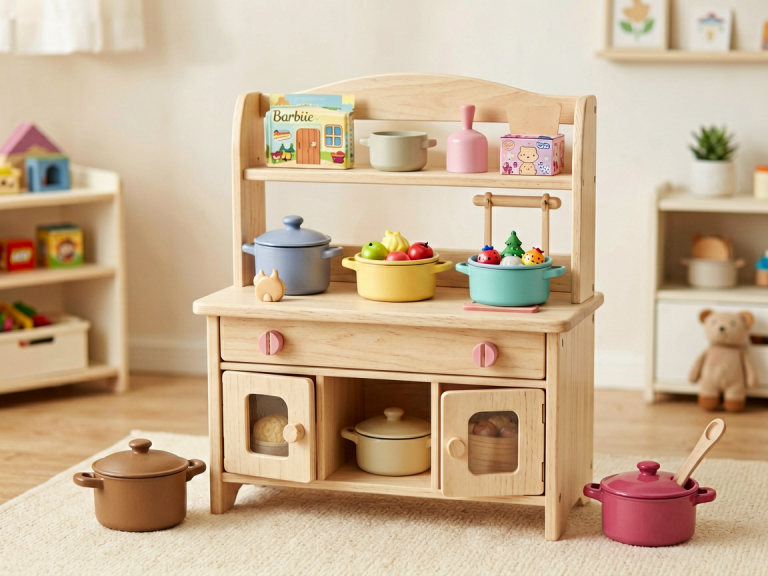
At this stage, toys also help children practice perspective‑taking. A child playing a game of “store” with a cash register must consider both the customer’s and the shopkeeper’s viewpoints. Role‑playing toys (play kitchen, tool bench) encourage negotiation: “I’ll be the chef, you be the waiter.” More importantly, when a game goes wrong—a rule dispute or an accidental cheat—the toy becomes a neutral reference point. The rulebook itself is a social arbitrator.
—
5. Collaborative Strategy Toys and Digital‑Physical Hybrids (Ages 8–12)
The Power of Shared Goals and Complex Communication
Pre‑adolescents can engage in multi‑step planning, division of labor, and long‑term collaboration. The most powerful toys at this stage are those that demand sustained teamwork. Board games like *Pandemic* (cooperative) or *Settlers of Catan* (competitive with negotiation) require players to trade resources, form alliances, and discuss strategy.
Toy Types That Foster Advanced Social Skills
- Complex building kits (LEGO Technic, K’Nex): Two or three children building a motorized robot must divide sub‑tasks—one reads the manual, one sorts pieces, one assembles gears. They must ask clarifying questions, offer help, and adjust plans when a piece doesn’t fit.
- Strategy board games (Ticket to Ride, Carcassonne): These involve planning ahead while reacting to other players’ moves. Children learn to read social cues (“She’s building towards Chicago—I should block her!”) and practice persuasive language (“If you give me that card, I’ll help you next turn.”).
- Collaborative digital games (Minecraft in creative mode, Roblox with code sharing): Digital play is often dismissed as isolating, but when used deliberately, online multiplayer sandbox games require real‑time communication, delegation, and conflict resolution. Children must agree on a building project, allocate resources, and handle griefers (disruptive players) as a team.
Emotional Intelligence Through Play
By this age, toys can also be used to practice empathy in high‑pressure situations. A child who loses a critical game piece in *Labyrinth* can either blame others or ask for help. A toy‑mediated scenario like a cooperative escape room board game (e.g., *Unlock!* for kids) forces the group to listen to each other’s ideas, manage time, and accept that the group’s success outweighs individual glory.
—
6. The Role of Adult Facilitation in Toy Progression
Why the Toy Itself Is Not Enough
No matter how perfectly chosen a toy may be, social skills do not flourish without intentional coaching. The toy progression described above is most effective when adults:
- Model language: Instead of just giving a child a ball, say, “I’ll roll the ball to you. Now you roll it back to me. Let’s count how many times we can do it together.”
- Introduce social scripts: With a set of play food, an adult can suggest, “Let’s pretend we are at a restaurant. You be the chef, and I’ll order a pizza. How should we take turns?”
- Mediate conflicts: When two children fight over a toy dump truck, the adult can use the toy itself as a problem‑solving tool: “How many scoops can the truck carry? Maybe each of you can fill it once, then we take turns.”
Avoiding Common Pitfalls
- Too much competition too soon: Introducing *Monopoly* to a 4‑year‑old can backfire, leading to tears and frustration. Match the toy’s social demands to the child’s current emotional capacity.
- Over‑intervention: Allowing children to struggle through minor disagreements (without physical aggression) builds resilience. A toy‑mediated argument is a rehearsal for real‑life negotiation.
- Neglecting solo play: Even the most social child needs quiet, solitary toy time to recharge. A balanced toy progression includes sensory or creative toys (clay, drawing materials) that do not require interaction.
—
Conclusion: A Lifelong Social Blueprint, Built One Toy at a Time
The journey from a newborn clutching a rattle to a pre‑teen negotiating alliances in a board game is not automatic. It is shaped by the intentional introduction of toys that challenge and support social growth at each developmental stage. A toy progression for social skills is not a rigid curriculum but a flexible map: start with solitary sensory exploration, move to parallel play with duplicates, then to cooperative games, competitive games, and finally complex collaborative strategies.
Parents, educators, and caregivers who understand this progression can transform a simple toy chest into a social‑emotional gymnasium. Each block stacked together, each turn taken on a checkerboard, and each shared victory in a cooperative game builds the neural and emotional pathways for empathy, communication, and teamwork. In a world where digital connectivity often replaces face‑to‑face interaction, the humble toy remains one of our most powerful tools for teaching children how to be human—together.
(Word count: approximately 1,050 words)