Little Numerals, Big Beginnings: Engaging Math Activities for 2-Year-Olds
Introduction: Why Math Matters Even Before Age Two
When we think of mathematics, images of complex equations, geometry theorems, or advanced calculus often come to mind. Yet for a two-year-old, mathematics is not about numbers written on a page or abstract symbols to be memorized. It is about the very fabric of their everyday world: the shape of a cookie, the number of blocks in a tower, the order of songs in a lullaby, or the size comparison between a big teddy bear and a small one. At this tender age, children are naturally wired to explore patterns, quantities, spatial relationships, and sequences. In fact, research in early childhood development has shown that foundational mathematical understanding begins long before formal schooling. Two-year-olds possess a remarkable ability to absorb concepts such as “more” and “less,” “big” and “small,” and even simple counting routines—provided these concepts are presented in playful, hands-on, and context-rich ways.
The purpose of this article is to provide parents, caregivers, and early childhood educators with a comprehensive guide to math activities specifically designed for two-year-olds. These activities are not about pushing academic pressure onto toddlers; rather, they are about harnessing their innate curiosity and turning everyday moments into opportunities for mathematical discovery. Each activity respects the developmental stage of a two-year-old: short attention spans, a need for sensory engagement, and a love for repetition and routine. The activities are divided into five core areas: counting and number sense, shapes and spatial awareness, size and comparison, patterns and sequences, and sorting and classification. With each section, you will find practical, low-prep ideas that use common household items and require minimal adult preparation. By the end, you will see that mathematical thinking can be woven seamlessly into play, mealtime, bath time, and even diaper changes.
Counting and Number Sense: Making One, Two, Three Tangible
At two years old, children are often beginning to understand that numbers correspond to quantities, even if they cannot yet recite them perfectly. The goal here is not to teach them to count to ten rote, but to help them feel the rhythm of numbers and connect spoken words to actual objects.
1. Snack-Time Counting
One of the most effective and enjoyable ways to introduce counting is during snack time. Place a small bowl of crackers, berries, or cheese cubes in front of your toddler. Say, “Let’s count one cracker,” and pick up one piece, placing it on the table. Then say, “Now two crackers,” and add a second. Even if your child cannot repeat the words, they will observe the one-to-one correspondence. Over time, you can invite them to hand you “one” piece or “two” pieces. The key is to keep it light and celebratory. If they hand you three when you asked for two, simply smile and say, “You gave me three! Let’s count them together: one, two, three.”
2. Staircase Steps and Finger Plays
Another powerful tool is physical movement combined with counting. When walking up or down stairs, count each step aloud: “One step, two steps, three steps…” Toddlers love the rhythmic chanting, and the physical act of stepping reinforces the idea that numbers correspond to actions. Similarly, finger plays like “Five Little Monkeys Jumping on the Bed” or “One, Two, Buckle My Shoe” engage both auditory and motor skills. Sing these songs while using your fingers to show the numbers. Encourage your child to wiggle their own fingers along. Even if they only manage to hold up two fingers, celebrate that effort.
3. Counting During Clean-Up
Two-year-olds are notorious for dumping out toys, but this mess can be turned into a math lesson. When it is time to clean up, say, “Let’s put the blocks away. Can you give me two red blocks?” or “Let’s count how many cars we have to put in the bin.” As they hand you items, count them aloud. This not only builds number sense but also teaches responsibility in a playful way.
Shapes and Spatial Awareness: Building the Language of Geometry
Long before a child can name a square or a triangle, they are learning about shapes through their bodies and their environment. A two-year-old’s world is full of circles (plates, wheels), squares (windows, books), and triangles (roofs, pizza slices). Activities that highlight these shapes help develop visual discrimination and spatial reasoning.
1. Shape Hunt Around the House
Take a walk through your home or yard with your toddler and look for shapes. Point to a round clock and say, “Look! That’s a circle.” Stop at a rectangular door and say, “This is a rectangle.” Then ask, “Can you find another circle?” Your child may point to a ball, a button, or a cup. Even if they mix up names, the act of searching builds attention to detail. For a more structured activity, cut out basic shapes from colored construction paper and tape them to different objects. Then give your toddler a “shape mission”: “Find the triangle on the refrigerator!”
2. Play-Doh Shape Stamping
Play-Doh is a sensory goldmine for two-year-olds. Roll out a flat sheet of dough and provide shape cookie cutters (circles, stars, hearts, squares). Show your child how to press the cutter into the dough and lift it to reveal the shape. While they do this, name the shape each time: “You made a star! Now let’s try a square.” The tactile feedback and the satisfying “pop” when the shape comes out reinforce the concept. You can also use simple plastic lids, bottle caps, or even your hands to create shapes.
3. Building with Blocks: Spatial Vocabulary
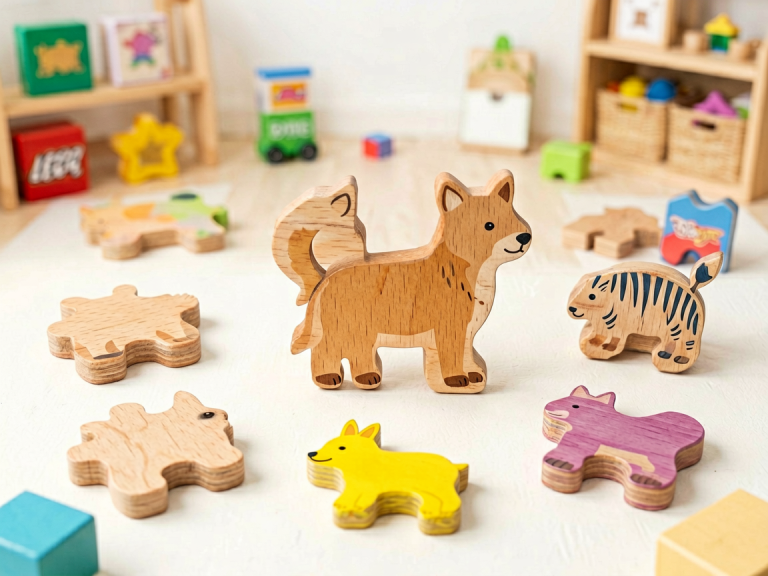
Block play is arguably the richest math activity for two-year-olds. As your child stacks blocks, introduce spatial language: “You put the block on top,” “The blue block is next to the red one,” “Can you put the block under the table?” Use prepositions like in, on, under, behind, and beside. You can also build simple structures together and then ask, “Where is the yellow block?” Let them point or retrieve it. This builds not only shape recognition but also an intuitive understanding of geometry and position.
Size and Comparison: Big, Small, Tall, Short
Two-year-olds are fascinated by differences in size. They notice that Daddy is bigger than they are, that a big scoop of ice cream is more than a small one, and that a tall tower is exciting while a short one is easy to knock down. Activities that compare sizes help children develop measurement vocabulary and the concept of relative magnitude.
1. Sorting Laundry by Size
Laundry time becomes an unexpected math lesson. Gather a few items of clothing—a big t-shirt of yours, a medium shirt of your partner’s, and a small shirt of your toddler’s. Lay them on the floor and say, “Which one is big? Which one is small?” Let your child point and then help them sort the items into piles: “Put the big shirts here, and the small shirts there.” As they gain confidence, add more items and compare sizes using words like “bigger,” “smaller,” “longer,” and “shorter.” You can do the same with socks, shoes, or towels.
2. Water Play with Different Containers
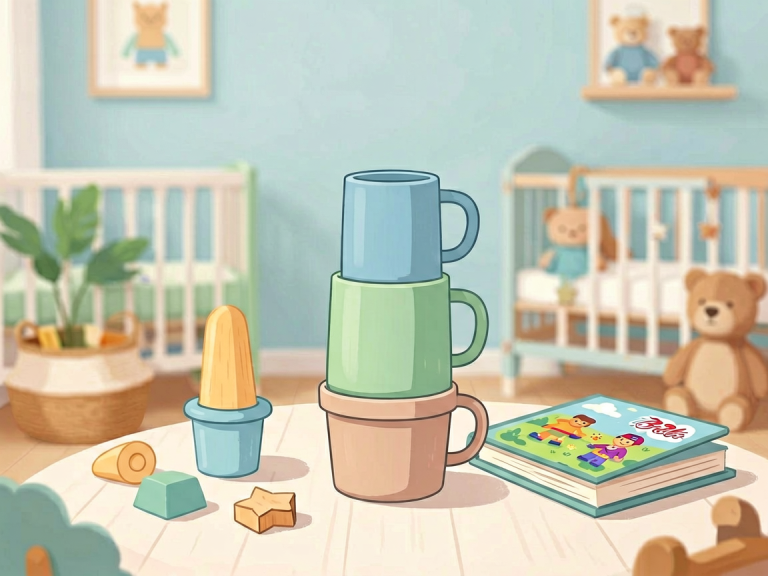
Bath time or a simple basin of water on the kitchen floor offers endless size comparison opportunities. Provide a large plastic cup, a medium bowl, and a small bottle cap. Let your child pour water from one container to another. Ask, “Does the big cup hold more water than the little cup?” Even if they cannot answer verbally, they will observe the water level rising and falling. You can also compare the weight of full versus empty containers, or the height of the water column. This is a very early introduction to volume and capacity.
3. Nature Walks: Big Leaves and Little Rocks
On a walk outside, encourage your child to collect natural objects: leaves, pinecones, pebbles, sticks. Then sit down and compare them. “This leaf is big. Let’s find a bigger one!” or “This rock is small. Can you find a smaller one?” Use your hands to show the difference in size by holding objects side by side. Such activities connect math to the natural world and foster observation skills.
Patterns and Sequences: The Rhythm of Repetition
Patterns are the cornerstone of mathematics—they help children predict what comes next, recognize order, and develop logical thinking. Two-year-olds are already pattern-seeking creatures: they love routines, repeated songs, and predictable games like peek-a-boo. Leveraging this love for repetition can build early algebraic thinking.
1. Simple Alternating Patterns with Objects
Start with two types of objects: for example, red blocks and blue blocks, or large pasta shells and small ones. Lay them in a simple alternating pattern: red, blue, red, blue. Point to each as you say, “Red, blue, red, blue. What comes next?” Even though a two-year-old may not be able to answer, they will gradually notice the sequence. You can then let them place the next object. If they put red after red, gently say, “Let’s see… after blue comes red again. Can you try?” With patience, they will begin to copy simple AB patterns.
2. Movement Patterns: Clap, Stomp, Clap, Stomp
Patterns do not have to be visual; they can be kinesthetic. Sit on the floor with your child and perform a pattern: clap your hands, then stomp your feet, then clap again, then stomp again. Say, “Clap, stomp, clap, stomp!” Encourage your child to imitate. Once they get the hang of it, change the pattern: tap your head, then pat your tummy, then tap your head, then pat your tummy. This not only teaches pattern recognition but also strengthens gross motor coordination and listening skills.
3. Song and Rhyme Repetition
Songs with repetitive lyrics—like “Old MacDonald Had a Farm,” “The Wheels on the Bus,” or “Row, Row, Row Your Boat”—are pure pattern practice. Each verse follows the same structure, and the chorus repeats. As you sing, pause and let your child fill in the missing word: “Old MacDonald had a farm, E-I-E-I-__!” The predictable pattern gives them a sense of mastery and anticipation. You can also create simple rhythmic patterns with pots and pans: bang, bang, pause, bang, bang, pause.
Sorting and Classification: The First Step to Logical Thinking
Sorting is the ability to group objects based on a common attribute—color, size, shape, or function. For a two-year-old, sorting activities are highly satisfying because they impose order on a chaotic world. Classification skills are directly linked to later mathematical reasoning, including set theory and data analysis.
1. Color-Matching with Pom-Poms or Toy Cars
Purchase a few small bowls in primary colors—red, blue, yellow, green. Then gather a bag of colorful pom-poms or a collection of toy cars. Have your child place all the red pom-poms in the red bowl, all the blue ones in the blue bowl, and so on. Start with just two colors to avoid overwhelming them. As they succeed, add a third color. Narrate the process: “You found a red car. Where does it go? Yes, in the red bowl!” This teaches both color recognition and the concept of belonging.
2. Animal Family Sorting
If your child has a set of plastic or stuffed animals, ask them to “put all the farm animals together” or “put all the animals that live in the water together.” For two-year-olds, simpler categories work better: “All the dogs go here, all the cats go there.” You can also sort by size (big animals vs. little animals) or by number of legs (two legs vs. four legs). Do not worry if they miscategorize; the process of deciding is more important than the perfect answer.
3. Snack Mix Sorting
Give your toddler a small bowl of mixed snacks—for example, goldfish crackers, raisins, and cereal rings. Show them how to separate the different items into separate compartments of an ice cube tray or a muffin tin. As they pick up each piece, say, “That’s a goldfish. Let’s put it in this spot.” This activity is not only mathematical but also develops fine motor skills. And at the end, they can eat their sorted snacks as a reward!
Conclusion: The Joy of Early Math
Mathematics for a two-year-old is not a subject to be taught from a worksheet; it is a language to be spoken through everyday experiences. The activities described above—counting with snacks, hunting for shapes, comparing sizes, creating patterns, and sorting objects—are all rooted in play. They require no special textbooks, no flashcards, and no pressure. What they do require is a caregiver who is willing to slow down, observe, and talk about the mathematical moments that are already happening.
Remember that every child develops at their own pace. Some two-year-olds may enthusiastically count every step, while others may be more interested in dumping and filling. Both behaviors are valuable. The dumping stage—filling a container and then emptying it—is actually an early exploration of volume and capacity. Trust the process. Use simple, descriptive language. Celebrate mistakes as learning opportunities. And most importantly, keep the mood light and joyful. When children associate mathematics with laughter, physical movement, and loving interactions, they build a positive emotional foundation that will carry them through more formal math education in the years to come.
So next time you are in the kitchen, at the park, or in the bathtub, look around. You will see numbers hiding in the crackers, shapes on the windows, patterns in the songs, and sizes in every toy. Your two-year-old is already a little mathematician. All they need is you to point it out.