The Best Toy Path for Developing Social Skills: A Developmental Guide
Introduction
In an era dominated by screens and solitary digital entertainment, the question of how to nurture a child’s social skills has become more pressing than ever. While many parents instinctively reach for the latest educational gadget or flashy electronic toy, research in developmental psychology consistently points to a simpler, more profound truth: the right sequence of physical, interactive toys—what we might call a “toy path”—can systematically build the foundational competencies of sharing, turn-taking, empathy, negotiation, and collaborative problem-solving. Social skills are not innate; they are cultivated through repeated, guided experiences. The best toy path for social skills is not a single magic product but a carefully curated progression that matches a child’s developmental stage, moving from solitary sensory exploration to complex group dynamics. This article outlines that path, providing parents, educators, and caregivers with a clear, research-backed roadmap to foster socially competent, emotionally intelligent children.
The Foundation: Solitary Play and Sensory Toys (Ages 0–2)
Before a child can engage with others, they must first develop a sense of self and basic emotional regulation. The earliest toys in the social-skills path are not social at all—they are sensory-rich objects that help infants and toddlers understand cause and effect, body awareness, and emotional soothing. At this stage, the “best” toys include soft blocks, textured balls, rattles, stacking rings, and simple puzzles. These toys encourage focused attention and independent exploration, which are prerequisites for later social interaction. A child who can calm themselves with a familiar object is better equipped to handle the frustrations of sharing. Moreover, when a caregiver sits alongside the child and narrates their play—“You stacked the red block on the blue one!”—they are modeling the language of social connection. This parallel, quiet interaction creates a secure attachment, the bedrock of all future social relationships. The toy is merely a tool; the real magic happens in the adult’s responsive presence. Therefore, the first step in the best toy path is to choose items that invite slow, unhurried, and sensory-driven play, laying a calm foundation for the more demanding social challenges ahead.
Parallel Play: Building Awareness with Simple Shared Toys (Ages 2–3)
Around age two, children enter the classic stage of parallel play: they play alongside peers but not yet with them. This is a critical transition. The best toys for this phase are those that can be used independently but whose value increases when two or more children use them in proximity. Think of a large bucket of Duplo bricks, a sandbox with scoops and molds, or a set of simple musical instruments like tambourines and maracas. These toys do not require cooperation, but they naturally spark observation and imitation. A child building a tower next to another child may begin to copy their technique, then accidentally knock over the other’s tower, triggering a first lesson in apology and repair. The adult’s role here is to provide duplicates of popular items to reduce conflict, but also to introduce simple turn-taking rituals. A toy telephone set, for instance, allows two children to “talk” without needing complex language. The key is that the toys themselves do not enforce social rules; they merely create opportunities for brief, low-stakes encounters. This path respects the toddler’s need for autonomy while planting seeds of shared experience. Parents should look for toys that are open-ended, durable, and easy to manipulate, avoiding anything with a single correct use, as that can frustrate parallel play.
Cooperative Play: Interactive and Role-Playing Toys (Ages 3–5)
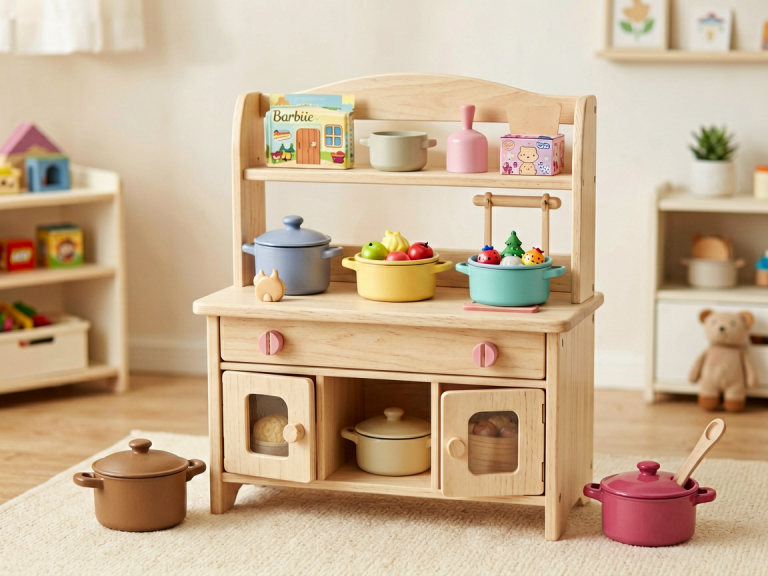
The preschool years mark the explosion of cooperative play, where children begin to negotiate roles, share narratives, and work toward common goals. This is the heart of the social-skills toy path. The most powerful tools are pretend-play sets: play kitchens, doctor’s kits, tool benches, dollhouses, and dress-up costumes. These toys invite children to step into another’s perspective, practice empathy, and engage in complex verbal exchanges. For example, when two children play “restaurant,” one must be the chef, one the customer, and they must agree on the menu, take turns speaking, and handle a “mistake” in the order. This demands impulse control and flexible thinking. Additionally, board games designed for young children—such as “Candy Land” or “Hi Ho! Cherry-O”—introduce structured turn-taking and simple rule-following. Unlike free play, games have clear beginnings and endings, which teach children to manage winning and losing gracefully. The best toys at this stage are those that require at least two participants to function fully. A set of walkie-talkies, for instance, is useless alone; it forces communication. Likewise, a large building set like a marble run requires one child to hold a piece while another places it. These toys create interdependency, which is the essence of social skill. Parents should consciously rotate toys to maintain novelty and avoid overstimulation, and they should intentionally step back to let children resolve minor disputes, stepping in only when safety or extreme frustration occurs.
Advanced Social Skills: Strategy Games and Group Activities (Ages 6–12)
As children enter elementary school, social interactions become more complex, involving peer hierarchies, longer-term projects, and abstract concepts like fairness and strategy. The toy path must now include items that challenge higher-order social cognition. Classic strategy board games—such as “Settlers of Catan” (junior edition), “Blokus,” “Chess,” or “Ticket to Ride: First Journey”—teach planning, patience, reading opponents’ intentions, and handling defeat. These games require players to negotiate trades, form temporary alliances, and manage limited resources together. Team sports equipment, like a soccer ball or a badminton set, also fits here, but the focus should be on cooperative rather than purely competitive use. For example, a “parachute” game (a large nylon circle that a group lifts and waves together) builds synchronized action and collective decision-making. Construction kits that require multiple builders, such as a complex LEGO set tackled by a small team, encourage delegation and communication. At this stage, the best toys are those that explicitly require negotiation and compromise. A “Rube Goldberg machine kit” that several children must design and test together is excellent: they must listen to each other’s ideas, accept failure, and revise plans as a group. Digital toys can also contribute, but only if they are cooperative multiplayer games (like “Minecraft” in creative mode with shared goals) rather than competitive or solitary ones. The adult’s role shifts from facilitator to coach, helping children reflect on social dynamics: “How did it feel when you both wanted the same piece?” “What could you say next time to reach an agreement?” This metacognitive layer cements the skills into lifelong habits.
Conclusion: Curating a Toy Path for Lifelong Social Competence
The best toy path for social skills is not a rigid curriculum but a fluid, responsive journey that respects each child’s tempo. It begins with the quiet security of sensory play, moves through the observation-rich parallel phase, blossoms in the imaginative collaboration of preschool, and matures into the strategic alliances of middle childhood. Throughout this progression, the common thread is that toys are most effective when they are simple, open-ended, and designed for multiple users. They should invite conversation, create gentle friction that must be resolved, and reward collaboration over solo achievement. Importantly, no toy can replace the presence of a caring adult who models empathy and guides reflection. The path also requires intentionality: parents should periodically audit their toy collection, removing items that encourage isolated play (single-player electronic games, for instance) and adding those that require a partner. They should create regular, screen-free times for peer play, and they should embrace boredom as a catalyst for social creativity. Social skills are not a destination but a practice, and the right toys are the tools that make that practice joyful. By following this developmental pathway, caregivers can give children not just better play, but the fundamental ability to connect, cooperate, and thrive with others—a gift that far outlasts any toy on the shelf.