Beyond the Glow: A Parent’s Guide to Choosing Toys That Naturally Reduce Screen Time
Introduction
In an era where children as young as two can swipe a tablet before they can tie their shoes, many parents find themselves trapped in a silent battle against glowing rectangles. Screens offer convenience, quiet, and even education – but too much of them chips away at creativity, attention spans, and physical activity. The desire to reduce screen time is widespread, yet the path is often unclear. Many parents turn to toys as the natural antidote, only to end up with a pile of plastic that gathers dust while the child reaches for the iPad again.
The problem is not the toy itself, but the type of toy, the way it is introduced, and the environment around it. A thoughtful toy guide is not simply a shopping list; it is a philosophy of play. This article provides a comprehensive, research-backed guide for parents who want to replace passive screen consumption with active, engaging, and developmentally rich play. We will explore the principles behind choosing effective toys, review categories that work best by age group, and offer practical strategies to make the transition smoother for both you and your child.
Why Reducing Screen Time Matters More Than You Think
Before diving into toy selection, it is crucial to understand why screens are so addictive for children and what we hope to regain. Screens provide instant gratification, constant novelty, and a passive flow of content that requires little effort from the child. In contrast, real-world play often demands patience, problem-solving, and physical engagement. This is not a bad thing – it is precisely what builds neural connections and executive function.
The American Academy of Pediatrics recommends limiting screen time to one hour per day for children aged 2 to 5, and consistent limits for older children. Excessive screen time has been linked to sleep disruption, delayed language development, reduced empathy, and a higher risk of obesity. More subtly, it robs children of boredom – the very state that sparks imagination. When children are bored, they invent games, build forts, and create stories. Screens eliminate this fertile void. Therefore, the goal of a good toy is not just to entertain, but to invite the child into a world they must actively construct themselves.
Key Principles for Choosing Toys That Beat Screens
Not all toys are created equal in the fight against screen addiction. The most effective toys share several common characteristics. Parents should keep these principles in mind when shopping or decluttering their toy boxes.
1. Open-Ended Over Single-Purpose
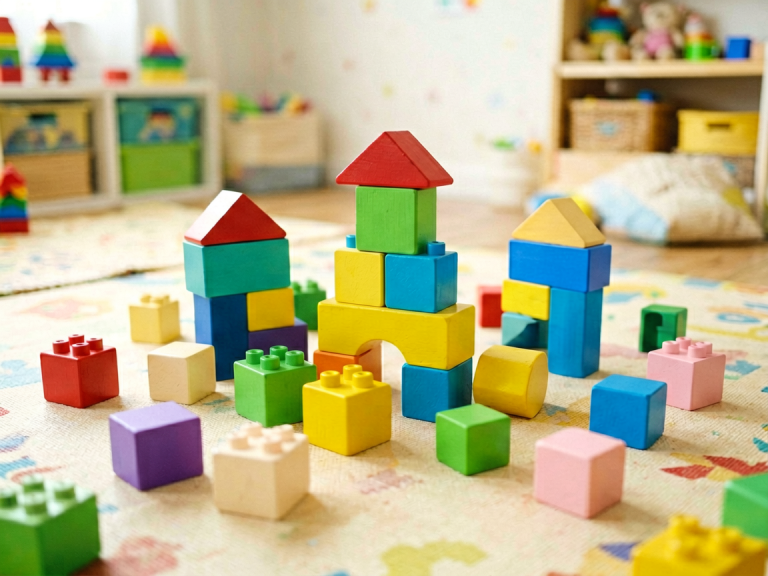
A toy that can be used in only one way (e.g., a battery-operated robot that only dances and makes sounds) will lose its appeal within days. Once the novelty wears off, the child returns to the screen for the next dopamine hit. Open-ended toys, on the other hand, have no fixed outcome. Building blocks, wooden planks, play silks, clay, and loose parts (such as stones, shells, and bottle caps) can be transformed infinitely. A set of plain wooden blocks can become a castle, a spaceship, a bridge, or a birthday cake. This flexibility mirrors the creative freedom that screens cannot provide – on a screen, the rules are set by the programmer; in open-ended play, the child is the programmer.
2. Low-Tech or No-Tech
Ironically, many “educational” toys these days come with flashing lights and digital sounds, effectively becoming a mini screen. These toys often overstimulate children without requiring deep engagement. The best screen-reducing toys are often the simplest: a ball, a jump rope, a magnifying glass, a set of crayons. They rely on the child’s imagination and physical effort, not on batteries. When a toy does not entertain by itself, the child must entertain themselves – and that is the whole point.
3. Encourages Physical Movement
One of the biggest drawbacks of screen time is that it locks the body in a sedentary position. Toys that invite movement – such as balance boards, scooters, skipping ropes, or even a simple catch ball set – help children release energy and develop gross motor skills. They also trigger the release of endorphins and improve mood, making the child less likely to crave the blue glow.
4. Promotes Social Interaction
Screens are solitary by nature. Even multiplayer online games lack the nuance of face-to-face communication – eye contact, tone of voice, and spontaneous laughter. Board games, cooperative puzzles, and role-playing kits (such as a pretend restaurant set) encourage siblings or friends to negotiate, take turns, and collaborate. For only children, consider toys that can be played with a parent or that invite imaginary peers.
5. Involves a Process, Not a Result
Toys that focus on the finished product (like paint-by-numbers or sticker books with predetermined patterns) can be satisfying, but they limit creativity. Better are toys that emphasize the process: a big box of mixed art supplies, a sandbox, a sensory bin with rice and scoops, or a science kit that allows experimentation without a precise outcome. Process-oriented play teaches children that the journey is more rewarding than the destination – a lesson that screens rarely teach.
Toy Recommendations by Age Group
Now that we understand the principles, let us look at specific toy categories and examples for different developmental stages. Remember that every child is unique; the best toy is one that matches their current interests and abilities.
Infants and Toddlers (0–2 years)
At this age, sensory exploration is paramount. The best toys engage the senses without overwhelming them. Good choices include:
- Wooden stacking rings and nesting cups – They teach cause and effect, size discrimination, and fine motor control.
- Cloth books with different textures – These encourage touch and manipulation, and they are safe for mouthing.
- Push-and-pull toys – A wooden snail that wobbles as it is pulled helps with walking practice and spatial awareness.
- Rattles and shakers with natural materials – Avoid plastic ones with loud electronic sounds; instead, choose a bamboo rattle or a small maraca.
- Water play mats and texture boards – You can even make your own sensory board with fabric scraps, zippers, and Velcro.
Avoid light-up, musical toys that play automatically. They make the child a passive observer. Instead, choose toys that require the child to take an action (e.g., shaking, pushing, stacking) to produce a result.
Preschoolers (3–5 years)
This age group is building language, imagination, and social skills. Their play becomes more narrative-driven. Ideal toys include:
- Building bricks (classic wooden blocks or DUPLO-style) – No batteries needed. Encourage your child to build a city, a zoo, or a rocket. Sit with them and ask open-ended questions like “What will the giraffe eat in your zoo?”
- Pretend play sets – A wooden kitchen with play food, a doctor’s kit, or a simple dress-up trunk with hats, scarves, and old costumes. These invite storytelling and role-playing.
- Magnetic tiles – They are more versatile than standard blocks; children can build 3D structures that collapse and rebuild, teaching geometry and perseverance.
- Simple puzzles (12–24 pieces) – Choose puzzles with interesting images, such as animals or scenes from their favorite storybooks. Puzzles teach focus and spatial reasoning.
- A small balance bike – This is a wonderful investment. It builds gross motor skills, confidence, and a love for outdoor movement. No pedals, no training wheels – just a child learning to balance and glide.
School-Age Children (6–10 years)
As children enter formal schooling, they need toys that challenge their growing cognitive abilities and sustain their attention for longer periods. Key recommendations:
- Board games that require strategy – Games like *Settlers of Catan* (junior version), *Ticket to Ride* (first journey), *Carcassonne*, or classic chess/checkers. These games replace screen-based strategy games with real face-to-face interaction.
- Construction kits with more complexity – Meccano metal sets, K’Nex, or Lego Technic. Building a working crane or a wind-powered car requires reading instructions, patience, and fine motor skills.
- Science and nature exploration kits – A magnifying glass, bug catcher, compass, and a simple microscope. Encourage your child to go on “nature walk missions” to collect leaves, observe insects, or identify constellations. Pair these with a blank journal for drawing and notes.
- Art and craft supplies that go beyond crayons – Air-dry clay, watercolor sets, knitting looms, or even a simple beginner’s sewing kit. The process of creating something tangible – like a clay bowl or a woven potholder – gives a deep sense of accomplishment that a finished level in a video game cannot replicate.
- Marble runs and domino sets – These teach cause and effect, gravity, and design thinking. And they are mesmerizing to watch, which is a plus!
Preteens and Teens (11+)
Older children may claim that toys are “for babies,” but the key is to choose activities that are sophisticated enough to engage their developing minds while still being screen-free. Suggestions:
- Advanced building systems – Robot kits like *Makeblock* or *Snap Circuits* that teach electronics and coding without a full screen interface (some kits use physical blocks or a simple display). Alternatively, a 1000-piece puzzle of a world map or a Escher design.
- Music instruments – A ukulele, electric keyboard, or drum pad. Learning an instrument is the ultimate screen-reducing activity: it requires hours of deliberate practice, improves memory, and provides a creative outlet.
- Strategy games and RPGs – *Dungeons & Dragons* starter set, *Catan*, *Azul*, *Scythe*. These games encourage negotiation, strategic thinking, and hours of immersive conversation – all without a glowing screen.
- Outdoor gear – A skateboard, longboard, rollerblades, or a slackline. Physical mastery requires repetition and builds resilience. These are not “toys” in the traditional sense, but they replace the sedentary lure of screens.
- Creative writing and journalism kits – A nice notebook, a set of quality pens, and a small digital voice recorder (if needed). Encourage your teen to start a blog or a handwritten zine. The act of writing by hand slows down thinking and enhances creativity.
Practical Strategies to Make the Transition Smoother
Even the best toy will fail if it is competing directly with an iPad in the same room. Environment design is half the battle. Here are actionable steps:
Create a “Screen-Free Zone” in the Living Room
Designate a corner or a shelf where screens are not allowed. Stock this zone with three or four carefully chosen, high-quality toys that rotate every week. The principle of “less is more” applies here: too many toys overwhelm children and lead to passive scanning – similar to what they do with screens. A curated selection invites deeper play.
Introduce Toys Before the Cravings Hit
Do not bring out a new toy when your child is already begging for the tablet. Instead, introduce it at a calm moment – Saturday morning with a lazy breakfast, or just after a playdate. Model the play yourself: sit down on the floor and start building with blocks while humming. Children are natural imitators; if they see you engaged, they will be curious.
Use the “Toy Rotation” System
Store 70% of toys out of sight and rotate them every two weeks. This makes existing toys feel new again. It also simplifies cleanup and reduces decision fatigue for your child. When a toy reappears after being “missing” for a month, its novelty is restored.
Pair Gradual Screen Reduction with Increased Outdoor Time
Cold turkey often backfires. Instead, reduce screen time by 15 minutes a day, and use that freed time to go outside. A toy that is specifically for outdoor use – like a kite, a jump rope, or a scooter – becomes the natural alternative. The fresh air and sunlight also help regulate sleep cycles and mood.
Be Patient with Boredom
The first week without a screen may be filled with complaints. Do not rescue your child from boredom. Instead, say calmly: “It’s okay to be bored. That’s when good ideas come.” Then walk away. Often, within ten minutes, the child will pick up a toy they previously ignored. Boredom is the gateway to creativity.
Conclusion
Reducing screen time is not about deprivation; it is about replacement. The right toys offer what screens can never deliver: physical movement, real human connection, sensory richness, and the open-ended freedom to imagine without limits. This guide is not exhaustive, but it provides a framework for evaluating any toy you see in a store or online. Ask yourself: Does this toy require my child to think, move, create, or collaborate? Does it have a single, fixed purpose, or can it be reimagined a hundred ways? Does it run on batteries, or on the inexhaustible power of a child’s mind?
The most expensive interactive robot will never teach a child how to be patient, how to negotiate a trade, or how to feel the satisfaction of building something with their own two hands. But a pile of wooden blocks, a well-worn deck of cards, or a muddy patch of dirt just might. The toys we choose are not just distractions; they are the architects of our children’s inner lives. Choose wisely, and the screens will fade into the background – where they belong.