Simple Joys: Play Activities for Babies Using Everyday Toys
Babies are born explorers. In their first year of life, every rattle, every crinkle, every soft texture becomes a gateway to understanding the world. While brightly colored electronic toys may catch a parent’s eye in store aisles, the truth is that the simplest objects—a wooden spoon, an empty cardboard box, a scarf—often provide the richest opportunities for learning and development. Play activities for babies with simple toys not only stimulate sensory, motor, and cognitive growth but also strengthen the parent-child bond through shared moments of discovery. This article presents a collection of purposeful, easy-to-set-up play activities using everyday items you likely already have at home. Each activity is designed with safety, simplicity, and developmental benefits in mind, making it accessible for parents, caregivers, and educators alike.
Sensory Exploration with Textures and Sounds
Newborns and young infants (0–6 months) rely heavily on their senses to make sense of their surroundings. Simple toys that offer contrasting textures, gentle sounds, and safe mouthable surfaces are perfect for this stage.
The Crinkle Box
Take a small, clean cardboard box (like a shoebox) and cut a few soft fabric scraps of different textures—fleece, satin, corduroy, muslin. Tuck them inside, leaving the box open. Babies love pulling out the fabrics, feeling the differences between smooth and nubby surfaces. Add a piece of crinkly cellophane or a clean, empty potato chip bag (with the sharp edges trimmed and sealed inside a fabric pouch) to create a satisfying crackle sound. Lay the baby on their tummy or back and let them explore. This activity builds tactile awareness, hand-eye coordination, and the beginning of cause-and-effect understanding: “When I grab this, it makes a sound.”
Homemade Rattle Bottles
Fill a small, transparent plastic water bottle with a handful of dried rice, lentils, or pasta. Secure the lid tightly with superglue or strong tape—never leave a baby unattended with a bottle that might open. Let the baby shake, roll, and mouth the bottle. For a visual twist, use a bottle with a little water and a few drops of food coloring, then add glitter or small floating objects (like beads sealed inside a mesh bag). The gentle sound and movement captivate a baby’s attention, encouraging tracking with their eyes and strengthening neck muscles as they lift their head to follow the shifting contents.
Fine Motor Play with Household Objects
From around 4 to 9 months, babies develop a growing ability to grasp, transfer, and manipulate objects. Simple toys that require reaching, grasping, and releasing are ideal for this phase.
The Sponge Squeeze
Cut a clean, unused kitchen sponge into small, baby-safe chunks (about the size of a large strawberry). Soak one in water and let the baby squeeze it while sitting in a high chair or on a waterproof mat. The water streaming out fascinates babies and builds hand strength. For a sensory twist, freeze a damp sponge and let the baby explore the cold, hard texture as it warms and softens. Always supervise closely, and keep the activity short to prevent over-chilling.
Cup Stacking and Nesting
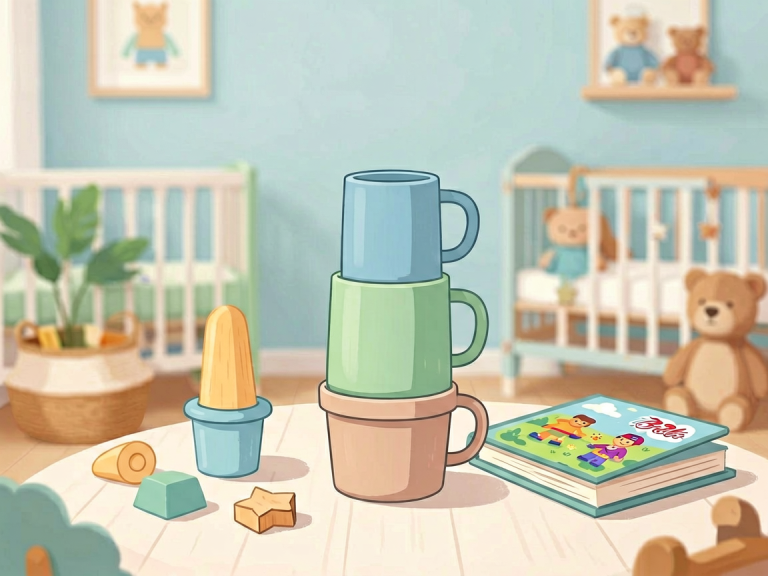
Collect several lightweight plastic cups of different sizes (like stacking cups or disposable party cups with the rims trimmed smooth). Show the baby how to place one cup inside another, then let them try. Younger babies will simply bang cups together or drop them; older babies will begin to mimic stacking. This activity develops spatial awareness, problem-solving (figuring out which cup fits inside which), and bilateral coordination—using both hands together. You can also hide a small toy under a cup and lift it to surprise the baby, reinforcing object permanence.
Gross Motor Movement with Simple Props
As babies grow stronger, they need opportunities to roll, crawl, pull up, and eventually walk. Simple toys can transform the floor into an obstacle course of movement.
The Blanket Roll
Lay a soft, large blanket on the floor. Place the baby on their back on one edge, then gently lift that edge to encourage them to roll over. For a baby who is already rolling, lay a favorite simple toy—like a wooden spoon or a clean sock stuffed with crinkly paper—just out of reach. The baby will naturally stretch, roll, and scoot to get it. This builds core strength, neck control, and motivation to move. You can also use the blanket as a “hammock” to gently rock a younger baby, which develops vestibular balance.
The Pull-Along Scarf
Tie a lightweight scarf or a long fabric ribbon (no longer than 12 inches to avoid strangulation risk) to a small toy, like a plastic ring or a soft block. Place the toy a few inches in front of the baby during tummy time. As the baby reaches, you gently pull the scarf to slide the toy just a little farther. This encourages the baby to shift weight, reach with one hand, and eventually pivot or crawl. Always keep the scarf short and supervise to ensure it doesn’t wrap around any part of the baby’s body.
Cognitive and Language Development Through Repetition
Babies learn through repetition and imitation. Simple toys create predictable, repeatable actions that lay the foundation for later problem-solving and language skills.
The Lid-and-Box Game
Use a small cardboard box with a separate lid (like a gift box). Show the baby how to take the lid off and put it on. At first, the baby will bat at the box or mouth the lid. Over several sessions, they learn to coordinate lifting and placing. Talk to the baby throughout: “Off goes the lid! Where is the box? On goes the lid!” This builds vocabulary, memory, and an understanding of “in” and “out.” For older babies (9+ months), hide a small toy inside the box before closing the lid—they will delight in finding it.
The Stacking Tower
Use large, lightweight blocks or simply roll up soft socks into tight balls to create “blocks.” Show the baby how to stack two or three. They may knock them down, which is perfectly fine—that teaches cause and effect and gravity. Narrate your actions: “Up, up, up… boom! All fall down!” The baby learns to anticipate the fall and may even try to stack themselves. This simple activity supports early math concepts (size, shape, balance) and attention span.
Social-Emotional Play with Mirrors and Faces
Babies are naturally drawn to faces. Simple toys that incorporate reflections and expressions help them learn about self-awareness and emotions.
The Unbreakable Mirror
Place a baby-safe acrylic mirror (or a metal tray with a smooth surface) on the floor during tummy time. Let the baby look at their own reflection. Make funny faces in the mirror next to them. Point to their nose, your nose, the baby’s reflection. This supports self-recognition, which typically emerges around 18 months, but earlier mirror play helps with visual tracking and social smiling. You can tape a simple toy, like a brightly colored pom-pom, to the mirror’s edge to draw attention.
The Peek-a-Boo Scarf
Take a lightweight, breathable scarf (muslin is ideal) and hold it between you and the baby during face-to-face play. Say “Where’s baby?” as you slowly lift the scarf, then exclaim “Peek-a-boo!” Let the baby grab the scarf and pull it away. This classic game teaches object permanence, turn-taking, and emotional regulation—the joy of surprise followed by reunion. Use different scarf colors to add visual variety.
Conclusion
The most magical play activities for babies do not require store-bought gadgets or batteries. A paper towel tube becomes a telescope; a set of plastic measuring spoons becomes a musical instrument; an empty yogurt container becomes a drum. When we offer babies simple toys and follow their lead, we honor their natural curiosity and capacity for wonder. These activities are not only developmentally rich but also free from the pressure of performance—babies learn through repetition, mistakes, and joyful mess. So next time you reach for a toy, consider the humble household object first. With a little creativity and a lot of love, you can turn the everyday into an extraordinary adventure of growth and connection.