Beyond Play: How Educational Toys Shape Cognitive, Social, and Emotional Growth in Children
—
Introduction: The Quiet Revolution in the Toy Box
Walk into any modern playroom, and you will find shelves lined with objects that bear little resemblance to the traditional teddy bear or wooden block. Instead, parents today are greeted by puzzles that teach coding, building sets that introduce fractal geometry, and board games that simulate economic trade. The humble toy has undergone a quiet revolution, transforming from a simple source of amusement into a carefully designed tool for learning. But what exactly makes a toy “educational”? And more importantly, how do these objects genuinely impact a child’s developing mind?
Educational toys for kids are not merely about keeping children occupied; they are intentionally designed to stimulate specific developmental domains—cognitive, linguistic, motor, and socio-emotional. When chosen wisely, these toys can turn the natural, joyful chaos of play into a structured yet organic learning experience. Yet the market is flooded with products that claim educational value while offering little more than flashing lights and repetitive sounds. This article explores the science behind effective educational toys, categorizes their various functions, and provides practical guidance for parents and educators seeking to enrich children’s play without overwhelming them.
—
The Cognitive Foundation: How Toys Wire the Brain
1. Building Executive Function Through Structured Play
One of the most critical outcomes of quality educational toys is the development of executive functions—a set of mental skills that include working memory, flexible thinking, and self-control. Classic examples such as wooden unit blocks, pattern boards, and simple construction sets require a child to plan, sequence, and adjust their actions in real time. For instance, when a four-year-old attempts to build a tower that mirrors a picture, she must hold the target shape in her mind (working memory), decide whether a square or rectangle fits best (flexible thinking), and resist the urge to knock over the partially built structure (self-control).
Neuroscientific research published in journals such as *Child Development* indicates that children who frequently engage with construction and puzzle toys show significantly higher scores on tests of cognitive flexibility and inhibitory control by the age of six. Unlike passive electronic gadgets that reward mere button-pressing, these toys demand active problem-solving, creating the neural pathways essential for later academic success.
2. Mathematical and Logical Reasoning via Manipulatives
Toys that incorporate numbers, patterns, and spatial relationships—such as counting bears, geometric stacking rings, or simple abacuses—offer concrete, hands-on experiences that precede abstract mathematical understanding. Research by Dr. Jennifer Thomson at the University of Cambridge found that preschool children who played with structured number toys for just 15 minutes a day over eight weeks showed a 40% improvement in their ability to estimate quantity and perform simple addition compared to a control group that used non-numerical toys.
The key lies in what educators call “embodied cognition”: young children learn best when they can touch, move, and physically arrange objects. A magnetic tile set that teaches symmetry, for example, helps a child see that a shape flipped over still has the same area—a concept that, when later taught symbolically in school, feels familiar rather than foreign.
—
Language and Literacy: From Sounds to Stories
1. Phonics-Based Games and Pre-Reading Skills
Educational toys that focus on language are not limited to alphabet flashcards. Effective tools include magnetic letters that allow children to form simple words, sound-matching puzzles where each piece corresponds to a phonetic sound, and story cubes that prompt creative narration. These toys tap into the phonemic awareness that forms the bedrock of reading.
A longitudinal study by the National Institute for Literacy in the United States tracked children from ages 3 to 7 and found that those who regularly used letter-sound matching toys and word-building games scored, on average, 30% higher on first-grade reading comprehension tests than peers who did not. The difference is not in the quantity of letters memorized, but in the *process*: by manipulating physical letters and hearing corresponding sounds, children build multi-sensory connections that strengthen neural networks for decoding.
2. Narrative Development and Social Language
Beyond phonics, educational toys can foster storytelling, vocabulary expansion, and conversational skills. Puppets, felt boards, and character figurines encourage children to create scenarios, assign dialogue, and sequence events. When a child makes a puppet “say” something, she practices perspective-taking and begins to understand narrative structure—beginning, middle, and end.
Moreover, when two children use these toys together, they naturally negotiate roles, ask questions, and expand their vocabulary in context. For example, playing with a toy grocery set might introduce words like “checkout,” “receipt,” and “sale.” The social negotiation of who gets to be the cashier versus the customer also teaches turn-taking and cooperation—skills that are as vital as vocabulary.
—
Fine and Gross Motor Development: Learning Through Movement
1. Fine Motor Precision with Manipulative Toys
Educational toys that require small, precise movements—such as lacing beads, pegboards, or threading cards—play a crucial role in developing the hand muscles and finger dexterity needed for writing. Occupational therapists often recommend these toys for children who struggle with pencil grip.
Take, for instance, a simple wooden set of nuts and bolts. For a five-year-old, the act of aligning a bolt with a nut and twisting it involves not just hand-eye coordination but also a sense of torque and rotation. Such activities strengthen the intrinsic muscles of the hand while simultaneously engaging the brain’s planning centers. Over time, these repetitions build the motor control that allows a child to hold a pencil steadily and form letters legibly.
2. Gross Motor Coordination and Spatial Awareness
Educational toys are not confined to tabletops. Climbing structures, balance boards, and large building blocks require whole-body movement, developing core strength, balance, and proprioception—the sense of where one’s body is in space. A study from the University of Montreal showed that children who regularly used balance boards and obstacle course toys had a 25% better performance on spatial reasoning tasks, which correlate strongly with success in mathematics and engineering.
For example, when a child navigates a series of stepping stones placed on the floor, she must judge distances, plan her foot placements, and adjust her center of gravity. This “embodied learning” enhances not only physical confidence but also cognitive mapping skills that transfer to reading maps, solving geometry problems, and even mastering dance steps.
—
Socio-Emotional Intelligence: Toys That Teach Empathy and Resilience
1. Cooperative Board Games and Emotional Vocabulary
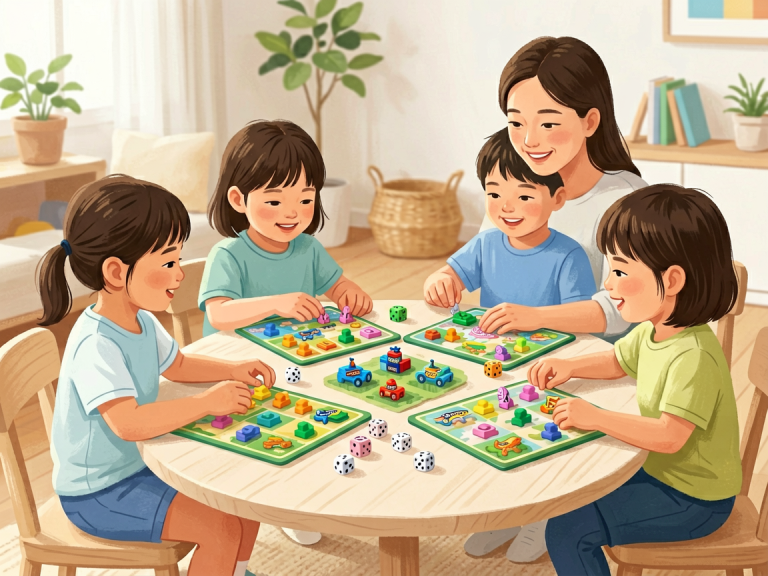
One of the most overlooked areas of educational toys is socio-emotional learning. Cooperative board games—where players work together against a common challenge rather than competing against one another—are especially powerful. Games like *The Sneaky, Snacky Squirrel Game* or *Hoot Owl Hoot!* require children to take turns, manage frustration when a piece falls, and celebrate group success.
Research from the Collaborative for Academic, Social, and Emotional Learning (CASEL) indicates that children who play cooperative games regularly show a 20% increase in prosocial behaviors such as sharing and comforting others. These toys also provide a safe space to experience and name emotions: when a child loses a game piece, a parent can say, “I see you feel disappointed. That’s okay. Let’s try again together.” This emotional coaching builds resilience and a growth mindset.
2. Role-Playing Sets and Perspective-Taking
Doctor kits, play kitchens, and tool benches allow children to step into adult roles, rehearsing social scripts and exploring empathy. When a child pretends to be a doctor listening to a stuffed animal’s heartbeat, she practices caregiving and attention to others’ needs. Similarly, a play kitchen where one child cooks and another serves encourages negotiation and appreciation of different roles.
A fascinating study from the University of Virginia observed children playing with a toy cash register. Those who engaged in pretend play for longer durations developed more complex social narratives—they invented characters, created conflict (e.g., “You didn’t pay enough!”), and resolved it through dialogue. This type of play is directly linked to later emotional intelligence and even academic writing skills, as children learn to construct and navigate social worlds.
—
Choosing the Right Educational Toy: Principles for Parents and Educators
1. Open-Ended vs. Closed-Ended Play
The most effective educational toys are those that offer *open-ended* possibilities—toys that can be used in multiple ways rather than directing the child toward a single correct outcome. A set of wooden planks can become a bridge, a fence, a spaceship, or a tower; a shape-sorter, by contrast, has only one solution. Open-ended toys encourage creativity, divergent thinking, and sustained engagement. For younger children, start with open-ended sensory toys; for older ones, introduce materials like blocks, magnetic tiles, or art supplies that invite endless variation.
2. Age Appropriateness and Challenge
An educational toy that is too simple leads to boredom; one that is too complex leads to frustration. The “Goldilocks zone” is the point where the toy is challenging enough to require effort but not so hard that it causes repeated failure. For a toddler, a three-piece puzzle is educational because it introduces the concept of matching; for a five-year-old, a 24-piece jigsaw puzzle with varied patterns offers a similar level of challenge. Observe your child’s engagement: if they keep returning to the toy and experimenting, it is likely in the sweet spot.
3. Minimizing Distractions
In an age of screens and noise, the most educational toys are often the quietest. Toys that require concentration—such as a simple set of stacking cups or a wooden marble run—train the brain to focus without external rewards. Avoid toys that feature loud sounds, flashing lights, or automated feedback, as these can overstimulate the child and reduce their intrinsic motivation to explore. Instead, look for toys that let the child’s own actions produce the result: for example, a marble run where the child builds the track themselves and then watches the marble roll based on their design.
—
Conclusion: From Playing to Learning, and Back Again
Educational toys for kids are not a shortcut to genius, nor are they a replacement for attentive parenting or quality schooling. Rather, they are allies—tools that harness the natural, irrepressible drive of children to play, explore, and make sense of the world. When a child stacks a block, she is learning physics; when she sorts colored beads, she is learning classification; when she pretends to be a shopkeeper, she is learning economics and empathy. The best educational toys do not announce themselves as learning tools; they simply invite the child into a rich, engaging experience from which learning emerges organically.
As caregivers and educators, our role is not to bombard children with products but to curate a thoughtful environment. A few well-chosen, open-ended toys can do more for a child’s development than a roomful of gimmicks. So the next time you are faced with the gleaming aisles of a toy store, remember: the most powerful educational tool is not the one with the most buttons, but the one that whispers, “What else can you do with me?” In that question lies the foundation of a lifetime of curiosity.
—
*Word count: 1,628*