Building Baby’s Focus: Play Activities to Strengthen Attention Span
—
Introduction: Why Attention Span Matters in Infancy
Attention span – the length of time a child can concentrate on a single activity without becoming distracted – might seem like an abstract concept for babies who can barely hold up their heads. Yet from the very first weeks of life, infants are actively building the neural foundations of focused attention. A baby’s ability to sustain interest in a face, a toy, or a sound is not merely a developmental milestone; it is a critical building block for learning, language acquisition, and later academic success. Research in developmental psychology shows that early attentional skills predict executive function in toddlerhood and even kindergarten readiness.
Play, at its core, is the most natural vehicle for this kind of development. When a baby explores a rattle, follows a moving object with her eyes, or repeatedly drops a spoon from her high chair, she is not just “playing” – she is exercising her attentional muscles. The key lies in choosing activities that match her current developmental stage, that are neither too simple nor too overwhelming, and that invite her to stay engaged just a little longer than she would on her own. This article provides a roadmap of specific, research-backed play activities designed to gently stretch a baby’s attention span from birth to 12 months, organized by age range so you can meet your little one exactly where she is.
—
Understanding Baby’s Developing Attention Span
Before diving into activities, it is helpful to know what typical attention looks like at different ages. A newborn’s attention is almost entirely reflexive: she will stare intently at a high-contrast pattern for a few seconds, then her gaze drifts away. By 2 months, she may track a moving toy for 10–15 seconds. At 4 months, purposeful reaching emerges, and a baby might bat at a dangling toy for a full minute. Between 6 and 9 months, attention becomes more voluntary – a baby will actively choose to look at a picture book or shake a rattle for two to three minutes. By 12 months, many toddlers can sustain focus on a simple puzzle or a stacking game for up to five minutes, especially if an adult is engaged with them.
It is crucial to respect these limits. Trying to force a baby to “pay attention” longer than she is capable of is counterproductive and can lead to frustration. Instead, the goal of play activities should be to create a supportive environment where the baby *wants* to stay engaged because the activity is intrinsically rewarding, and where her focus is gradually lengthened through repetition and positive interaction.
—
Play Activities for Newborns (0–3 Months): Laying the Groundwork
High-Contrast Visual Stimulation
Newborns see best in black, white, and bold patterns. Their visual system is still maturing, and high-contrast images capture their attention because they are easier for the retina to process. Place a black-and-white striped card or a simple geometric pattern about 20–30 cm from your baby’s face. Slowly move it from side to side. At first she may only follow it for a second or two; over weeks, you will notice her tracking becomes smoother and lasts longer. This activity trains the brain to sustain visual attention and strengthens the eye muscles needed for future focus.
Face-to-Face Interaction
Your face is the most powerful attention-grabbing tool for a newborn. Lie down so your face is close to your baby’s, make exaggerated expressions (a big smile, a surprised “O” mouth), and speak softly. Pause after each expression to see if your baby holds your gaze – she may even try to imitate you. Babies are biologically primed to focus on faces, and this “serve and return” interaction is the earliest form of joint attention, a skill that underlies all later learning. Aim for sessions of 30–60 seconds several times a day; you are building both attention span and emotional bonding.
Gentle Auditory Play
Use a soft rattle or a bell attached to a wrist band. Shake it gently on one side of your baby, then pause. Watch for her to turn her head toward the sound. Once she locates it, shake again on the other side. This auditory localization game requires her to hold her attention on a sound source and shift focus – a precursor to the sustained listening needed for language. Keep the sounds gentle; overstimulation can cause a newborn to turn away or become fussy.
—
Play Activities for 3–6 Months: Reaching, Grasping, and Cause-Effect
Tummy Time with a Purpose
By 3 months, most babies can hold their heads up for short periods during tummy time. Place a bright, crinkly toy or a small mirror just out of reach in front of your baby. The novelty of the texture and the reflection will entice her to lift her head, support herself on her forearms, and reach forward – all actions that require sustained concentration. Praise her efforts, and if she becomes tired, roll her onto her back. Gradually increase the time from 30 seconds to one or two minutes of focused effort.
Simple Cause-and-Effect Toys
Introduce toys that produce a clear, immediate result when a baby acts upon them. A silicone rattle that makes a sound when shaken, a soft block that squeaks when squeezed, or a toy that lights up when a button is pressed are excellent choices. Sit your baby in a supportive seat or on your lap, and demonstrate the action. Then place the toy in her hand and let her explore. At first she may randomly bat it, but over time she will intentionally shake or squeeze to produce the effect. This feedback loop motivates her to repeat the action, thereby lengthening her attention as she tries to master the cause-effect relationship.
Peek-a-Boo with a Slow Reveal
Peek-a-boo is a classic for a reason: it teaches object permanence and holds a baby’s attention through anticipation and surprise. For a 4-month-old, cover your face with a sheer scarf or your hands, pause for a second or two, then slowly reveal your face with a big smile and a “Peek-a-boo!” The slow reveal builds suspense and encourages her to watch closely for the moment of reappearance. As she grows, you can increase the pause time to see if she “waits” for you – a sign that her attention is expanding.
—
Play Activities for 6–9 Months: Exploration and Social Attention
Sensory Baskets
Fill a shallow basket with safe, everyday objects of different textures: a wooden spoon, a silk scarf, a rubber spatula, a fabric ball, a metal measuring cup. Sit on the floor with your baby and let her explore the basket freely. Describe what she is touching: “That spoon is smooth and cool” or “The scarf feels soft.” Resist the urge to direct her every move; instead, follow her lead. Babies at this age can spend 3–4 minutes examining multiple objects in a row, and the variety of sensory input holds their interest longer than a single toy. The key is to rotate the objects weekly to maintain novelty.
Stacking and Nesting Games
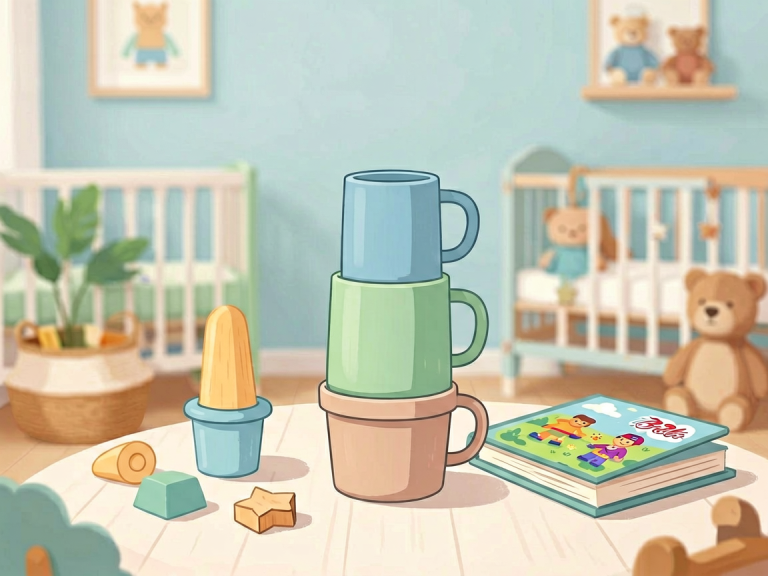
Offer a set of lightweight stacking cups or rings. At 6–7 months, your baby will likely enjoy banging them together or mouthing them. At 8–9 months, she may begin to deliberately put one cup inside another or attempt to stack one ring on a post. This requires fine motor coordination, problem-solving, and sustained attention to the spatial relationship between objects. Sit beside her, but do not take over. If she struggles, you can gently guide her hand or show her once, then let her try again. The process of repeated attempts – and the satisfaction when a cup nests perfectly – naturally lengthens her focus.
Interactive Nursery Rhymes
Sing a simple song like “The Itsy Bitsy Spider” or “Row, Row, Row Your Boat” while using hand motions. Pause at the end of each verse and wait for your baby to look at you expectantly. This “call and response” pattern teaches her to anticipate what comes next, which holds her attention across the duration of the song. You can also vary the tempo – sing very slowly and then very fast – to re-engage her if she loses interest. Babies as young as 6 months will often fix their gaze on your hands or face, absorbing the rhythm and sequence.
—
Play Activities for 9–12 Months: Problem-Solving and Pretend Play
Simple Shape Sorters and Puzzles
Choose a shape sorter with large, easy-to-grasp blocks – for example, a cube with circle, square, and triangle holes. Show your baby how to drop a block through the matching hole. At first she may try to push a square through a circle hole or simply remove the lid and dump out all the blocks. That is fine; exploration is part of the learning. With repeated exposure, she will begin to consciously pick up the correct shape and try to fit it. The trial-and-error process demands focused attention for several minutes. Stay nearby to offer a gentle hint if she becomes frustrated, but allow her to solve the problem herself whenever possible.
Container Play (In and Out)
Provide a small cardboard box or a plastic container with a lid and a collection of small toys (like wooden beads or plastic animals). Show your baby how to take each toy out, one by one, and then put them back in. This seemingly simple game is incredibly absorbing for a 10-month-old because it involves sequencing, hand-eye coordination, and the concept of containment. You can increase the challenge by using containers with different types of closures – a screw-top jar (baby-safe, with your supervision) or a flap that needs to be lifted. Each time you introduce a new container, the novelty renews your baby’s attention.
Pretend Play with Real Objects
At around 11 months, babies begin to imitate everyday actions. Offer a toy phone, a plastic cup and spoon, or a doll and a small blanket. Model a simple action: pick up the phone, say “Hello!”, then hand it to your baby. She may bring it to her ear or just bang it – either way, she is engaged in symbolic thinking. Pretend play naturally draws babies into longer episodes because it mirrors real-life routines that they are motivated to understand. You can extend the activity by narrating a mini story: “Baby is hungry. Let’s feed her with the spoon.” Many babies will watch the action and then try to copy it, staying focused for two to three minutes or more.
—
Tips for Parents: How to Maximize Attention-Building Play
Follow the Baby’s Lead
The most effective way to lengthen attention span is to let the baby choose what to focus on. If she is fascinated by the crinkle sound of a paper bag, resist the urge to switch to a toy that you think is “better.” Instead, stay with her interest and gently expand it – for example, place another crinkly object nearby and see if she notices. When a baby is intrinsically motivated, her attention will naturally be longer and more intense.
Minimize Distractions
Turn off the television, put away your phone, and choose a quiet, uncluttered space for play. Even a subtle background sound or a toy lying in her peripheral vision can pull a baby’s attention away. By creating a calm environment, you help her brain learn to sustain focus on a single stimulus – a skill that becomes increasingly important in toddlerhood and beyond.
Keep Sessions Short and Sweet
A baby’s attention span is measured in minutes, not hours. Plan for 5–10 minutes of focused play two or three times a day, rather than trying to fill an hour. If your baby turns her head away, arches her back, or becomes fussy, she is telling you she is done. Respect that signal; forcing attention only leads to aversion. End the activity on a positive note, even if it was short.
Use Repetition and Variation
Babies learn through repetition, but too much repetition leads to boredom. The sweet spot is to repeat the same activity several times over a week, then introduce a small variation (a new color, a different sound, a slightly harder puzzle). This pattern keeps the activity familiar enough to be comforting, yet novel enough to hold interest. Over time, you will notice that your baby can engage with a single activity for progressively longer periods.
—
Conclusion: Small Steps, Big Gains
Building a baby’s attention span is not about pushing her to sit still and “focus” in an adult sense. It is about creating a rich, responsive play environment where she is naturally drawn to explore, interact, and linger. Each time you hold a high-contrast card in front of your newborn, sing a nursery rhyme to your 6‑month‑old, or solve a shape sorter alongside your 11‑month‑old, you are strengthening neural pathways that will support her future learning. The activities described in this article are designed to be gentle, respectful of the baby’s pace, and most importantly, fun. Remember that every baby develops differently – some will focus intently on a single object for minutes, while others flit from one thing to another. Trust your child’s unique rhythm, celebrate the small victories when she holds your gaze for an extra second, and above all, enjoy the precious time spent playing together. In the end, the greatest gift you can give your baby’s developing attention span is your own undivided attention.