Building Blocks of Speech: How Toys Foster Language Development in Two-Year-Olds
Introduction
At the age of two, children are on the cusp of a linguistic explosion. Their vocabularies expand from a handful of words to several hundred, they begin combining words into simple sentences, and they become increasingly eager to communicate their needs, feelings, and observations. While genetics and caregiver interaction play primary roles in language acquisition, the environment—including the toys a child encounters—can significantly accelerate or enrich this process. The right toys for two-year-olds are not merely entertainment; they are tools that scaffold vocabulary, encourage turn-taking, model sentence structures, and inspire imaginative dialogue. This article explores the most effective categories of toys that support language development in toddlers, explaining how each type works and offering practical tips for caregivers to maximize the linguistic benefits.
Why Toys Matter for Language at Age Two
Before diving into specific toy types, it is important to understand the developmental stage of a typical two-year-old. At this age, children are learning that words have consistent meanings and that they can use language to influence their world. They often engage in parallel play but are beginning to show interest in interactive play with adults and peers. Toys that prompt naming, describing, questioning, and sequencing are particularly valuable. Moreover, the best toys for language development are those that invite conversation rather than passive consumption. A toy that simply lights up or makes a sound when a button is pressed may capture attention but offers limited linguistic input compared to a toy that requires a child to request, label, or explain.
Interactive Storybooks and Picture Books
One of the most powerful language-building tools for two-year-olds is the humble picture book. Unlike digital screens, physical books invite back-and-forth interaction. Look for board books with bright, simple illustrations of everyday objects, animals, and actions. Interactive features such as lift-the-flaps, textures to feel, or peek-a-boo windows encourage a child to point, name, and anticipate.
How they promote language: When a caregiver reads with a two-year-old, the adult naturally models rich vocabulary, intonation, and sentence patterns. The child learns to associate words with images and begins to participate by filling in words (“The cat says… meow!”). Repetitive texts, such as those found in *Brown Bear, Brown Bear* or *Dear Zoo*, allow toddlers to predict and join in, building confidence. Furthermore, books spark conversation beyond the page: “What do you think will happen next?” or “Where is the dog’s tail?” This back-and-forth, known as “dialogic reading,” is proven to accelerate language growth.
Pretend Play Sets: Kitchens, Tool Benches, and Doctor Kits
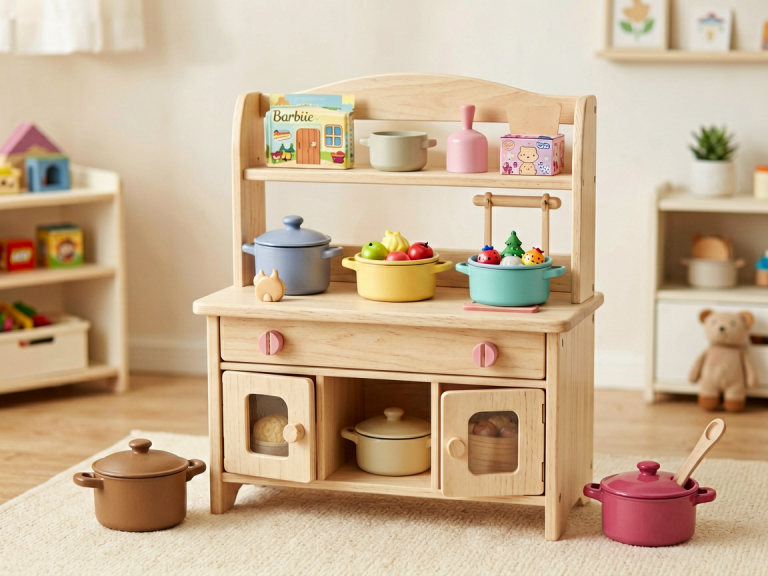
Pretend play reaches a peak around age two as children begin to imitate adult roles. A toy kitchen with plastic food, pots, and utensils, or a miniature doctor set with a stethoscope and bandages, provides endless opportunities for language use. These toys are open-ended, meaning they can be used in countless scenarios, each generating new vocabulary and sentence structures.
How they promote language: When a child pretends to cook a meal, the caregiver can introduce action verbs (“stir,” “pour,” “slice”) and nouns (“spatula,” “carrot,” “soup”). More importantly, pretend play encourages narrative and role-taking. A child might say, “Baby is sick. I give medicine.” The caregiver can model expanded sentences: “Oh, the baby is feeling sick? You are giving her medicine with a spoon. That is very kind.” This process not only teaches new words but also demonstrates how to build longer sentences and express empathy. Role-play also invites questions (“What are you making for dinner?”) and commands (“Put the banana in the bowl”), which improve comprehension and expressive language.
Sorting, Stacking, and Shape-Sorting Toys
While often considered “math” or “fine motor” toys, sorting and stacking toys are surprisingly rich for language development. Simple wooden shape sorters, nesting cups, or stacking rings require a child to match, compare, and order objects. These actions naturally elicit descriptive language about size, color, shape, and position.
How they promote language: As a child tries to fit a triangle block into a triangular hole, the caregiver can narrate: “The triangle goes in the triangle hole. Let’s find the circle. Where is the circle? Yes, it’s red and round.” This labeling of attributes builds a child’s descriptive vocabulary. Additionally, concepts like “big,” “bigger,” “biggest,” “on top,” “under,” and “next to” become concrete through hands-on play. Two-year-olds are just beginning to grasp prepositions and comparatives, and manipulating these toys provides a physical context that makes those abstract words meaningful. Question-asking (“Which one is the smallest?”) further encourages a child to think and respond verbally.
Musical Toys and Sound-Making Instruments
Music and rhythm are deeply connected to language processing in the brain. Toys that produce sounds—such as xylophones, maracas, drums, or simple percussion shakers—invite children to listen, imitate, and create. Musical toys also support phonological awareness, the ability to hear and manipulate sounds within words, which is a precursor to reading.
How they promote language: When a child shakes a maraca, the caregiver can sing a simple song like “Shake, shake, shake your maraca, shake it loud and clear.” The repetition and rhyme help a child internalize speech rhythms. Call-and-response games (“I play loud, you play loud; I play soft, you play soft”) teach turn-taking and following directions, both essential for conversation. Moreover, naming instruments (“drum,” “bell,” “tambourine”) and describing the sounds (“loud,” “soft,” “fast”) expands vocabulary. For two-year-olds who are still mastering articulation, mimicking sounds like “boom boom” or “ding dong” is a fun, low-pressure way to practice speech motor patterns.
Puzzles and Matching Games
Simple puzzles with large knob pieces and matching games (such as picture-to-picture or object-to-shadow) are excellent for building vocabulary and encouraging verbal problem-solving. The best puzzles for language development feature clear images of familiar objects, animals, or people.
How they promote language: As a child works on a puzzle, the caregiver can label each piece: “This is a cow. The cow says ‘moo.’ Where does the cow go?” This reinforces word-object associations. Matching games require a child to find two identical pictures, which naturally leads to describing similarities: “Look, both of these are apples. They are red and round.” Caregivers can also extend the language by asking “Why?” or “How do you know?”—even if the child’s answer is just a point, the caregiver models the full sentence. These toys also teach categories (animals, food, vehicles), which help a child organize their growing lexicon.
Role-Play Costumes and Props (Hats, Capes, Puppets)
Costumes and hand puppets are often underestimated but incredibly effective for language growth. A simple firefighter hat or a princess crown can launch elaborate pretend scenarios. Puppets, in particular, encourage a child to speak “for” the puppet, lowering the pressure to speak perfectly and allowing experimentation with different voices and emotions.
How they promote language: When a child puts on a firefighter hat, the caregiver can enter the scene: “Hello, Firefighter! There is a fire at the school! Can you drive your truck to save the cat?” This prompts the child to respond within the context, using words like “go,” “fast,” “water,” and “up.” Puppets invite dialogue because the child naturally talks to the puppet or makes the puppet talk back. This dramatic play helps a child practice social scripts (“Hello,” “Thank you,” “What happened?”) and experiment with tone and volume. Additionally, using puppets allows a caregiver to model a wide range of sentences and questions that the child might otherwise find intimidating.
The Critical Role of Adult Interaction
No toy, no matter how carefully designed, can replace a responsive, engaged adult. The most important “toy” for language development is a caregiver who observes the child’s play, follows the child’s lead, and adds language to the moment. When using any of the toys described above, adults should:
- Narrate actions (“You put the blue ring on first.”)
- Ask open-ended questions (“What should we make with the play dough?”)
- Expand the child’s utterances (Child: “Truck go.” Adult: “Yes, the big red truck is going fast down the hill!”)
- Repeat and model correct grammar without criticizing (Child: “He runned.” Adult: “Oh, he ran very quickly!”)
By combining quality toys with rich language input, caregivers create an environment where a two-year-old’s natural curiosity meets the necessary linguistic fuel to ignite speech.
Conclusion
Toys are not just playthings; they are catalysts for learning. For a two-year-old building language, the best toys are those that invite interaction, encourage naming and describing, and stimulate imagination. Interactive books, pretend play sets, sorting toys, musical instruments, puzzles, and costumes each offer unique pathways to vocabulary expansion, sentence formation, and conversational skills. However, the magic happens when an attentive adult joins the play, turning a simple stacking game into a lesson in prepositions or a puppet show into a dialogue of emotions. By choosing toys with purpose and engaging with intention, parents, educators, and caregivers can turn everyday play into a powerful foundation for lifelong language success.
(Word count: approximately 1,150)