Building Bridges: The Best Toys for Social Skills in 4-Year-Olds
Introduction
At the age of four, children are rapidly transitioning from parallel play—where they play alongside but not with peers—to more interactive, cooperative forms of play. This developmental milestone is a golden window for nurturing social skills such as sharing, taking turns, negotiating, empathizing, and communicating effectively. While parents and educators often focus on academic readiness, the social-emotional foundation built during this period is equally critical for later success in school and life. One of the most enjoyable and effective ways to support this growth is through carefully selected toys. However, not all toys are created equal when it comes to fostering social abilities. The best toys for social skills for 4-year-olds are those that inherently require interaction, cooperation, and communication. They transform play from a solitary activity into a shared experience where children learn to navigate relationships in a safe, playful context. This article explores the top categories of toys that research and practical experience have shown to be most effective in building social competence in four-year-olds, offering specific examples and explaining why each type works.
Cooperative Board Games: Learning to Win and Lose Together
Traditional board games often pit players against each other, which can lead to frustration and conflict for young children who are still developing emotional regulation. Cooperative board games, on the other hand, are designed so that all players work together toward a common goal, either winning or losing as a team. This shifts the focus from individual competition to shared problem-solving and mutual support.
A standout example is *Hoot Owl Hoot!*, a color-matching game where players help owls fly back to their nest before the sun rises. Every move requires players to discuss which owl to move and which color tile to play. Children quickly learn to articulate their ideas (“I think we should move the blue owl because the next tile is blue”) and listen to suggestions from others. The game naturally promotes turn-taking, patience, and the ability to accept others’ decisions. When the team loses—which happens often—children experience collective disappointment and learn to comfort each other, building empathy. Similarly, *The Sneaky Snacky Squirrel Game* is another cooperative favorite that involves collecting acorns with a spinner. It teaches waiting, sharing the spinner, and celebrating together when everyone fills their log. Unlike competitive games that can end in tears, cooperative games offer repeated practice in collaborative decision-making and emotional regulation.
Role-Playing and Pretend Play Sets: The Theater of Social Interaction
Four-year-olds have a rich imagination, and pretend play is their natural laboratory for social learning. Role-playing sets—such as a toy kitchen, doctor’s kit, or construction workbench—invite children to step into different roles and negotiate scenarios with peers. These toys are powerful because they require children to communicate, assign roles, and follow an unspoken script that demands cooperation.
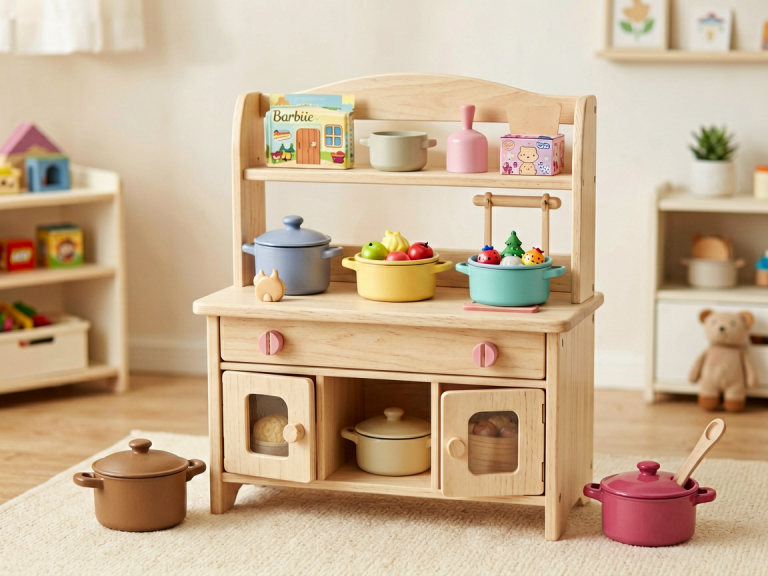
A toy kitchen, for instance, is a classic social catalyst. When two or more children play together, they must decide who is the chef, who is the customer, and what is being “cooked.” They practice asking for items (“Can I have the red plate?”), offering help (“I’ll stir the soup while you cut the carrots”), and resolving disputes (“But I wanted to be the chef!”). The open-ended nature of pretend play allows children to experiment with social norms, such as politeness and turn-taking, in a low-stakes environment. A doctor’s kit similarly encourages empathy, as one child plays the patient and another the doctor, learning to soothe and care for the “sick” friend. Research in developmental psychology shows that the quality of pretend play at age four is a strong predictor of later social competence, because it forces children to coordinate perspectives and manage the flow of interaction. The best sets include enough accessories for at least two children, such as two stethoscopes or multiple food items, to avoid resource conflict while still requiring sharing.
Construction and Building Toys: Collaboration Through Creation
Construction toys like wooden blocks, LEGO Duplo, or magnetic tiles are often viewed as solitary STEM activities, but when used in a group setting, they become powerful tools for social skill development. Building a tower, a bridge, or a castle together requires children to communicate plans, divide tasks, and solve spatial problems as a team. The physical nature of these toys also provides immediate feedback: if children don’t cooperate, the structure might collapse.
Consider a set of large wooden unit blocks. Four-year-olds naturally gravitate toward building something grand, but they quickly discover that one child cannot hold all the blocks while another places them. They must ask for help (“Can you hold this end?”), give directions (“Put the long block here”), and negotiate design choices (“I want a tunnel, but she wants a house”). Magnetic tiles, such as Magna-Tiles, are especially effective because they are easy to connect and allow for quick, satisfying creations. In a group, children learn to share pieces, wait their turn to add a tile, and praise each other’s contributions. When a tower falls, they experience a shared problem: do they blame each other or work together to rebuild? With gentle adult guidance, they learn to say “It’s okay, let’s try again” instead of pointing fingers. The act of co-creating also fosters a sense of joint ownership and pride, reinforcing positive social bonds.
Art and Craft Materials: Expressing and Connecting
Art activities—such as drawing, painting, clay modeling, or collage-making—can be highly social when set up as a shared experience rather than individual projects. The key is to provide materials that require sharing and collaboration, such as one large sheet of paper for a mural, a communal tub of playdough, or a single set of markers.
For example, a group mural project on a roll of butcher paper encourages children to negotiate space (“You draw here, I’ll draw there”), comment on each other’s work (“I like your rainbow!”), and sometimes combine ideas (“Let’s put a sun in the corner”). Playdough is another superb tool. When two children share a single batch of playdough, they must divide it, ask for colors, and create together—making a “playdough pizza” or a “snake” that they can both decorate. Craft kits that require multiple steps, like bead threading or sticker mosaics, also promote turn-taking and helping behavior. Importantly, art allows children to express emotions non-verbally, which can be a gateway to discussing feelings. A child who draws a sad face might prompt a peer to ask “Why are you sad?” and offer comfort, building empathy. The open-ended nature of art means there are no right or wrong results, reducing competition and encouraging mutual appreciation.
Musical Instruments: Rhythm, Sharing, and Group Harmony
Music is inherently social. A set of simple percussion instruments—such as shakers, drums, tambourines, xylophones, and bells—can transform a playroom into a mini orchestra. For four-year-olds, playing music together teaches them to listen to others, match tempo, and take turns leading and following.
When children are given a basket of instruments and asked to create a “band,” they must decide who plays what, when to start and stop, and how to keep a steady beat together. This requires eye contact, verbal cues (“Ready? One, two, three, go!”), and sensitivity to others’ actions. A child playing a drum might slow down if they notice a friend with a shaker struggling to keep up. Musical play also encourages call-and-response patterns, which are foundational for conversational turn-taking. Products like the *Melissa & Doug Band in a Box* or *Hape Early Melodies* sets are designed for multiple players, and they naturally prompt cooperation rather than solitary noise-making. Furthermore, group singing—even with a simple toy microphone—builds confidence in expressing oneself in front of others and fosters a sense of belonging.
Puppets and Plush Toys: Safe Social Practice
Puppets and stuffed animals are often underestimated, but they are brilliant tools for social-emotional learning. A set of hand puppets—including diverse characters like a bear, a rabbit, and a lion—allows children to practice social scenarios through the safety of a pretend character. They can role-play apologizing, asking for a turn, or inviting someone to play, all without the vulnerability of being themselves.
For instance, two children can each hold a puppet and act out a story where one puppet is sad because the other didn’t share. They rehearse phrases like “I’m sorry, can we play together?” This type of play builds perspective-taking and conflict resolution skills in a non-threatening way. Plush toys, especially those with multiple “friends” (like a set of small animal plushes), also encourage caregiving behaviors. Four-year-olds often use stuffed animals to practice nurturing, which translates into empathy for peers. Toys that come with emotional expression cards or that have changeable faces—like the *Feelings Friend* line—can prompt discussions about emotions, helping children name and understand their own feelings and those of others.
Outdoor and Movement Toys: Shared Physical Play
Finally, outdoor toys that require two or more children to use together are invaluable for social development. Classic examples include a tandem swing, a see-saw, a large inflatable ball that needs to be rolled back and forth, or a parachute (even a small one). These toys force children to coordinate their bodies and movements.
A see-saw, for instance, demands mutual cooperation: one child must push off the ground while the other lifts, and they must communicate to maintain rhythm. A large ball for rolling or tossing teaches turn-taking and anticipation. Push-and-pull toys like a wagon or a large trolley can be used by two children to move “cargo” around, requiring them to decide direction and speed together. Even a simple game of “Simon Says” with a group encourages listening and following instructions as a social unit. These physical activities also help release pent-up energy, reducing frustration and making children more receptive to positive social interactions. The best options are those that cannot be played alone—they inherently require a playmate, which motivates children to invite others and practice social initiation.
Conclusion: Choosing Toys That Grow Relationships
The best toys for social skills for 4-year-olds are not the flashiest or most electronic. Instead, they are the ones that create a context for interaction—toys that cannot be fully enjoyed in isolation. Cooperative board games, role-playing sets, building materials, shared art supplies, musical instruments, puppets, and group-movement toys all share a common feature: they require children to communicate, negotiate, empathize, and collaborate. By providing these tools, parents, teachers, and caregivers give children a structured yet playful environment to practice the social competencies that will serve them for a lifetime. When selecting toys, look for open-ended, multi-player designs that encourage dialogue and shared goals. The real magic happens not in the toy itself, but in the conversations, compromises, and connections that unfold around it. Investing in these types of toys is an investment in a child’s ability to build friendships, resolve conflicts, and thrive in a social world.