Unlocking Words on a Dime: The Best Language Toys Under $25
In an age where digital screens dominate children's attention, parents and educators are constantly seeking affordable, engaging tools to foster early language development. The good news is that you don't need to break the bank to build a rich linguistic environment. With a budget of just $25, you can access a treasure trove of language toys that spark curiosity, expand vocabulary, and nurture a love for words. From classic flashcards to interactive story cubes, the market offers surprisingly effective options that combine play with learning. This article explores the best language toys under $25, categorizing them by type, examining their educational benefits, and offering practical tips for making the most of every dollar. Whether you are a parent, a teacher, or a caregiver, these affordable resources can transform ordinary playtime into a powerful language-learning opportunity.
The Power of Play: Why Language Toys Matter
Before diving into specific products, it's important to understand why language toys are worth the investment. Language development is not just about learning words; it’s about building cognitive connections, improving communication skills, and fostering social interaction. Toys that encourage naming objects, forming sentences, and engaging in dialogue stimulate the brain’s language centers in ways that passive screen time cannot. According to child development experts, interactive play with tangible objects helps children internalize vocabulary more effectively because it involves multiple senses—touch, sight, hearing, and even movement. Moreover, affordable language toys democratize access to quality educational resources. A $25 budget can cover a variety of tools that grow with the child, from toddlerhood through early elementary years. The key is to choose toys that are open-ended, repetitive, and adaptable to different learning stages.
Interactive Books and Flashcards: The Foundation of Early Literacy
Lift-the-Flap and Touch-and-Feel Books
One of the most effective language toys under $25 is the interactive book. Unlike passive storybooks, these books invite children to participate actively. For example, "Dear Zoo" by Rod Campbell, a classic lift-the-flap book, typically retails for around $8 to $12. Each flap reveals a new animal, prompting the child to name it, imitate its sound, and eventually retell the story. The repetitive structure reinforces vocabulary while the physical action of lifting flaps engages fine motor skills. Similarly, "That’s Not My…" series by Usborne offers touch-and-feel textures combined with simple descriptive language ("That’s not my puppy; its nose is too bumpy"). Priced at about $7 to $10 each, these books introduce adjectives, opposites, and sensory words. For under $20, you can build a small library of such books that provide countless hours of language-rich interaction.
Photo Flashcards and Word Rings
Flashcards may seem old-fashioned, but modern versions are far from boring. High-quality photo flashcards, such as those from "eeBoo" or "Learning Resources," often cost between $10 and $15 for a set of 50 to 100 cards. Unlike basic alphabet cards, these focus on categories like animals, foods, actions, or emotions. The best ones feature real photographs instead of cartoon drawings, which helps children generalize vocabulary to the real world. To maximize the value, parents can use them for multiple activities: naming, sorting, memory matching, or even creating simple sentences. For instance, a set of "emotion cards" can be used to discuss feelings while reading a story. A word ring—a set of laminated cards on a key ring—costs about $8 to $12 and is perfect for on-the-go learning. You can make your own by printing images and attaching them to a ring, but store-bought sets often include sturdy, wipeable cards.
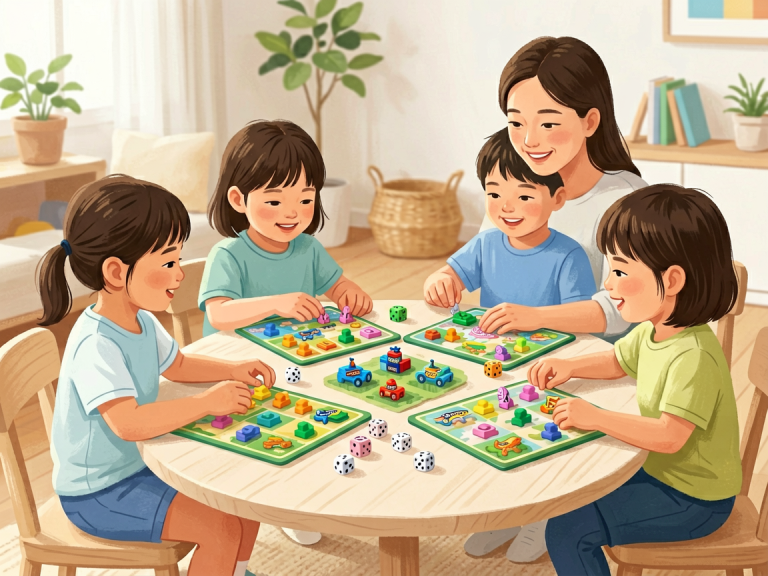
Board Games That Build Vocabulary and Social Skills
Storytelling Cubes and Dice Games
Rory's Story Cubes is a prime example of a language toy that fits comfortably under $25—usually around $13 to $16. This set of nine picture dice features simple icons like a clock, a key, a star, and a hand. Players roll the dice and use the images to create a story. The game has no right or wrong answers, which encourages creativity and oral language development. Children learn to sequence events, use descriptive language, and practice narrative structure. The compact size makes it ideal for car rides or waiting rooms. For younger children, you can simplify the game by asking them to name each image or describe what they see. For older kids, you can add rules like "use the word 'because' in every sentence" to target complex sentence structures.
Word Association and Alphabet Games
Games like "Zingo! Word Builder" (around $20) or "Alphabet Bingo" ($10–$15) turn letter recognition and phonics into a fast-paced competition. Zingo! uses a mechanical dispenser that reveals tiles with letters and simple words. Players match them to their cards, reinforcing letter-sound connections. The excitement of the game keeps children engaged, and repeated exposure builds automaticity. Another excellent choice is "Spot It! Alphabet" (about $12), a visual matching game that challenges players to find the one common symbol between two cards. This game strengthens visual discrimination skills, which are foundational for reading, while also introducing letter names and sounds. All of these games involve social interaction—taking turns, listening, and responding—which is crucial for language pragmatics.
Puzzle and Matching Games: Hands-On Language Learning
Wooden Alphabet and Spelling Puzzles
Wooden puzzles are a durable, budget-friendly choice. Melissa & Doug offers several alphabet puzzles for around $12 to $18. The "See & Spell" set, for example, includes wooden letters that fit into picture boards. Children spell words by matching the letters to the images, learning both the spelling and the meaning. The tactile feedback of picking up and placing letters reinforces motor memory. Unlike digital apps, wooden puzzles require manipulation, which is especially beneficial for young learners who need sensory input. For under $25, you can also find "magnetic spelling kits" that come with a magnetic board and letter tiles. These allow children to build words freely, promoting experimentation. A set from "Magnetic Wooden Alphabet" retails for about $15 and includes uppercase and lowercase letters.
Memory and Matching Card Games
Memory games are a classic tool for vocabulary development, and they are incredibly affordable. A standard “Memory” game with thematic images—such as animals, fruits, or household items—costs around $8 to $12. To turn it into a language activity, require players to say the word aloud when they flip a card. For older children, you can add challenges: “Use the word in a sentence” or “What sound does this animal make?” Some memory games are specifically designed for bilingual learning, with words printed in two languages. For example, “eeboo’s Spanish/English Memory Game” is about $14 and features everyday objects with their names in both languages. This is a wonderful way to introduce a second language without pressure.
Digital and Audio Toys: Tech That Talks (But Stays in Budget)
Talking Flashcards and Simple Electronic Games
While passive screen time is discouraged, interactive electronic toys that respond to touch or speech can be valuable language tools—as long as they are used sparingly. The "LeapFrog Learning Friends 100 Words Book" is a popular choice for toddlers, retailing for about $15 to $20. It features a touch-sensitive panel that plays words, sounds, and simple sentences when children press on pictures. The book introduces 100 words in categories like animals, foods, and colors. It also offers a bilingual mode in Spanish. The battery life is long, and the device can be turned off when not in use. Another option is the "VTech Touch and Learn Activity Desk" expansion packs, which cost around $10 to $15 each and add new themes like phonics or numbers. These are interactive but not always portable.
Audio Story Players and CDs
A less screen-dependent digital toy is the audio story player. Devices like the "Yoto Player" are unfortunately over $25, but many "Storypod" or "Tonies" character figures are priced at $15 to $20 each. However, a budget-friendly alternative is a simple CD player or a Yoto Card-only set (the cards themselves are about $8–$12 each). You can also use a smartphone with offline audiobooks, but that's a tool, not a toy. For a more tactile experience, consider "Listen and Play" audio books that come with a physical book and a CD. These are often found at library sales or thrift stores for under $10. Listening to fluent reading models pronunciation, intonation, and storytelling rhythm.
DIY Language Toys: Creativity Within Your Budget
Make Your Own Flashcards and Games
If you are willing to invest a little time, you can create highly personalized language toys for almost nothing. Use index cards and markers to make flashcards for your child’s specific interests—dinosaurs, vehicles, or family members. Laminating them (inexpensive pouches available at dollar stores) increases durability. Another idea: write simple words on bottle caps or wooden discs from craft stores. You can then use them for spelling games, sorting by first letter, or creating sentences. A set of 50 reusable flashcards costs less than $3 to make. The process of creating them together with your child is itself a language-rich activity, as you talk about the images, choose colors, and repeat the words.
Scavenger Hunt and Labeling Activities
A scavenger hunt is a free language toy. Write or draw clues for objects around the house. For example, “Find something that starts with the letter B” or “Find a soft toy.” As children search, they practice comprehension and vocabulary. You can also label common items with post-it notes: “door,” “table,” “lamp.” Reading the labels repeatedly embeds the words. This activity costs only the price of a notepad. Similarly, “I Spy” games require no materials at all. Playing “I Spy with my little eye something that is green” builds descriptive language and attention to detail.
Tips for Choosing Language Toys Under $25
Look for Open-Ended and Adaptable Toys
The best value comes from toys that can be used in multiple ways and grow with the child. A simple set of alphabet magnets can be used for letter recognition, spelling, sorting, and even magnet fishing. Avoid toys that are overly prescriptive or have limited replay value. For instance, a pop-up toy that says the same phrase repeatedly will quickly bore a child, whereas a set of storytelling cubes can create endless new narratives.
Prioritize Durability and Safety
Cheap toys can break easily, which is not only frustrating but also dangerous. When shopping under $25, look for reputable brands known for quality: Melissa & Doug, eeBoo, Learning Resources, and LeapFrog often offer affordable yet sturdy products. Check for non-toxic materials, rounded edges, and easy-to-clean surfaces. Cardboard puzzles and paper flashcards should be laminated or made of thick stock.
Incorporate Real-Life Context
No toy can replace authentic conversation. The most effective language toys are those that spark dialogue between child and caregiver. When using flashcards, don't just flip them; ask questions: “What does a cow say?” “Where does a cow live?” “What color is the cow?” When playing a memory game, narrate your own thoughts: “I think the cat is under the green card.” These interactions double the learning value. Also, consider cultural relevance. For example, if you are raising a bilingual child, look for toys that include both languages, or create your own bilingual labels.
Combine Multiple Toys for Less Than $25
With a budget of $25, you can actually purchase two or three small items. For example, a set of alphabet flashcards ($8) plus a memory game ($10) plus a storytelling cube set ($7) would total $25. This combination covers different skills: letter naming, visual memory, and narrative creation. Another combo: a touch-and-feel book ($10) plus a set of word magnets ($8) plus a reusable sticker book ($7) focused on vocabulary. The variety keeps the child interested and addresses different learning modalities.
Conclusion: Small Investment, Big Linguistic Returns
Language development does not require expensive electronics or elaborate curriculum. With a budget conscious approach, you can assemble a rich collection of language toys under $25 that will engage, educate, and delight your child. From the tactile satisfaction of lifting flaps in a book to the collaborative storytelling sparked by dice, these toys turn everyday moments into opportunities for word growth. The key is to choose wisely—prioritizing interactivity, durability, and open-ended play—and then to actively participate alongside the child. A $10 set of flashcards used with enthusiasm and creativity can be far more effective than a $100 tablet app used in isolation. So next time you are looking for a gift or a learning tool, remember that the best language toys are the ones that inspire conversation, and you can find excellent ones without spending more than $25. Unlock the power of words without unlocking your wallet.