Building Little Thinkers: The Best Toys for Problem-Solving in Two-Year-Olds
Introduction: The Cognitive Revolution at Age Two
The second year of life is a whirlwind of transformation. A toddler who once relied entirely on caregivers for stimulation now begins to experiment, manipulate, and reason. At age two, children are transitioning from sensorimotor exploration to what developmental psychologist Jean Piaget called the preoperational stage. They start to represent objects mentally, imitate complex actions, and, most importantly, solve simple problems through trial and error, imitation, and nascent symbolic thought. This is the perfect window to introduce toys that intentionally nurture problem-solving skills—not just keep them busy, but genuinely stretch their cognitive muscles.
Problem-solving for a two-year-old is not about algebra or logic puzzles. It involves tasks like figuring out how to fit a shape into a hole, how to stack blocks without toppling them, how to retrieve a toy that has rolled under the couch, or how to make a sound by pressing a button. The best toys for this age are those that present a clear, achievable challenge, provide immediate feedback, and allow for repetition and variation. They should be safe, durable, and open-ended enough to encourage multiple approaches. Below, I have categorised the top problem-solving toys for two-year-olds, explaining why each type works and offering specific examples.
1. Shape Sorters and Puzzle Boards: The Classics of Logical Reasoning
The humble shape sorter is arguably the quintessential problem-solving toy for toddlers. Its premise is simple: a cube or box with cut-out holes and a set of corresponding geometric pieces. The child must match each piece to its correct opening. This task demands visual discrimination (recognising that a star is different from a square), spatial reasoning (understanding that the piece must be rotated to fit), and fine motor control (grasping and guiding the piece). When a child tries to force a triangle into a circle and fails, then tries a different hole, they are engaging in hypothesis testing.
Why it works for two-year-olds: At this age, children are developing the ability to categorise and recognise patterns. Shape sorters provide instant feedback—the piece either fits or it doesn’t—which reinforces learning. Look for sorters with a variety of shapes (beyond the basic circle, square, triangle) and those that also introduce colours or numbers. For example, the Melissa & Doug Take-Along Shape Sorter has nine colourful wooden pieces and a convenient handle. Another excellent option is the Fisher-Price Laugh & Learn Smart Stages Shape Sorter, which adds sound effects and phrases that praise the child’s effort, thereby encouraging persistence. The challenge level can be adjusted: start with just two or three shapes, then increase the set as the child masters them.
2. Stacking and Nesting Toys: Building Spatial Awareness and Balance
Stacking toys—rings on a cone, cups that nest inside one another, or simple wooden blocks—teach cause and effect, size relationships, and balance. A two-year-old who tries to stack a large ring on top of a small one will watch it wobble and fall. Through repeated attempts, they learn that size order matters. Nesting cups, similarly, require the child to sequence cups from largest to smallest to make them fit. This is a direct exercise in seriation, a foundational problem-solving skill.
The beauty of these toys lies in their open-ended nature. A child can stack blocks into a tower, then knock it down; they can nest cups into a tidy stack or use them to scoop and pour water during bath time. The best stacking toys are made from natural materials like wood, which provide sensory feedback, or from soft plastic with textured surfaces. The classic Fisher-Price Rock-a-Stack is a staple: five brightly coloured rings that must be placed on a rocking base in order of size. For more variety, the Battat Wooden Stacking Tower includes a wobble base and rings with different textures, encouraging the child to stabilise the tower while stacking—a more advanced problem. Nesting cups from Green Toys or Munchkin are also fantastic because they double as bath toys and building tools, extending the play possibilities.
3. Cause-and-Effect Toys: Understanding Action and Reaction
Two-year-olds are natural scientists. They love to push a button and hear a sound, pull a lever and see a pop-up, or drop a ball into a hole and watch it roll out. Cause-and-effect toys explicitly teach that one action leads to a predictable outcome. Problem-solving enters when the toy offers multiple possible actions, or when the desired outcome requires a sequence of steps. For instance, a toy that requires the child to slide a switch, then press a button, then turn a wheel to release a ball demands planning and sequencing.
The best cause-and-effect toys are those that invite exploration without overwhelming the child. The Fisher-Price Laugh & Learn Puppy’s Activity Cube has sides with different mechanisms: a piano key, a spinner, a door that opens, and a light-up button. Each side presents a unique problem—how to make the puppy sing, how to make the spinner stop, how to open the door. Another superb choice is the VTech Drop and Go Dump Truck, where the child loads balls into a chute, pulls the truck, and watches them drop out. The toy also counts and says colours, adding a language component. The key is to choose toys that respond to the child’s actions in a clear, consistent way, helping them build mental models of causality.
4. Simple Puzzles and Peg Boards: Fine Motor Precision and Matching
Puzzles for two-year-olds are typically chunky wooden or plastic pieces with knobs, designed to be grasped easily. Unlike shape sorters, puzzles present a picture or scene that the child must complete by placing each piece in its correct spot. This requires visual matching (finding the piece that fits the outline), spatial awareness (rotating the piece to align), and memory (remembering where a piece goes). The puzzles should have large, familiar images like animals, vehicles, or household objects.
Problem-solving emerges when the child encounters a piece that doesn’t fit and must try a different orientation or a different slot. For example, a farm animal puzzle might have a cow, a pig, and a sheep. The child must recognise that the cow’s outline is different from the pig’s, then physically place the cow piece into the cow-shaped indentation. The Melissa & Doug Safari Chunky Puzzle has nine thick pieces with easy-to-grip handles and stands upright on the table. Peg boards, like the Lauri Crepe Rubber Peg Board, offer a different challenge: the child must press pegs into holes of matching colours, which strengthens hand-eye coordination and colour recognition. Some peg boards come with pattern cards that suggest sequences (e.g., red-blue-red), introducing a simple logic pattern.
5. Building Blocks and Construction Sets: The Ultimate Open-Ended Challenge
Perhaps no toy is more valuable for problem-solving than a set of building blocks. Blocks can be stacked, lined up, knocked down, and arranged into structures limited only by imagination. A two-year-old who wants to build a tower that stands as high as possible must solve the problem of stability: bigger blocks on the bottom, careful placement, and a steady hand. If the tower falls, they must reassess and try again. This process teaches resilience, planning, and spatial reasoning.
The best blocks for this age are large, lightweight, and easy to grip. Standard wooden unit blocks (like those from Melissa & Doug or Guidecraft) are excellent, but ensure they are unfinished or coated with non-toxic paint. For a twist, consider magnetic wooden blocks (such as Tegu or Magna-Tiles), which allow the child to build vertical structures that don’t easily topple—a different but equally valuable challenge. Magnetic tiles also teach polarity: the child discovers that some sides attract and others repel. Another option is foam building blocks (like the Mega Bloks First Builders), which are soft and safe for toddlers who might throw or fall onto them. These big blocks interlock, requiring the child to align the studs and press down, a satisfying fine-motor task.
6. Manipulative Toys with Locks, Latches, and Buttons: Fine Motor Problem-Solving
Toys that incorporate locks, latches, chains, and sliding doors are particularly effective for two-year-olds because they mimic real-world challenges. A busy board—a board covered with various closures like a door latch, a toggle switch, a zipper, a buckle, and a padlock—invites the child to figure out how each mechanism works. Each latch requires a different motor plan: some need to be lifted, others slid, others rotated. This is pure problem-solving.
The Melissa & Doug Latches Board is a classic: it features six doors with different coloured wooden latches. Behind each door is a picture of a friendly animal or object. The child must figure out how to open each latch—some slide, others turn, others lift. This teaches persistence because the solution varies by latch. Similarly, the PlanToys Wooden Lacing Shoe or the Melissa & Doug Farm Wooden Lacing Beads introduce lacing, which requires sequencing and hand-eye coordination. For a more electronic version, the VTech Busy Learners Activity Cube has many of these mechanisms built into a cube, including a phone dial, a spinner, a sliding flap, and a light-up button.
7. Open-Ended Art and Sensory Materials: Creative Problem-Solving
Problem-solving isn’t limited to structured puzzles. When a two-year-old has access to play dough, crayons, or a set of animal figurines, they engage in imaginative problem-solving: “How can I make this dough into a snake?” “Where shall I put the elephant?” “How can I draw a circle?” Art and sensory materials offer the ultimate open-ended play experience. The problem is self-defined, which is an important part of cognitive development.
For example, a set of non-toxic play dough (like Play-Doh) with simple tools—a rolling pin, cookie cutters, a plastic knife—allows the child to experiment with cause and effect (pressing a cutter into dough leaves a shape), fine motor manipulation (rolling a ball), and physical properties (squashing, stretching). Finger paints, watercolour sets, and chunky crayons also encourage problem-solving: “How do I mix blue and yellow?” “If I push hard, the line gets thicker.” While these activities may seem purely creative, they are rich with problem-solving opportunities. The child must figure out how to achieve a desired effect, test hypotheses, and adjust their approach.
8. Role-Play and Pretend Play Toys: Social Problem-Solving
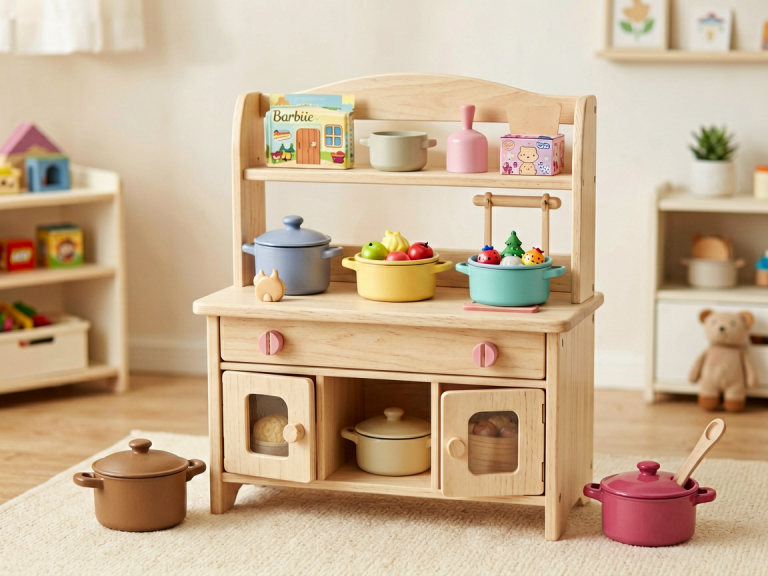
At age two, simple pretend play emerges. A toy kitchen, a doctor’s kit, or a set of animal puppets allows the child to act out scenarios. Problem-solving in this context is social and narrative: “The baby is hungry—what should I feed her?” “The cat is sick—how do I make it better?” While the problems are imaginary, the cognitive processes—identifying a need, selecting a response, and adjusting based on feedback—are real.
Look for toys that provide multiple props and open-ended possibilities. The Learning Resources New Sprouts Fresh Picked Fruits and Veggies set includes plastic foods that can be sorted, stacked, and “cut.” A simple doll with a bed and blanket invites the child to problem-solve how to tuck the doll in. The Fisher-Price Little People sets (like the Farm or the House) offer characters and a setting, prompting the child to figure out where each figure belongs and what they do. These toys build empathy, language, and flexible thinking.
Conclusion: Choosing the Right Toy for Your Two-Year-Old
The best problem-solving toys for two-year-olds are not the flashiest or the most expensive. They are the ones that invite active manipulation, present a clear but manageable challenge, and allow for repetition and variation. A shape sorter, a set of nesting cups, a simple puzzle, and a pile of blocks can provide months of problem-solving practice. When selecting toys, consider your child’s current developmental stage. Some two-year-olds are ready for four-piece puzzles; others still struggle with two-piece ones. Rotate toys to maintain interest, and always play alongside your child, guiding but not directing. Ask open-ended questions like “What happens if you put the big block on the bottom?” or “How can we make the ball come out?” This kind of scaffolding teaches the child to think through problems rather than just following instructions.
Remember, the goal is not to create a genius problem-solver overnight, but to foster a love of exploration and a willingness to try, fail, and try again. In the process, you are building the neural pathways that will serve your child for a lifetime of learning. So go ahead—bring home that shape sorter, dump out the blocks, and watch your little one become a tiny engineer, a budding artist, and a resilient thinker. Each stack, each match, each latch they master is a step toward a more curious and capable mind.