Building Words, Building Worlds: The Best Toys for Language Development in 6-Year-Olds
At age six, children stand at a remarkable crossroads in their linguistic journey. Their vocabulary has exploded to roughly 5,000–8,000 words, they are mastering complex sentence structures, and they are beginning to use language not just to describe the world but to imagine, persuade, and narrate. This is a golden window for language development—and the right toys can turn play into a powerful classroom. Unlike passive entertainment, well-chosen toys actively engage a child’s mind, prompting them to think, speak, listen, and reason. This article explores four categories of toys that specifically nurture language skills in six-year-olds, offering practical examples and explaining the developmental mechanisms behind each.
Storytelling and Role-Play Toys: Unlocking Narrative Thinking
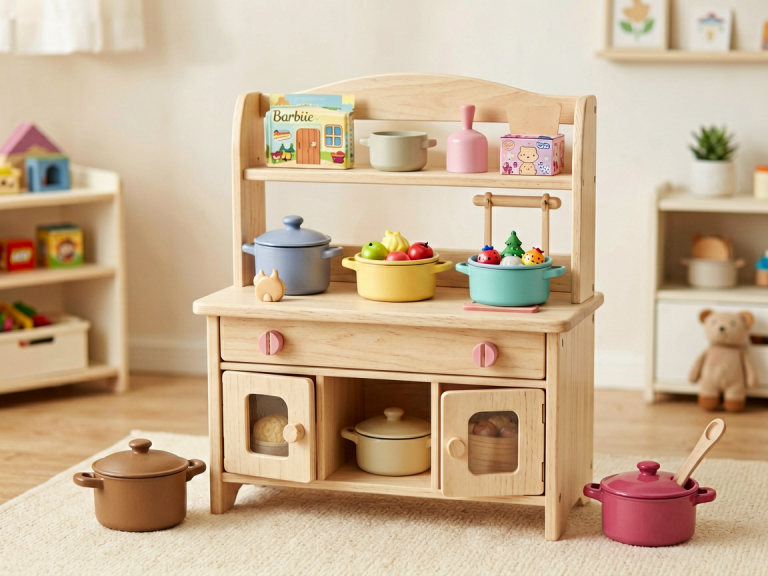
Six-year-olds thrive on stories. They love telling them, acting them out, and inventing new ones. Toys that encourage role-play and storytelling are therefore invaluable for language growth. Puppets, dollhouses, doctor kits, kitchen sets, and toy farm or castle figurines all fall into this category. The magic lies in the open-ended nature of these toys: there is no single “correct” way to play, so children must constantly create dialogue, describe actions, and build plots.
Consider a simple set of animal puppets. A six-year-old might invent a scenario in which a rabbit and a bear argue over a carrot. To sustain the play, the child must use language to express the rabbit’s frustration (“No, that’s mine! I found it first!”) and the bear’s reasoning (“But I’m bigger, so I need more food”). This kind of spontaneous dialogue forces the child to adopt different perspectives, use emotional vocabulary, and practice turn-taking in conversation. Furthermore, when parents or peers join in, the child learns to negotiate the storyline, clarify misunderstandings, and extend the narrative—all core language skills.
More elaborate sets, such as a wooden castle with knights and dragons, encourage children to construct multi-step narratives. They must explain backstory (“The dragon stole the princess because she laughed at his tiny wings”), describe settings (“The castle has a secret tunnel under the tower”), and resolve conflicts (“The knight and the dragon became friends after sharing a pizza”). Research in developmental psychology shows that narrative competence in early childhood strongly predicts later reading comprehension and writing ability. Therefore, investing in high-quality, open-ended role-play toys is one of the most effective ways to boost a six-year-old’s language development.
Board Games and Card Games: Structured Play for Vocabulary and Grammar
While free play is essential, structured games offer unique benefits for language learning. Board games and card games designed for ages six and up typically involve following rules, taking turns, and using specific vocabulary—all of which exercise a child’s linguistic muscles. Games like “Scrabble Junior,” “Boggle,” “Zingo!,” or simple word-matching card games provide explicit practice in letter recognition, spelling, and word formation. However, the language benefits go far beyond literacy.
For example, a game like “Story Cubes” (dice with different pictures on each face) is a brilliant tool for language development. Players roll the dice and must create a story that incorporates all the images shown. This demands rapid lexical retrieval, syntactic planning, and coherent sequencing. A six-year-old might say, “First the fish jumped out of the water, then it saw a key floating, so it swam to a treasure chest…” The child must use conjunctions (first, then, so), prepositions (out of, to), and descriptive modifiers (floating, treasure) to build the narrative. Playing repeatedly strengthens these grammatical structures.
Other games, such as “Guess Who?” or “20 Questions” style card games, require children to formulate yes/no questions accurately (“Does your character have blue eyes?” “Is it an animal?”). Forming questions is a sophisticated grammatical skill that even some adults struggle with. For a six-year-old, repeatedly practicing inversion (“Is he wearing a hat?” rather than “He is wearing a hat?”) solidifies that syntactic pattern. Additionally, games that involve describing objects without naming them (e.g., “Taboo Kids” or homemade “What’s in the Box?”) force children to use circumlocution and synonyms, expanding their vocabulary in a fun, low-pressure context. The key is to choose games that are challenging enough to stretch language skills but not so difficult that they cause frustration.
Construction and Building Sets: Engineering Language Through Sequential Thinking
Construction toys—such as LEGO, magnetic tiles, wooden blocks, or K’Nex—are often marketed as promoting STEM skills, and rightly so. But they are equally powerful for language development, especially in the areas of sequential language, instruction-giving, and descriptive vocabulary. When a six-year-old builds a tower or a spaceship, they are not just manipulating physical objects; they are mentally planning a sequence of steps. To articulate that plan (to a parent, sibling, or even to themselves), they must use time-order words (“first,” “then,” “next,” “finally”), conditionals (“if I put this block here, it might fall”), and spatial prepositions (“on top of,” “underneath,” “behind”).
One particularly effective activity is “build and describe.” Have the child build a simple object (a car, a house, a robot) and then ask them to explain, step by step, how they built it. This encourages the use of past tense (“I put the red block on the yellow one”), comparative adjectives (“this brick is bigger than that one”), and causal connectives (“I added a window because I wanted to see out”). Another technique is “partner building”: one child builds a structure while the other tries to replicate it using only verbal instructions. This task is remarkably challenging for six-year-olds—they quickly learn the importance of precise language. For instance, instead of saying “put the red brick there,” they must say “place the red 2×4 brick on the left side of the blue 2×2 brick, facing forward.” This forces them to use measurement words, position words, and orientation words, all of which enrich their lexicon.
Moreover, construction play often involves troubleshooting. When a tower collapses, a child must explain what went wrong: “The bottom was too weak because I used small blocks.” This requires cause-effect language, which is a cognitive and linguistic milestone for this age. Parents can scaffold this by asking open-ended questions: “Why do you think it fell?” “What could you do differently next time?” In answering, the child practices reasoning, hypothesis formation, and explanatory discourse—skills that are foundational for both oral and written communication.
Electronic and Interactive Toys: Digital Tools for Phonics and Word Recognition
In moderation, electronic and interactive toys can be excellent supplements to traditional play. For six-year-olds, devices that combine audio, visuals, and touch (such as LeapFrog tablets, interactive storybooks, or spelling robots) offer immediate feedback and can motivate reluctant learners. The critical point is to choose toys that require active participation, not passive watching. Well-designed apps and electronic toys often target specific language skills: phonics, rhyming, word families, and sight-word recognition.
For example, an interactive talking pen that reads books aloud and asks comprehension questions (“What color was the frog?” “What happened after the rain?”) trains listening comprehension and recall. Some toys, like the “Osmo” system for iPad, use physical pieces (letter tiles, word cards) that the camera recognizes, turning screen time into a hands-on experience. A child might arrange letters to spell “cat,” then hear the word pronounced, see an animation of a cat, and be asked to use the word in a sentence. This multi-modal approach reinforces the connection between spoken and written language.
However, electronic toys should never replace human interaction. The American Academy of Pediatrics recommends that screen-based play be limited and always co-used with a caregiver. The toy itself cannot teach conversational skills—it cannot ask follow-up questions or respond to a child’s unique turn of phrase. That is why the best electronic toys are those that spark dialogue between parent and child. For instance, a toy that records the child’s voice and plays it back (“Tell me a story about a brave kitten!”) encourages the child to narrate, and then the parent can discuss the story, ask for details, and expand on the vocabulary. Used thoughtfully, electronic toys can provide the repetitive practice (e.g., phonics drills) that some children need, while freeing parents to focus on the more complex aspects of language.
Conclusion: Play with Purpose
Language development at age six is not a passive process—it blossoms through active, meaningful, and joyful interaction. The toys we choose can either support or stifle that process. Role-play toys nurture narrative creativity and perspective-taking. Board and card games teach grammar, question formation, and vocabulary in a structured yet playful context. Construction sets build sequential thinking and precise descriptive language. Electronic tools, used wisely, can reinforce phonics and word recognition. Yet none of these toys works in isolation. The most powerful ingredient remains the attentive, talkative adult who plays alongside the child, asking questions, offering new words, and celebrating every story. By selecting toys that demand language—not just entertain—we give six-year-olds the tools to build not only towers and tales, but the very foundation of their future communication. Choose wisely, play often, and watch their words take flight.