The Intellectual Ladder: How Toy Progression Cultivates Lifelong Curiosity
Introduction
Curiosity is the engine of human discovery. From the first time a baby reaches for a dangling rattle to the moment a teenager dismantles a drone to understand its inner workings, the desire to explore and understand the world is a fundamental driver of learning. Yet curiosity is not a static trait; it requires cultivation, and one of the most powerful tools for its cultivation is the deliberate progression of toys. Toy progression is not merely about replacing a stuffed animal with a video game. It is a carefully designed sequence of playthings that match a child’s cognitive, motor, and emotional development, each stage building upon the last to deepen and expand the child’s curiosity. In this essay, I will examine how toy progression functions as a scaffold for curiosity, from infancy through adolescence, and offer principles for parents and educators who wish to nurture this essential quality.
—
The Foundation: Infancy and Sensory Exploration
In the first year of life, a child’s primary mode of learning is through the senses. Toys at this stage are simple, but their design is critical. Soft rattles, textured teethers, black-and-white contrast cards, and mobiles provide the raw material for the infant’s first curiosity-driven experiments. A baby who shakes a rattle hears a sound; she shakes it again, harder, and hears a different sound. This cause-and-effect loop is the most primitive form of inquiry: “What happens if I do this?” Toy progression at this stage must move from passive to active engagement. A mobile that spins on its own, for example, may briefly capture attention, but it does not invite manipulation. A toy that requires the baby to bat it to make it move, on the other hand, encourages repetition and prediction.
As the infant grows, toys that offer varying degrees of resistance or feedback become essential. A simple wooden block can be grasped, mouthed, dropped, and banged. Each action yields a different result: a thud on carpet, a clatter on a hardwood floor. The child’s curiosity is piqued by the inconsistency—why does it sound different here? This is the beginning of hypothesis testing. The progression from a single sensory toy to a set of toys with multiple sensory dimensions (sound, texture, weight, color) lays the groundwork for more complex inquiry. Without this foundational stage, later curiosity may lack the sensory scaffolding necessary for abstract thought.
—
The Spark: Toddlerhood and Cause-Effect
Between one and three years of age, the toddler’s cognitive world expands dramatically. Now, toys that were merely interesting become tools for deliberate experimentation. Shape sorters, nesting cups, and simple puzzles are archetypal examples. A shape sorter does not simply entertain; it demands that the child match a triangle to a triangular hole. The first attempts are often random, but frustration quickly gives way to concentration. The child tries the triangle in the circle hole, fails, and tries again. Why doesn’t it fit? This is the birth of systematic reasoning.
Crucially, toy progression at this stage must introduce a gradient of difficulty. A toddler who masters a four-piece shape sorter will quickly lose interest if no new challenge appears. The next step might be a six-piece sorter with more complex shapes, or a stacking toy that requires balancing in a specific order. Each new toy offers a slightly higher level of uncertainty. That uncertainty is the fuel of curiosity. Psychologists call it the “optimal novelty gap” – the sweet spot between what the child already knows and what is just beyond reach. Toys that are too simple bore; toys that are too complex frustrate and shut down inquiry. A well-designed toy progression for toddlers is therefore a delicate dance of increasing novelty while maintaining a sense of mastery.
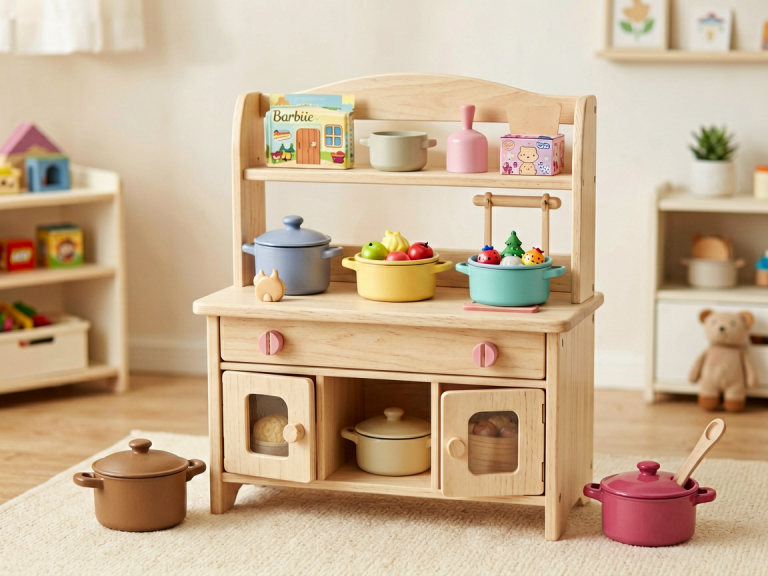
Another key element at this stage is the introduction of toys that support pretend play. A toy kitchen, a set of plastic animals, or a simple doctor’s kit allows the child to act out scenarios. Pretend play is not merely fun; it is a form of narrative curiosity. “What would happen if I were a firefighter?” “How does a cat talk to a dog?” These questions are not literal, but they open up the child’s mind to possibility. Toy progression from solitary cause-effect toys to social, symbolic toys expands curiosity from the physical world into the social and imaginative realms.
—
The Expansion: Preschool and Imaginative Play
The preschool years (ages three to five) are a golden age of curiosity. Language blossoms, and with it, the ability to ask endless “why” questions. Toys during this period should respond to this verbal explosion. Construction sets like Duplo or large wooden blocks allow the child to build not just towers but entire worlds. A child who builds a castle may then ask, “Who lives here?” and invent a story. The toy is no longer just an object; it is a prompt for narrative exploration.
Toy progression at this stage should also introduce elements of open-ended design. A set of magnetic tiles, for instance, can be arranged into endless configurations. There is no “right” answer. This is crucial because curiosity thrives in environments where multiple outcomes are possible. In contrast, a pre-programmed electronic toy that beeps and flashes in fixed patterns may be exciting at first, but it quickly exhausts its mystery. The child learns the pattern, and curiosity ceases. The best toys for preschoolers are those that remain unpredictable, that offer new possibilities each time they are used.
Another important progression is the move from solitary play to collaborative play. Board games with simple rules (e.g., Candy Land) introduce the curiosity of social negotiation: “What if I take this path? What if you block me?” Role-playing sets, such as a pretend grocery store with play money and shelves, invite children to ask questions about social roles, economics, and fairness. At this age, curiosity is not only about “how does this work?” but also “how do we work together?” Toy progression must therefore include objects that encourage shared inquiry.
—
The Challenge: School Age and Problem-Solving
When children enter elementary school, their cognitive abilities take a leap forward. They can hold multiple variables in mind, understand cause-and-effect chains, and begin to reason logically. Toy progression must now emphasize systematic problem-solving. Science kits, building sets like LEGO Technic, and strategy-based board games (e.g., chess or checkers) are ideal. A simple chemistry set that allows the child to mix baking soda and vinegar demonstrates a chemical reaction. But a more advanced kit that introduces variables—temperature, concentration, quantity—invites the child to design experiments: “What happens if I use more vinegar? What if I add soap?” This is authentic scientific curiosity.
At this stage, toy progression also benefits from digital integration, but with caution. Coding toys like programmable robots or simple video games that reward creative solutions can be powerful. The key is that the toy must demand active input, not passive consumption. A game that teaches basic programming logic by requiring the child to drag commands to move a character through a maze exercises curiosity about sequence and cause. However, a mindless shooting game does not. Toy progression for school-age children should gradually increase the complexity of the problems: from single-step solutions to multi-step algorithms, from simple puzzles to open-ended design challenges (e.g., “build a bridge that can hold a weight using only these materials”). Each new toy should pose a question that cannot be answered immediately, prompting the child to iterate, fail, and try again.
—
The Mastery: Adolescence and Creative Expression
Adolescence is a period of identity formation and abstract thinking. Toy progression at this stage is less about “toys” in the conventional sense and more about tools for creation and exploration. Model-building kits (like detailed plastic aircraft or architectural models), advanced robotics kits, musical instruments, or even software for digital art and animation become vehicles for curiosity. The adolescent is no longer simply asking “how does this work?” but “can I make something new?” and “what if I combine these two ideas?”
A key characteristic of adolescent toy progression is the shift from guided to self-directed exploration. A 13-year-old who has mastered a basic coding robot might now be given a microcontroller and a set of sensors to build an original invention. The curiosity is now fueled by autonomy. The toy is no longer a closed system; it is a springboard for personal expression. Similarly, a photography kit or a chemistry set with advanced reagents allows the adolescent to pose their own questions and test their own hypotheses. At this level, toy progression supports what psychologists call “epistemic curiosity”—the deep, intrinsic desire to fill a gap in one’s understanding.
It is also vital to introduce toys that encourage interdisciplinary thinking. For example, a kit that combines electronics with sewing (e-textiles) or a set that merges woodworking with physics can spark curiosity about how different domains connect. Adolescents are naturally drawn to complexity and nuance; toy progression should honor that by offering tools that reward prolonged engagement and offer unexpected challenges.
—
Designing for Curiosity: Principles for Parents and Educators
Understanding the theory of toy progression is one thing; applying it is another. Here are four evidence-based principles for selecting and sequencing toys to cultivate curiosity:
- Follow the developmental curve. Each toy should be slightly more challenging than the child’s current comfort level, but not so advanced that it creates frustration. Observe the child’s frustration tolerance and adjust accordingly.
- Prioritize open-endedness. Toys that can be used in multiple ways—blocks, art supplies, construction sets, loose parts—invite endless experimentation. Avoid toys that have a single correct use or a pre-scripted outcome.
- Encourage failure as feedback. Choose toys that allow the child to make mistakes without penalty. A building set that collapses teaches more about gravity and structural balance than a set that snaps together perfectly every time.
- Fade the scaffolding. As the child grows, step back and let them lead. The ultimate goal of toy progression is not to entertain but to build self-sustaining curiosity—the ability to ask one’s own questions and find one’s own answers.
—
Conclusion
Toy progression is not merely a schedule of purchases; it is a philosophy of learning. From the first rattle to the last robot kit, each toy is a carefully chosen step on a staircase that leads to ever-deeper curiosity. When parents and educators understand this trajectory, they can create environments that not only satisfy a child’s current curiosity but also provoke new questions. The child who grows up with a well-structured toy progression learns that the world is not a set of fixed facts but a living puzzle. That lesson, once internalized, lasts a lifetime.