The Magic of Make-Believe: Pretend Play Activities for Babies
When we hear the term “pretend play,” we often imagine a preschooler commanding a magical kingdom with toy wands or a toddler serving invisible tea to stuffed animals. Yet the seeds of this imaginative world are planted much earlier—in the arms of a parent, during daily moments with a baby who is just beginning to understand symbols, cause and effect, and the joy of shared attention. For babies, pretend play looks very different from the elaborate scenarios of older children. It is subtle, fleeting, and deeply rooted in sensory exploration and social bonding. A baby’s pretend play might involve lifting an empty cup to her lips, making a “brrm” sound while pushing a block across the floor, or covering her face with a blanket and then peeking out with a delighted giggle. These simple acts are not merely cute—they are powerful developmental tools that build cognitive flexibility, emotional understanding, and early language skills. In this article, we will explore why pretend play matters for infants and provide a collection of practical, safe, and engaging pretend play activities for babies from about six months to one year of age.
Why Pretend Play Matters for Infant Development
Before diving into specific activities, it is important to understand the developmental significance of pretend play during the first year of life. Even though a six-month-old cannot yet create a narrative or assign complex roles, she is already developing the foundational skills for symbolic thinking—the ability to use one thing to stand for another. When a baby pretends to drink from an empty cup, she is connecting the physical action with the concept of drinking. This is the earliest form of representation, a precursor to using words to represent objects and ideas.
Pretend play also strengthens the parent-child bond through joint attention. When you engage with your baby in a make-believe game—for example, pretending to feed a doll—you are sharing a focus of attention, taking turns, and responding to each other’s cues. These interactions build social-emotional skills such as empathy, reciprocity, and the ability to read facial expressions. Additionally, pretend play encourages imitation, which is a primary way babies learn. By copying your actions—like putting a toy phone to your ear—the baby practices motor planning and begins to understand that behaviors have social meanings. Finally, pretend play supports language development because it naturally invites sounds, words, and communication. Even if your baby only babbles back, you are creating a rich conversational environment that lays the groundwork for future speech.
Activity 1: Peek-a-Boo with a Pretend Twist
Peek-a-boo is a classic game for a reason: it teaches object permanence, builds anticipation, and delights babies. You can elevate this game into a simple form of pretend play by adding elements of character and plot. For example, take a lightweight scarf or a small piece of fabric and hide your face behind it. Instead of simply revealing yourself, pretend to be a different animal each time. Say in a playful tone, “Where’s Mommy? Oh, here comes a little bird!” Then pop out and make a soft “tweet tweet” sound. Next time, hide again and announce, “Here comes a lion!” and give a gentle roar. Your baby will begin to associate the fabric with a transformation, and she may eventually pull the scarf away herself in anticipation.
To make this activity even more engaging for babies around nine to twelve months, you can use a stuffed animal as the “actor.” Hide the stuffed bear behind the scarf and then make it appear with a “Boo!” and a silly voice. The baby learns that objects can take on roles—a key step toward later pretend scenarios. Keep the game short and responsive; if your baby loses interest or seems overwhelmed, stop and try again later. The goal is joyful connection, not a perfect performance.
Activity 2: Feeding Time Fantasy
One of the most natural pretend play activities for babies involves feeding routines. Babies are intimately familiar with bottles, spoons, and high chairs, so they easily transition into pretending to feed others. Sit your baby on your lap or place her in a stable seated position and offer her a small, clean, empty plastic bowl and a soft baby spoon. Hand her a stuffed animal or a baby doll and say, “Teddy is hungry! Can you feed Teddy?” Then take the spoon, scoop imaginary food from the bowl, and bring it to the doll’s mouth, making a cheerful “Yum yum!” sound.
At first, your baby may simply bang the spoon or put it in her own mouth—that is fine. Over time, she will imitate your action and try to feed the doll. This activity encourages fine motor control as she learns to hold the spoon and guide it toward the doll’s mouth. It also fosters empathy, because she is caring for another creature. For safety, always use unbreakable, non-toxic materials and supervise closely so she does not put small parts in her mouth. An older baby (ten to twelve months) may also enjoy pretending to feed you—lean forward, open your mouth, and say, “Ahh, yummy!” when she offers you the spoon. This back-and-forth is a beautiful example of early turn-taking in pretend play.
Activity 3: Phone Call Fun
Babies are endlessly fascinated by the way adults talk on phones. They watch us hold a device to our ear, speak, and react. You can turn this observation into a delightful pretend play activity. Give your baby a toy phone—or simply a clean, sturdy plastic block that resembles a phone—and hold your own toy phone to your ear. Say, “Ring, ring! Hello! Is that my baby? Hello, baby!” Then pause and look expectantly at your baby. Wait for her to make a sound—a coo, a babble, or even a laugh—and then respond as if she has spoken. “Oh, you’re playing with your blocks? That sounds fun!” Continue the “conversation” with simple phrases, modeling how we take turns.
For babies who are already walking or cruising, you can walk around the room while holding the “phone,” chatting about what you see. This pretend play activity promotes auditory discrimination, social awareness, and the concept of communication. It also supports language development by exposing your baby to the rhythm of dialogue. To keep it safe, avoid using real phones or anything with cords, and always use non-toxic, smooth objects. As your baby grows, she may start to initiate the game by holding a block to her ear and babbling—a wonderful milestone in pretend play.
Activity 4: Simple Dress-Up Beginnings
Elaborate costumes are not necessary—or safe—for babies, but simple dress-up accessories can spark pretend play. Start with a soft hat, a pair of baby-safe sunglasses, or a large, lightweight scarf. Place the hat on your baby’s head and say, “You look like a little firefighter! Can you save the teddy?” Then pretend to put the same hat on a doll. Let your baby explore the texture and try to put the hat on herself. Avoid items with strings, buttons, or elastic bands that could pose choking or strangulation risks. The goal is not to create a full outfit but to introduce the idea that clothing can transform identity.
You can also use a soft mirror: hold it in front of your baby while she wears the hat, and smile broadly. Say, “Look! You’re a firefighter! *Wee-oo, wee-oo!*” This activity builds self-awareness and the concept of “as if.” For babies around twelve months, you can expand the game to include a simple blanket that becomes a “cape.” Drape it over her shoulders and say, “Now you’re a superhero!” then run your fingers along the blanket and fly a stuffed animal through the air. These brief moments of transformation are thrilling for babies and lay the groundwork for later role-playing.
Activity 5: Sound Pretend and Animal Imitation
Babies love sounds, and pretend play can be as simple as assigning a sound to an object or action. For this activity, gather a few soft animal toys—a cow, a duck, a dog—and sit with your baby. Hold up the cow toy and say, “Moo! The cow says moo.” Then place the cow near your baby’s foot and pretend the cow is kissing her toes, making a “moo” sound each time. Next, pick up the duck and say, “Quack, quack!” and make the duck waddle across your baby’s tummy. Your baby will begin to associate the toy with its sound, and eventually she may pick up the cow and babble “moo” or make a similar noise.
You can also make pretend sounds without toys. Hold your hands up like paws and say, “I’m a kitty! Meow!” then gently “paw” at your baby’s arm. She will likely giggle and may respond by reaching for your hands. This activity encourages auditory discrimination, vocal experimentation, and the understanding that different creatures have different “voices.” It is also a wonderful bonding activity because it is silly, physical, and full of laughter. As your baby approaches one year, she may start to initiate her own animal sounds during play, a clear sign that her pretend play skills are blossoming.
Activity 6: Block Cars and Movement Pretend
Long before a child can drive a toy car, she can pretend to make an object move. Give your baby a small wooden or plastic block (large enough that she cannot swallow it) and show her how to push it along the floor or across a tray while saying, “Vroom, vroom! The car is going fast!” Then encourage her to do the same. You can create a simple “road” with a piece of blue construction paper or a towel. Place the block at one end and gently push it toward your baby, then say, “Here comes the car! Beep, beep!” Let your baby push it back.
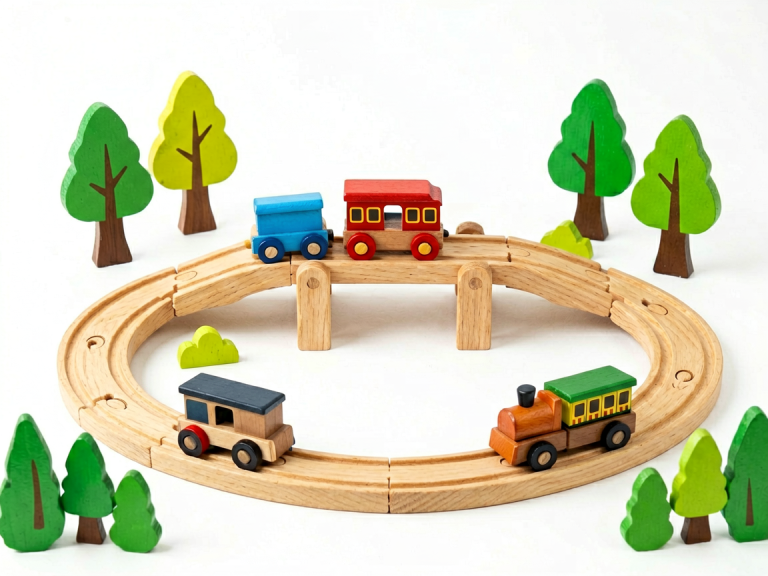
This pretend play activity builds gross motor skills as babies learn to coordinate their arm movements to push the block. It also introduces the concept of “movement pretend”—the block is not really a car, but we are pretending it is. For added fun, you can use a small empty cardboard box as a “garage” and have the block “park” inside. A baby around ten to twelve months may also enjoy pretending that a block is a train or a boat—just change the sound to “Choo-choo” or “Toot toot.” This open-ended play fosters creativity and problem-solving because there are no strict rules; the block can become anything you imagine together.
Activity 7: Mirror Expressions and Emotion Pretend
Babies are captivated by their own reflection, and you can use a baby-safe mirror to engage in emotion pretend play. Sit with your baby in front of a mirror—either a floor mirror or a handheld one mounted securely. Point to your own reflection and make an exaggerated happy face: big smile, wide eyes, and say, “Happy! Mommy is happy!” Then point to your baby’s reflection and say, “You are happy too!” Next, make a sad face with a downturned mouth and say in a soft voice, “Sad… oh, so sad.” Then quickly switch to a surprised face with a gasp. Your baby will watch your expressions intently and may even try to copy them—though her version will be a clumsy but adorable attempt.
This activity helps babies learn to recognize and label emotions, an essential skill for social pretend play later on. It also strengthens the concept of “pretending” to feel something—even though you are not truly sad, you are acting as if you are. To keep it playful, always end on a happy note or a silly face like sticking out your tongue. For babies beyond nine months, you can extend the game by using a stuffed animal in the mirror. Hold the bear up and say, “Bear is sleepy!” and close the bear’s eyes. Then say, “Bear woke up!” and open them. This simple routine introduces narrative and cause-and-effect in a safe, visual format.
Conclusion
Pretend play for babies is not about elaborate storylines or complex props. It is about the small, everyday moments when a parent picks up a block and calls it a car, or a baby lifts an empty spoon to a doll’s mouth and smiles. These seemingly trivial acts are the building blocks of imagination, empathy, and language. By engaging in pretend play activities like peeking through a scarf as a different animal, feeding a stuffed friend, or having a phone conversation with a block, you are giving your baby a priceless gift: the message that the world is full of wonder and that she has the power to create meaning through play.
As your baby grows, these simple interactions will evolve into more complex games. A one-year-old who once babbled into a toy phone may one day hold a two-sided conversation with her stuffed cat. A baby who pushed a block across the floor may soon drive a toy truck around a make-believe city. The seeds you plant today through joyful, responsive pretend play will bloom into a lifelong love of creativity, problem-solving, and connection. So put down the screen, pick up a scarf or a spoon, and let the magic of make-believe begin. Your baby is waiting—and she is ready to pretend.