Memory-Building Play Activities for Babies: A Guide to Early Cognitive Development
Introduction: The Importance of Early Memory Development
From the moment a baby enters the world, their brain is a whirlwind of activity, forming connections at a staggering rate. Memory, the cornerstone of learning, does not emerge fully formed; it is gradually constructed through repeated, meaningful interactions with the environment. For parents and caregivers, understanding how to nurture this process through play is both a privilege and a responsibility. Play is not merely entertainment for infants—it is the primary vehicle through which they encode, store, and retrieve information. Research in developmental neuroscience shows that the first year of life is a critical window for building the neural pathways that support both short-term and long-term memory. By engaging babies in targeted play activities, we can strengthen their ability to recognize patterns, anticipate events, and eventually recall experiences. This article explores a range of play activities designed specifically to build memory in babies from birth to twelve months, offering practical, evidence‑based guidance for fostering a strong cognitive foundation.
Understanding Infant Memory: How Babies Learn and Remember
Before diving into activities, it is essential to grasp the unique characteristics of infant memory. Babies are not born with a fully operational hippocampal system—the brain region responsible for explicit, long-term memory. Instead, their early memory is predominantly implicit and procedural. For example, a newborn quickly learns that a particular sound (like a parent’s voice) signals comfort, but they cannot consciously “remember” the sound in the way an older child would. During the first few months, memory depends heavily on sensory repetition and association. By three to four months, babies begin to show signs of recognition memory—they will look longer at a familiar face than an unfamiliar one. Around six to eight months, object permanence emerges, meaning babies understand that an object continues to exist even when out of sight. This milestone is directly tied to working memory and the ability to hold a mental representation. From nine to twelve months, babies start to exhibit deliberate recall, such as imitating a caregiver’s action after a delay. Each stage presents opportunities for play that can strengthen these developing memory systems. The key is to provide experiences that are repetitive, predictable, yet slightly varied—to challenge the baby’s memory without overwhelming it.
Play Activities for Newborns to 3 Months: Sensory Foundations
In the earliest weeks, a baby’s world revolves around sensations. Memory at this stage is built through repeated sensory experiences that form the basis for later recognition. One simple yet powerful activity is patterned visual tracking. Hold a black-and-white high-contrast card or a simple geometric shape about 8–10 inches from your baby’s face. Slowly move it from side to side. At first, your baby may only glance at it, but with repeated sessions over several days, they will begin to follow it with their eyes for longer periods. This activity strengthens neural connections in the visual cortex and supports recognition memory—the baby learns to anticipate the movement pattern. Another activity is gentle rhythmic touch. While singing a soft lullaby, lightly tap or stroke your baby’s arms, legs, and belly in a consistent rhythm. Over time, the baby will associate the rhythm with the soothing sensation, and may even relax or smile when they hear the same song again. This is an early form of associative memory. Scented play also works well: place a soft cloth with a faint natural scent (like lavender or your own skin) near your baby during quiet time. After a few days, introduce the same scent during a different context; you may notice your baby becoming more alert or calm, indicating they remember the odor. These activities require only a few minutes each day, but their cumulative effect is profound—they lay the groundwork for all subsequent learning.
Play Activities for 4 to 6 Months: Object Permanence and Repetition
Around four months, babies begin to engage more intentionally with objects, and their memory capacity expands. This is the perfect time to introduce peek-a-boo with a twist. Instead of just hiding your face, hide a small, interesting toy under a lightweight cloth. Show the toy, then cover it while saying, “Where did it go?” Pause for a few seconds, then reveal it with an enthusiastic “There it is!” Repeat this three to four times in a session. Over days, your baby will start to reach for the cloth, demonstrating that they remember the hidden object—a clear sign of object permanence and working memory at work. Texture exploration is another excellent memory builder. Collect three or four small objects with distinct textures (e.g., a soft silk scarf, a bumpy rubber ball, a smooth wooden block). Let your baby feel each one while you name the texture (“soft,” “bumpy,” “smooth”). Later, offer just one texture and ask, “Is this bumpy?” Even if your baby cannot answer verbally, their facial expressions or hand movements may indicate recognition. Repetition across multiple days helps transfer this sensory information from short-term to long-term memory. Movement songs like “The Wheels on the Bus” or “Itsy Bitsy Spider” are also powerful. Perform the same song with the same gestures each day. After a few weeks, when you begin the song, your baby may start moving their hands or vocalizing in anticipation. This shows that they have stored the sequence in memory—a precursor to procedural memory.
Play Activities for 7 to 12 Months: Active Exploration and Recall
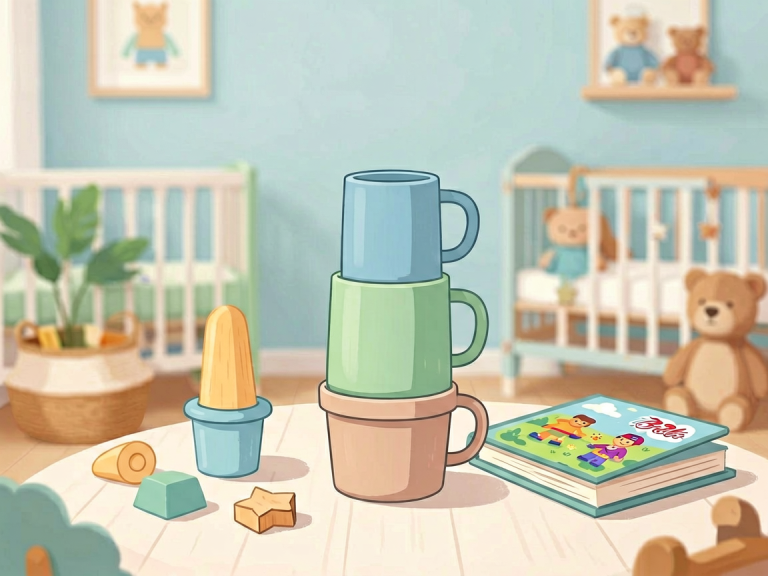
As babies become mobile and more curious, their memory can be challenged in increasingly complex ways. Object hiding with multiple locations is a fantastic activity for this stage. Using three identical cups or bowls, hide a small treat or toy under one while your baby watches. Then, scramble the positions of the cups. Encourage your baby to find the object. At first, they may lift the wrong cup, but with practice, they will remember the specific location. Increase the difficulty by using different-colored cups or by hiding the object under a different cup each time. This activity exercises spatial memory and the ability to hold a location in mind over a delay. Imitation games are equally valuable. Sit facing your baby and perform a simple two-step action, such as tapping your head and then clapping. Wait a few seconds, then encourage your baby to copy you. If they do not imitate immediately, repeat the same action several times over the next few days. Eventually, they will reproduce the sequence, demonstrating recall of the motor plan. Remember-the-toy games work well too. Show your baby three different toys, let them play with each briefly, then remove all toys. After a short pause (10–15 seconds), show them one of the toys again and ask, “Which one was this?” While they may not point accurately, their excitement or lack of interest can give you clues. Gradually increase the delay to 30 seconds or a minute. This helps strengthen the hippocampal memory system, which is maturing rapidly during this period.
The Role of Social Interaction and Language in Memory Building
While play activities are crucial, the social context in which they occur magnifies their memory‑building potential. Babies are biologically primed to learn from caregivers. When you narrate your actions—for example, saying, “Now I’m hiding the ball under the blue cup”—you provide a verbal label that helps the baby encode the event more richly. This combination of sensory, motor, and linguistic information creates multiple memory traces, making recall more likely. Conversational turn-taking is another powerful tool. Even before your baby can speak, treat their coos and babbles as responses. Pause after you speak, allowing them to “reply,” then respond again. This back-and-forth structure teaches the baby to anticipate a sequence—a form of episodic memory. Joint attention—when you and your baby both focus on the same object—has been shown to enhance memory consolidation. For instance, while playing with a spinning top, point to it and say, “Look, it’s spinning!” Your shared gaze and excitement anchor the memory in a socially meaningful context. Research from the University of Washington indicates that babies who experience frequent joint attention at nine months have better memory scores at 14 months. Therefore, every play activity should be infused with warmth, eye contact, and verbal engagement.
Tips for Parents: Creating a Memory-Rich Environment
To maximize memory development, consistency and variety must coexist. First, establish daily routines that include predictable play activities at the same time each day—for example, a five-minute peek-a-boo session after breakfast. Routines provide the repetition needed for memory consolidation. Second, introduce novelty within familiarity. Change one element of a familiar game: use a different colored cloth for peek-a-boo, or substitute a new toy into the hiding game. This prompts the baby to update their memory, strengthening cognitive flexibility. Third, limit screen time. While some apps claim to boost memory, real‑world, three‑dimensional interactions are far more effective because they engage multiple senses and motor systems simultaneously. Fourth, observe your baby’s cues. If they become fussy or turn away, they may be overloaded. Memory building is most effective when the baby is alert, calm, and interested. Finally, repeat activities across different contexts. Playing the same game in the living room, then in the bedroom, helps the baby generalize the memory, making it more robust. Remember, you are not trying to “teach” memory; you are creating an environment full of safe, joyful repetition that naturally strengthens the neural architecture.
Conclusion: The Lifelong Benefits of Playful Learning
Memory is not a fixed trait; it is a skill that can be cultivated from the very beginning of life. The play activities described in this article—from sensory tracking in newborns to complex object‑hiding games for older babies—are not merely fun diversions. They are the building blocks of cognitive capacity, shaping the brain’s ability to encode, store, and retrieve information. By engaging in these activities with patience, warmth, and consistency, parents and caregivers give their babies a gift that lasts a lifetime: a strong foundation for learning, problem-solving, and even emotional regulation. Each giggle during a game of peek-a-boo, each concentrated gaze as a cup is lifted, is a sign that a memory is being forged. In a world full of distractions, the simple, loving act of playing with your baby remains one of the most powerful tools for cognitive development. So take a deep breath, get down on the floor, and start playing—your baby’s memory is waiting to be built, one joyful moment at a time.