Play Ideas for 2-Year-Olds That Supercharge Language Development
Introduction
The second year of life is a remarkable window for language acquisition. At age two, children typically experience a “vocabulary explosion,” moving from a handful of words to several hundred, and begin combining them into two- and three-word phrases. Yet parents and caregivers often wonder: *How can I actively support this process without turning every moment into a formal lesson?* The answer lies in play. Play is the natural context in which toddlers explore, experiment, and communicate. When play is intentionally designed to spark conversation, label objects, encourage imitation, and prompt turn-taking, it becomes a powerful vehicle for language growth. This article provides a comprehensive set of play ideas for two-year-olds, each with a clear connection to language development. These activities are simple, low-cost, and easy to integrate into daily routines—because the best learning happens when children are having fun.
Why Play Matters for Language at Age Two
Before diving into specific ideas, it is important to understand the developmental stage of a two-year-old. At this age, toddlers are transitioning from relying primarily on gestures and single words to using short sentences. They are also developing phonological awareness (noticing sounds in words), building a receptive vocabulary (words they understand) that far outstrips their expressive vocabulary (words they say), and learning the social rules of conversation—such as taking turns, responding to questions, and using eye contact. Play offers a low-pressure environment where these skills can be practiced repeatedly. During play, adults naturally use “parentese” (exaggerated intonation, repetition, and simple syntax), which studies show helps toddlers segment speech and learn new words. Moreover, play provides concrete, sensory-rich contexts that make abstract language meaningful. A child who hears the word “splash” while actually splashing water will remember that word far better than from a flashcard.
Principle #1: Follow the Child’s Lead
Before listing activities, a foundational principle must be emphasized: follow the child’s lead. Two-year-olds have short attention spans and strong preferences. If a child is fascinated by a toy car, that car can become the centerpiece of dozens of language-rich interactions. Trying to force a child to participate in a suggested activity that does not interest them will likely backfire—it creates frustration rather than learning. The role of the adult is to observe, join in, and gently expand the child’s utterances. For example, if the child points to a dog and says “doggie,” the adult can respond with “Yes, that’s a big brown doggie! The doggie is running.” This technique, called “expansion,” models a more complete sentence without correcting or pressuring the child. All of the play ideas below are meant to be adapted based on the child’s current interests and mood.
Play Idea 1: Pretend Play with a Simple Kitchen
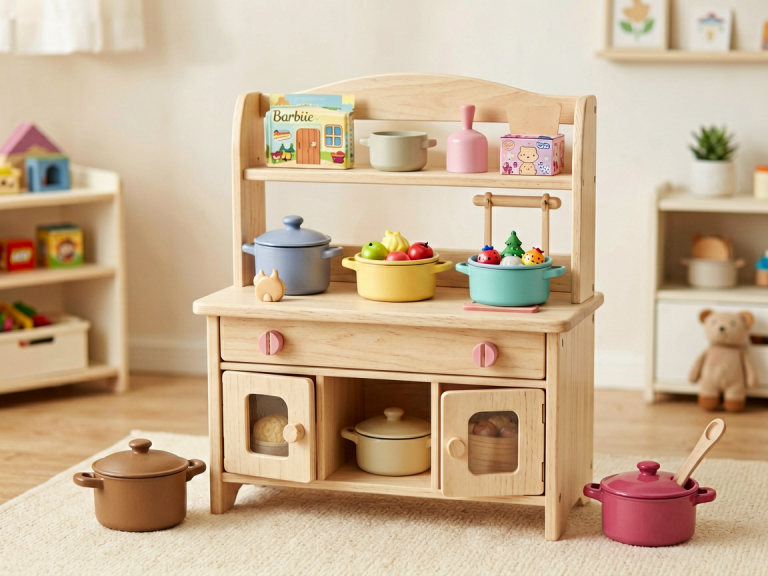
Pretend play—also called symbolic play—blossoms around age two. A toddler might pretend to stir an empty pot or feed a stuffed animal. This kind of play is ideal for language because it invites narration, naming, and dialogue. Set up a small play kitchen or simply provide a few real (safe) kitchen tools: a plastic bowl, a wooden spoon, a cup, and a cloth. Then sit down and begin “cooking.” Describe your actions in short, clear sentences: “I am stirring the soup. It’s hot! Let’s blow on it.” Ask simple questions: “Do you want some tea? Yes? Here is your cup.” Encourage the child to “taste” and respond. The child may not answer verbally at first, but they will absorb the vocabulary (stir, pour, hot, cold, yummy, yucky). Over time, they will begin to imitate your words. You can also introduce new words by pretending to cook different foods: “Let’s make pancakes. We need flour, eggs, and milk. We mix it.” This activity naturally targets nouns, verbs, adjectives, and even prepositions (in, out, on). The repetitive structure of cooking routines reinforces word patterns.
Play Idea 2: Sensory Bins with Hidden Objects
Sensory play engages multiple senses simultaneously, which strengthens neural connections and makes language more memorable. A simple sensory bin can be made by filling a shallow plastic tub with dry rice, beans, sand, or cooked (cooled) pasta. Add a few small, familiar objects: a plastic animal, a ball, a spoon, a small car. Let the child dig, pour, and explore. As they discover each object, name it clearly: “You found the cow! The cow says moo.” Encourage the child to hand you objects and label them: “Give me the car. Thank you!” To promote verbs, narrate the child’s actions: “You are scooping the rice. Wow, you poured it into the cup.” You can also hide objects under the sensory material and ask “Where is the duck? Let’s find it!” This builds listening comprehension and the concept of object permanence. For language development, the key is to provide a running commentary that is simple, repetitive, and connected to the child’s immediate experience. Avoid long monologues; instead, pause and wait for the child to respond or gesture, then expand on that.
Play Idea 3: Interactive Storytime with Repetitive Books
Reading aloud to two-year-olds is one of the most powerful language-building activities, but the technique matters. Choose books with repetitive text, clear illustrations, and simple storylines—classics like *Brown Bear, Brown Bear, What Do You See?*, *The Very Hungry Caterpillar*, or *Goodnight Moon*. While reading, use the “dialogic reading” approach: instead of reading every word straight through, pause and ask questions. Point to a picture and ask “What’s that?” Wait for the child to answer (even if only with a sound or point). Then reinforce: “That’s a brown bear! What does the bear say?” Let the child complete the phrase from a familiar book: for example, after several readings, you can say “Brown bear, brown bear, what do you…” and pause for the child to say “see?” Even if the child cannot yet say the word, they will try to make the sound or mouth the word. This builds narrative skills and prediction. After reading, extend the play by acting out a part of the story. For instance, after reading *The Very Hungry Caterpillar*, pretend to be the caterpillar eating through foods, naming each one: “I’m eating an apple! Now I’m eating a plum!” This multimodal learning (hearing, seeing, moving) reinforces language.
Play Idea 4: Music, Finger Plays, and Movement Songs
Music and rhyme are incredibly effective for language development because they highlight the rhythm and phonemes of speech. Two-year-olds love songs with actions, such as “Itsy Bitsy Spider,” “Wheels on the Bus,” “If You’re Happy and You Know It,” and “Head, Shoulders, Knees, and Toes.” When you sing these songs slowly and clearly, with exaggerated gestures, the child connects sounds with movements and meanings. For example, in “Wheels on the Bus,” you can emphasize different words each time: “The *wheels* on the bus go round and round” (while making circular motions with your hands). Then try replacing a word: “The *horn* on the bus goes beep, beep, beep.” This substitution activity teaches that words have specific meanings and can be swapped. You can also introduce new verses that include your child’s name: “(Child’s name) on the bus says hello, hello, hello.” Singing slows down speech, making it easier for toddlers to hear individual syllables. Finger plays like “Where Is Thumbkin?” help with fine motor coordination while exposing the child to vocabulary for body parts and location words.
Play Idea 5: Obstacle Course and Action Words
Gross motor play is often overlooked as a language activity, but it is excellent for teaching verbs, prepositions, and directional words. Create a mini obstacle course using pillows, cushions, a cardboard box tunnel, and a low table to crawl under. As your child moves through the course, narrate each step with rich language: “Crawl *through* the tunnel! Now step *over* the pillow! Jump *on* the cushion! Sit *down*.” Emphasize spatial words (in, out, on, under, over, through) and action words (crawl, step, jump, roll, climb). You can also give simple two-step commands that require following directions: “First, go under the table, then put the ball in the box.” If the child is hesitant, model the actions yourself while talking aloud. This not only builds receptive language but also encourages the child to use those words when they want to direct their own play. Later, you can reverse roles and ask the child to tell *you* what to do—even if they only gesture, you can verbalize for them: “You want me to jump? Okay, I’ll jump!”
Play Idea 6: Simple Matching and Sorting Games
Cognitive games that involve matching, sorting, and categorizing provide natural opportunities for naming objects and understanding relationships. Use sets of everyday items or toys: colored blocks, plastic animals, fruit pieces from a play food set, or even socks from the laundry. Start by holding up a red block and saying “Red. This block is red. Can you find another red block?” When the child hands you a red block, celebrate: “Yes! Two red blocks!” Then name other colors. For animals, you can sort by farm animals vs. zoo animals, or by size (big vs. small). While sorting, use simple comparative language: “The cow is big. The mouse is little.” You can also play “I Spy” with a small number of objects: “I spy something that says ‘moo.’” This requires the child to listen, identify, and point or say the word. Sorting games also introduce categories, which are foundational for semantic development. For two-year-olds, keep the number of items small (three to five) to avoid cognitive overload.
Tips for Maximizing Language During Any Play
Beyond the specific ideas, here are several general strategies to weave language into every play session:
- Use self-talk. Describe what *you* are doing while the child watches: “I am stacking the blocks. One, two, three blocks. Uh-oh, it fell down!”
- Use parallel talk. Describe what the *child* is doing: “You are pushing the car. The car goes vroom vroom!”
- Pause and wait. After asking a question or making a comment, give the child at least five to ten seconds to process and respond. Silence is productive.
- Avoid testing. Instead of asking “What color is this?” (which can feel like a quiz), make observations: “This ball is blue. I like the blue ball.” The child will learn color words without pressure.
- Repeat, repeat, repeat. Toddlers need to hear a word many times before they use it. Don’t worry about sounding repetitive; that repetition is exactly what builds neural pathways.
- Use gestures and facial expressions. Pointing, nodding, and showing surprise help toddlers infer meaning.
- Limit screen time. Real, face-to-face interaction with a responsive adult is far superior for language development than any app or video.
Conclusion
Language development in two-year-olds is not a separate lesson to be checked off a list—it is woven into the fabric of everyday moments. By choosing play ideas that naturally invite conversation, narration, and social interaction, caregivers can transform ordinary activities into powerful language-learning experiences. The kitchen, the sensory bin, the picture book, the song, the obstacle course, and the sorting game all become classrooms where words come to life. Remember that every child develops at their own pace; the goal is not to force speech, but to create a rich, supportive, and joyful environment in which language can blossom. So put away the flashcards, get down on the floor, and play—because for a two-year-old, play is the most serious work there is, and the foundation of all future communication.