The Power of Play: A Guide to Beginner Toys for Language Development
Introduction
Language is the cornerstone of human connection, and for young children, the journey to mastering it begins long before they utter their first word. From coos and babbles to simple sentences, every stage of language development is a miraculous process that can be profoundly influenced by the environment and the tools children interact with. Among the most effective and joyful tools are toys. For beginners—typically infants and toddlers aged 0 to 3 years—specially designed toys can stimulate auditory processing, vocabulary growth, social communication, and even pre-reading skills. This article explores the essential role of beginner toys in language development, categorizes the most effective types, offers specific examples, and provides practical tips for parents and educators. By understanding how these toys work, caregivers can turn playtime into a powerful language-learning laboratory.
The Role of Play in Language Acquisition
Before diving into specific toys, it is crucial to understand why play is such a fertile ground for language development. Jean Piaget and Lev Vygotsky, two giants of developmental psychology, emphasized that children learn best through active, hands-on exploration. Play is not merely entertainment; it is the child’s natural mode of learning. When a child interacts with a toy, they are experimenting with cause and effect, engaging in symbolic thinking, and practicing social scripts—all of which require and reinforce language.
For beginners, language acquisition is a multi-sensory process. Infants learn through listening to the rhythm and intonation of their caregivers’ voices. Toddlers begin to associate sounds with objects and actions. Toys that respond to a child’s actions—for example, a toy that makes an animal sound when squeezed—provide immediate audio feedback, reinforcing the link between a word and its meaning. Furthermore, toys that encourage turn-taking (like a simple ball that a parent rolls back) lay the foundation for conversational reciprocity. Thus, the right toys can accelerate the transition from passive listening to active speaking.
Types of Beginner Toys for Language Development
Beginner toys for language development fall into several broad categories, each targeting different aspects of communication. Understanding these categories helps caregivers make informed choices.
1. Auditory and Musical Toys
Sound is the first language input a baby receives. Toys that produce varied sounds—rattles, bells, musical mobiles, and simple instruments—attract a child’s attention and encourage them to discriminate between different auditory stimuli. For example, a xylophone allows a toddler to create different tones, and a caregiver can label them (“high note,” “low note,” “loud,” “soft”). This not only builds auditory discrimination but also introduces descriptive vocabulary. Musical toys that play nursery rhymes or simple songs support phonemic awareness—the ability to hear and manipulate individual sounds in words, a precursor to reading.
2. Cause-and-Effect Toys
Toys that respond to a child’s action teach the power of communication. A plastic hammer that makes a popping sound when tapped, a button that triggers a light or a recorded phrase, or a simple pop-up toy all demonstrate that actions have consequences. When a caregiver narrates the process (“I push the button, and the giraffe pops up!”), the child learns that language can describe and predict events. This kind of interaction builds vocabulary related to actions, objects, and spatial concepts.
3. Books and Interactive Story Toys
Even for non-reading beginners, board books with bright pictures, textures, and flaps are invaluable. They introduce the concept of narrative, new vocabulary, and the rhythm of language. Interactive story toys—such as a “talking” stuffed animal that recites a short story when pressed—provide repetition and exposure to sentence structures. Pointing to pictures and naming objects (“Look, a dog! Woof woof!”) expands a child’s receptive vocabulary long before they can produce those words.
4. Sorting and Shape-Matching Toys
Puzzles and shape sorters are not just for cognitive development; they are rich in language opportunities. When a child tries to fit a square block into a square hole, a caregiver can describe the shape, color, size, and positional words (“The red square goes in the hole. Push it down.”). This builds a lexicon of descriptive and spatial terms. Additionally, these toys promote joint attention—when both child and adult focus on the same object—a critical prerequisite for language learning.
5. Pretend Play Sets
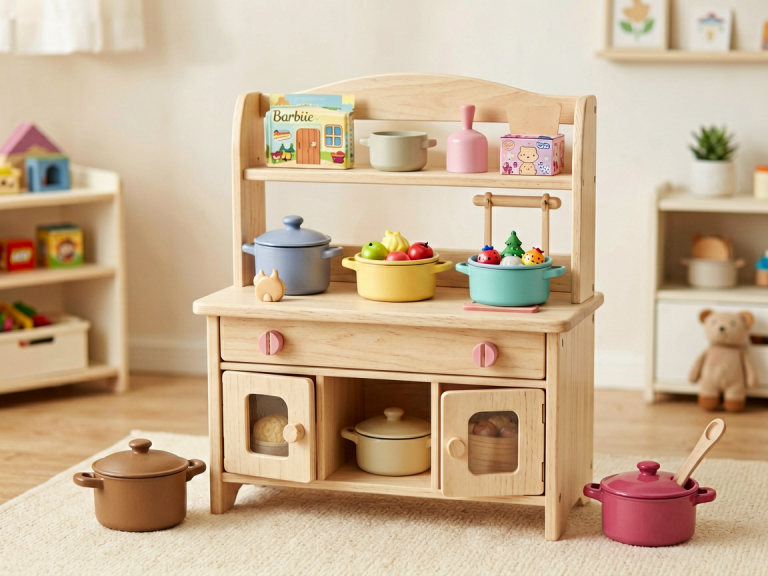
Simple pretend play tools—a toy phone, a set of plastic kitchen utensils, a doll, or a mini doctor’s kit—encourage symbolic thinking and narrative language. A child holding a toy phone might imitate a conversation they have overheard, practicing turn-taking and intonation. A caregiver can model language by saying, “Hello, who is calling? Oh, it’s Grandma! What did you do today?” Pretend play naturally evokes a rich stream of vocabulary related to daily routines, emotions, and social roles.
Specific Toy Examples and Their Benefits
To make the abstract concepts concrete, here are several highly recommended beginner toys that target language development, along with explanations of how they work.
Example 1: The “See & Say” Pull-String Toy
This classic toy features a rotating dial with pictures of animals or objects. When the child pulls the string, the toy names the item and makes a corresponding sound. For instance, “The cow says ‘moo.’” This toy is excellent for building vocabulary and auditory association. It also encourages repetition—children often pull the string dozens of times, which reinforces the word-sound connection. Parents can extend the learning by asking, “What does the cow say?” before the child pulls the string, prompting recall.
Example 2: Soft Fabric Books with Textured Pages
Books like “Pat the Bunny” or “Baby Faces” offer tactile elements and simple text. A baby can feel different textures while the adult reads, “The bunny is soft.” These books introduce cause-and-effect language (“If you touch the fur, it feels fuzzy”) and emotional vocabulary (“The baby is happy. Look at the smile!”). The durability of fabric books allows babies to explore them independently, fostering self-directed learning.
Example 3: Simple Shape Sorters (e.g., Fisher-Price Rock-a-Stack)
The classic stacking rings toy is a powerhouse for language. As the child stacks rings, the adult can name colors, sizes, and positions (“Put the big blue ring on first. Now the small yellow one.”). It also teaches sequence words (“before,” “after,” “next”) and comparative adjectives (“bigger,” “smaller”). The repetitive nature of stacking and knocking down provides endless opportunities for verbal modeling.
Example 4: Musical Instruments for Toddlers (e.g., Egg Shakers or a Mini Drum)
Egg shakers are inexpensive and easy for tiny hands to hold. Shaking them produces a satisfying sound, and a caregiver can sing a song while shaking along. This develops a sense of rhythm and phonemic awareness. For example, shaking an egg shaker while saying “shake, shake, shake” emphasizes the initial /sh/ sound. Drums allow the child to create loud/soft contrasts, which can be labeled with words like “boom” or “whisper.”
Example 5: A Toy Telephone (e.g., a vintage-style plastic phone with buttons)
A toy phone is ideal for practising conversational scripts. Children love to mimic adult phone conversations. By pressing buttons that produce sounds or recorded messages, they learn about turn-taking. A caregiver can pretend to call the child and ask simple questions: “Hello, what is your name? Are you hungry?” This builds comprehension and expressive language in a low-pressure, playful setting.
Tips for Parents and Educators
Even the best toys will not foster language development without thoughtful adult interaction. Here are several guiding principles.
1. Be an Active Play Partner
Do not simply hand a toy to a child and walk away. Sit with them, make eye contact, and narrate what you see and do. Use a slightly exaggerated, melodic tone (often called “parentese”) because it captures attention and highlights speech sounds. Describe the toy’s features, the actions you are taking, and the child’s reactions. For example, while playing with a shape sorter, say, “Oh, you dropped the triangle! Let’s see if it fits. No, it doesn’t fit in the square hole. Try the triangle hole!”
2. Follow the Child’s Lead
Pay attention to what the child is interested in. If they are fixated on the red ball, talk about the ball. Do not force a different toy. Language learning is most effective when it is relevant to the child’s current focus. If the child points to a picture of a cat, say, “Yes, that’s a cat! The cat says meow. Can you say ‘meow’?”
3. Use Repetition and Expansion
Repeat key words multiple times during play. For example, if the child says “ball,” you can expand: “Yes, that’s a big red ball! You rolled the ball. The ball is going fast!” This technique, known as “expansion,” adds grammatical complexity while confirming the child’s message.
4. Limit Distractions and Battery-Free Options
While some electronic toys can be helpful (like the See & Say), too many beeping, flashing toys can overwhelm a child and discourage the human interaction that is essential for language. Many speech-language pathologists recommend simple, battery-free toys that require the child’s active manipulation and the adult’s narration.
5. Rotate Toys
Keep a small selection of toys available and rotate them every week or two. This prevents boredom and keeps the child engaged. When a toy reappears after a break, the child often returns to it with renewed curiosity, providing another chance to reinforce new vocabulary.
Conclusion
Beginner toys are far more than entertainment; they are the scaffolding upon which language skills are built. By choosing toys that stimulate the auditory system, promote cause-and-effect understanding, encourage pretend play, and invite joint attention, caregivers can create a rich linguistic environment. A simple rattle, a shape sorter, a soft book, or a toy phone—each can become a tool for vocabulary expansion, sentence modeling, and conversational practice. However, the toy itself is only half the equation. The magic happens when a caring adult sits down on the floor, meets the child at eye level, and fills the moment with words, sounds, and responsive interactions. In those moments, a child learns not just words, but the joy of communication. And that joy is the most powerful motivator for a lifetime of language growth.