The Power of Play: Selecting Toys for 3-Year-Olds to Accelerate Language Development
Introduction: Why the Right Toys Matter at Age Three
At three years old, a child stands at the precipice of a linguistic explosion. Their vocabulary, which may have hovered around 200 to 300 words at age two, can balloon to over 1,000 words by their fourth birthday. Sentences evolve from two-word fragments like “more juice” to complex structures such as “I want the blue cup because it is my favorite.” This remarkable cognitive leap does not happen in a vacuum. It is nurtured by daily interactions, rich environmental input, and—crucially—the tools that invite and scaffold communication. Toys, often dismissed as mere entertainment, are in fact powerful language-learning instruments. For a three-year-old, the right toy can provoke questions, spark narratives, introduce new vocabulary, model conversational turn-taking, and reinforce grammatical patterns. Conversely, a passive toy that merely lights up or makes pre-recorded sounds may offer little linguistic nourishment. This article explores the specific categories of toys that best support language development at age three, explaining the mechanisms behind their effectiveness and offering practical guidance for parents, educators, and caregivers. Understanding the intersection of play and language is not just an academic exercise; it is a practical strategy for giving children the strongest possible foundation for literacy, social connection, and cognitive growth.
How Language Develops Between Three and Four: A Brief Overview
Before diving into toy recommendations, it is essential to understand what language milestones a typical three-year-old is working toward. At this stage, children are not merely acquiring new words; they are mastering the rules of grammar, expanding their ability to express abstract ideas, and learning to use language for social purposes such as negotiation, storytelling, and humor. Specifically, a three-year-old typically learns to:
- Use plurals and past tense (often with overgeneralizations like “goed” instead of “went”)
- Ask “who,” “what,” “where,” and “why” questions relentlessly
- Follow two- or three-step instructions
- Engage in short dialogues, though they may still struggle to stay on topic
- Understand spatial concepts (in, on, under) and basic opposites (big/little)
- Begin to tell simple stories or recount recent events
Toys that support this developmental stage must therefore do more than label objects. They must encourage questioning, require sequencing, invite creative storytelling, and provide opportunities for back-and-forth interaction. The best toys are those that act as conversational partners or narrative prompts, not just passive objects.
Category One: Construction and Building Toys That Foster Descriptive Language
How Blocks and Building Sets Encourage Linguistic Expansion
Construction toys—wooden blocks, LEGO Duplo, magnetic tiles, or snap-together pieces—are often praised for developing spatial reasoning and fine motor skills, but their contribution to language development is equally profound. When a three-year-old builds a tower, they are not just stacking; they are creating a context for talk. A caregiver can comment on the process: “You are putting the red block on top of the blue one. Now the tower is tall!” Such commentary introduces comparative adjectives (taller, shorter), prepositions (on, under, beside), and action verbs (balance, stack, fall). More importantly, the child is motivated to respond: “I need more blocks!” or “It fell down!” These exchanges are natural, meaningful, and repetitive—the very conditions that support language acquisition.
Specific Examples and Strategies for Interaction
Magnetic tiles, for instance, allow a child to build two-dimensional shapes and three-dimensional structures. A parent can ask, “What should we build next? A house or a castle?” This forced-choice question requires the child to process two distinct options and articulate a preference, strengthening vocabulary and decision-making. Later, when the structure collapses, the moment becomes an opportunity for causal language: “Why did it fall? Because it was too wobbly.” For a three-year-old, understanding cause and effect through physical play directly translates into using because, so, and if-then clauses.
To maximize language benefits, adults should avoid dominating the play. Instead, they should use parallel talk (describing what the child is doing) and self-talk (describing what they themselves are doing). For example: “I am putting the green block under the arch. Now I need a square one to make a door.” This modeling provides the child with a rich stream of grammatically varied input without forcing a response. Over time, the child internalizes these structures and begins to use them spontaneously.
Category Two: Pretend Play Toys That Nurture Narrative and Social Dialogue
The Role of Dress-Up, Play Kitchens, Dollhouses, and Doctor Kits
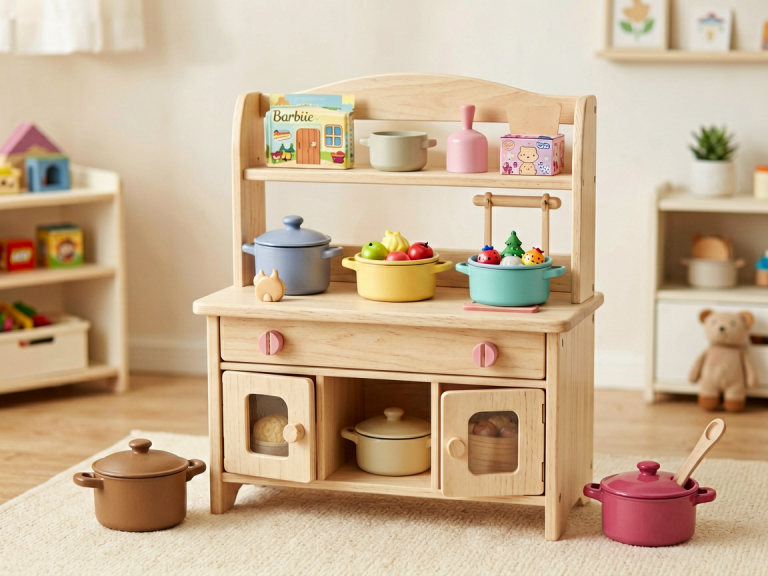
Pretend play is perhaps the most fertile ground for language development at age three. When a child engages in symbolic play, they are essentially practicing the art of storytelling. A toy kitchen set, for example, turns a child into a chef. They announce, “I’m making soup for you!” They engage in dialogue with an invisible customer or with a parent: “Do you want carrots or peas?” This role-playing requires them to adopt different voices, use polite formulas (“please,” “thank you”), and sequence events (first we wash the vegetables, then we cook them). The language of pretend play is richer, more varied, and more emotionally charged than the language of mere labeling.
Why Dolls and Stuffed Animals Are More Than Comfort Objects
Dolls and stuffed animals become conversational partners for a three-year-old. A child might scold a teddy bear for not eating dinner or comfort a baby doll by saying, “Don’t cry, it’s okay.” This is not just cute behavior; it is a rehearsal of social scripts and emotional vocabulary. Toys that have movable parts or accessories (a doll with a bottle, a bed, a blanket) encourage the child to create scenarios that require multiple steps and multiple utterances. A simple tea set with cups, saucers, and a teapot can generate a dozen different sentences: “The tea is hot. Blow on it. Now pour it for bunny. Bunny wants sugar. More tea please!”
Caregivers can extend these interactions by asking open-ended questions: “What will the teddy do next?” “How does the doll feel?” “Why is the dog sad?” Such questions prompt the child to infer mental states—a key component of Theory of Mind and advanced language use. Importantly, these questions do not have right or wrong answers, so the child feels safe to experiment with language.
Category Three: Puzzle and Matching Games That Strengthen Vocabulary and Categorization
From Simple Picture Puzzles to Themed Matching Cards
At three, children are developing the ability to categorize—to understand that a dog and a cat are both “animals,” or that apples and bananas are both “fruit.” Puzzles and matching games directly support this cognitive skill while simultaneously reinforcing vocabulary. A floor puzzle depicting a farm scene, for example, introduces specific animal names (goat, sheep, rooster) and location words (in the barn, behind the fence). As the child places each piece, an adult can narrate: “The sheep goes next to the fence. Where does the pig go? In the mud!” This spatial language, combined with animal names, builds a rich lexical network.
How Memory Card Games Promote Questioning and Turn-Taking
Memory card games—where children flip over cards to find matching pairs—are excellent for turn-taking, a fundamental conversational skill. A three-year-old must learn to wait, pay attention to another person’s move, and then take their own. During the game, language naturally emerges: “I found a match!” “Your turn.” “Where is the other red ball?” The game also encourages the use of location words (under, next to) and comparative phrases (same, different). For auditory learners, using cards with pictures of familiar objects (ball, shoe, apple) and naming them aloud reinforces the link between visual representation and spoken word.
Adults can scaffold the experience by modeling descriptive language: “That card has a blue train. I remember seeing a blue train over there.” This type of commentary helps the child build working memory and retrieval strategies, which are closely linked to vocabulary development.
Category Four: Musical Toys, Sound Books, and Rhyming Games That Support Phonological Awareness
The Connection Between Rhythm, Rhyme, and Language
Phonological awareness—the ability to hear and manipulate the sounds in words—is a strong predictor of later reading success. Three-year-olds are ready to play with sounds: they enjoy rhyming nonsense words, clapping syllables, and singing repetitive songs. Musical toys such as xylophones, drums, or simple keyboards can be used to create rhythmic patterns that mirror the stress patterns of language. Playing a simple rhythm and saying “BIG dog, small cat” while tapping helps the child feel the syllable beats.
Sound books that play animal noises, vehicle sounds, or environmental sounds also support language by linking auditory stimuli to words. When a child presses a button and hears “Moo!” they learn to associate the sound with the word “cow,” and they may spontaneously imitate the sound, which is a precursor to verbal production. Some sound books have interactive pages that ask, “Can you find the duck?” requiring the child to point and say the word—a perfect example of joint attention combined with vocabulary practice.
Using Nursery Rhymes and Finger Play Toys
Finger puppets or toys designed for singing classic nursery rhymes (like “Itsy Bitsy Spider” or “Wheels on the Bus”) are invaluable. The repetitive, predictable language of rhymes helps children internalize sentence patterns and new vocabulary. As they move the puppet along with the song, they are engaging multiple senses—auditory, kinesthetic, and visual—which strengthens memory and recall. Moreover, the act of performing the rhyme with a toy gives the child a sense of agency; they become the narrator, not just a passive listener. This shift from receptive to expressive language is precisely what fuels development.
Category Five: Interactive and Electronic Toys: A Cautious Approach
When Technology Helps and When It Hinders
The modern toy market is flooded with electronic gadgets that talk, light up, and ask questions. Some of these can be beneficial when used as a supplement to human interaction. For example, a toy that says “Press the red button to hear the letter A” can reinforce alphabet knowledge. However, research consistently shows that young children learn language best from responsive human interaction, not from pre-recorded speech. An electronic toy that does not adapt to the child’s responses—that simply plays the same phrase regardless of what the child says—offers limited linguistic value. Worse, it may discourage the very back-and-forth dialogue that is crucial for development.
Recommendations for Quality Electronic Learning Toys
If parents choose electronic toys, they should look for ones that encourage active participation rather than passive listening. Toys that record and play back the child’s voice, for instance, can be wonderful for self-monitoring and pronunciation practice. Simple tablets with limited apps that require the child to drag and drop letters or answer spoken questions can be useful—but only if a caregiver sits alongside and talks about what is happening. The key principle is that the toy should be a catalyst for conversation, not a replacement for it.
Practical Tips for Maximizing Language Growth Through Toy Play
No toy, no matter how carefully selected, can replace the role of an engaged, responsive adult. Here are actionable strategies to turn any play session into a language-rich experience:
- Follow the child’s lead. Observe what they are interested in and comment on it. If they are obsessed with the wheels of a toy car, talk about round, spin, fast, and slow.
- Use expansions. When the child says “car go,” respond with “Yes, the red car is going fast down the ramp.” This models a more complete sentence without correcting them.
- Ask open-ended questions. Instead of “Is that a dog?” ask “What do you think the dog is doing?” or “Why is the dog hiding?”
- Read toy instructions or stories aloud. Many construction toys come with picture guides. Describing the steps builds procedural language.
- Rotate toys to maintain novelty. A new set of blocks or a fresh play-doh kit reignites curiosity and stimulates new vocabulary.
- Avoid over-scheduling. Deep, extended play with a single toy allows for more complex narrative building than flitting between many items.
Conclusion: The Lasting Impact of Thoughtful Toy Choices
Language development at age three is not a passive process of absorbing words; it is an active, social, and playful construction of meaning. The toys a child encounters in this window of rapid growth can either enrich or impoverish this process. By selecting toys that invite dialogue, encourage storytelling, require categorization, and promote phonological play, caregivers provide the scaffolding that transforms a child’s natural curiosity into linguistic competence. Building blocks are not just blocks; they are building blocks of grammar. A play kitchen is not just a miniature appliance; it is a stage for conversational rehearsal. A simple set of magnetic tiles becomes a tool for understanding prepositions and cause-and-effect. In the hands of a three-year-old, the right toy is a gateway to a larger world of words, connections, and ideas. As we choose what to place in their hands, we are choosing what to place in their minds. The investment is small; the return—a child who can express, question, imagine, and connect—is immeasurable.